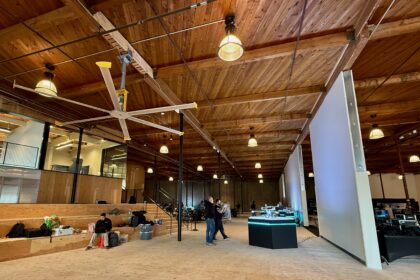


For years, Amazon Go stores stood at the pinnacle of retail store technology, showcasing a massive number of high-resolution digital cameras in each store that could visually track every customer and how that shopper interacted with every product.
The stores showcased Amazon’s technological superiority and brought an eerily human- and friction-free element to convenience store shopping. Unfortunately, the whole setup was also a poster child for technology that isn’t profitable and has no realistic path to get there. (Sounds a lot like all those vendors now selling generative AI (genAI) and Agentic AI systems; the crown for chasing unreachable ROI has been officially passed.)
The way it worked was wickedly simple: shoppers walked into a store by scanning a code from their Amazon app, the cameras and analytics took over, and the shopper grabbed what they wanted and left.
Amazon hung in as long as it could, but on Jan. 27, after almost eight years, it surrendered and announced it was closing all of the Amazon Go stores.
Don’t jump to the wrong conclusion here. Amazon didn’t pull the plug on the technology that fueled the stores (the company now calls it “Just Walk Out.”) Instead, it realized that the value of the technology lay elsewhere.
The original idea behind Go was to deliver a frictionless shopping experience. Turns out that shoppers visited Go mostly for the novelty and didn’t find it meaningfully better than their usual store options.
But, Amazon discovered, it was absolutely a lot faster. Not only were Go stores not profitable, according to retail IT leaders, they didn’t work as loss leaders either since they didn’t drive enough revenue to make the effort worthwhile. And since they didn’t succeed in the small footprint of a convenience store, they’d never work in a larger format store.
Amazon finally figured out that value was found not by going bigger — think of Costco, Walmart or Target-size stores — but by going smaller, a lot smaller.
Once Amazon execs realized speed was the only true advantage, they sought situations where speed was critical. So, they started licensing the technology to tiny venues where speed equals money.
The technology is “reducing cafeteria wait times from 25 to just 3 minutes at BayCare’s St. Joseph’s Hospital” and “enabling sports fans at Scotiabank Arena to grab concessions in 30 seconds,” Amazon said.
This is Amazonian brilliance at its best, albeit many years too late. Instead of losing money in physical stores they own, they licensed the technology to others. That’s instant profit. It’s really hard to lose money on licensing technology you perfected almost a decade ago.
And by going ultra-small, they are pushing into places where speed outranks everything else. Consider those sports concession stands. They typically can only sell their hotdogs, popcorn and soda in tiny blocks of time: during halftime and before the game. After the game is tricky, because people usually want to avoid waiting in line so they can get home.
The Go technology exponentially shortens those lines, allowing merchants to sell more goods during those brief windows of opportunity. The only gating factor is how long it takes to ask a customer what they want and to give it to them. It was always the payment process that slowed everything down.
Zak Stambor, a senior analyst tracking retail for Emarketer, said he found the technology working “phenomenally well” in a tiny snack stand at a train station he uses.
The revenue is relatively trivial. “If I’m only buying a soda or a snack, there isn’t much margin,” Stambor said. But speed makes all the difference. When he only has a minute before his train arrives, Stambor doesn’t have time to cross the street and make a regular purchase. But with the elimination of the payment mechanism, the whole transaction just works. He grabs a snack and jumps on the train.
“Amazon has learned quite a bit from this endeavor,” Stambor said.
It’s similar to how Apple changed authentication requirements to allow for almost instantaneous ticket purchases in the New York subways via NFC on an Apple Watch.
The interesting part of the NYC subway experience — and I use it periodically — is how much faster the Apple Watch is compared to the iPhone. I recently was in NYC with my wife and I zapped through the turnstile using my Apple Watch while my wife was repeatedly trying to get through with her iPhone.
Even worse, she had to have her iPhone in her hand, suboptimal in a crowded subway station. The fact that I didn’t need to hold anything for the payment to work made it feel like magic.
That’s the point. Amazon and Apple and others have figured out the handful of situations where speed is the most critical element — allowing super useful technology to be, well, super useful.
The lesson here is this: when IT is pushing for a business case for some new technology (and the financial folk are pushing back), the answer might not be to tweak the technology. It might be to tweak where and how it is used.
Read the full article here