
Anthropic is acquiring Vercept, a Seattle startup founded by alumni of the Allen Institute for AI, in a move that illustrates the growing competition to build AI agents capable of navigating computers and other devices to complete tasks for users.
The deal, announced Wednesday, will fold Vercept’s technology and an unspecified number of employees into Anthropic. Vercept’s desktop application, Vy, will shut down in 30 days as part of the transition, according to the startup’s message to users, which encouraged them to try Anthropic’s Claude tools as an alternative while the service winds down.
In a post about the news, San Francisco-based Anthropic said the acquisition will help advance its “computer use” capabilities, enabling Claude to complete multi-step tasks inside live applications, including navigating spreadsheets and managing workflows across multiple tools.
Vercept’s team has “spent years thinking carefully about how AI systems can see and act within the same software humans use every day,” Anthropic said. “That expertise maps directly onto some of the hardest problems we’re working on at Anthropic.”
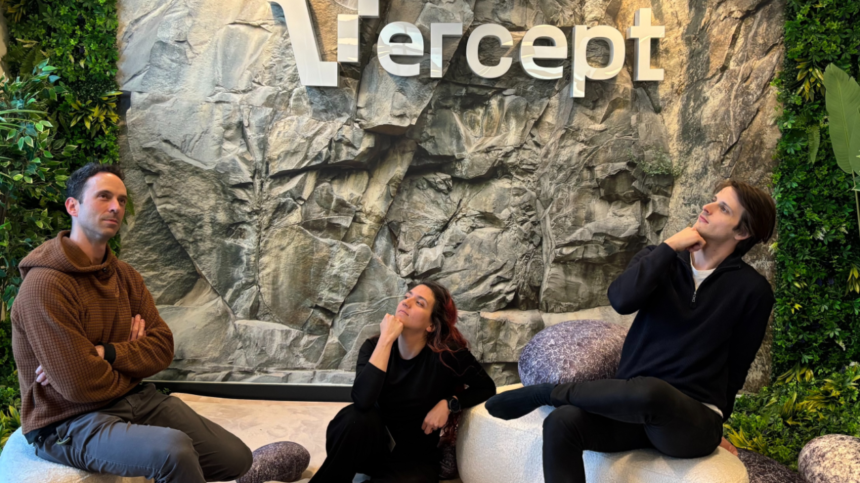
In their message to users, Vercept co-founders Kiana Ehsani, Luca Weihs, and Ross Girshick said the startup’s mission had “found a bigger home” at Anthropic, citing the AI lab’s focus on building “safe, steerable AI systems.” They said the deal would allow the team to “push further into what’s possible at the intersection of AI and the personal computing experience.”
Financial terms of the deal were not disclosed. Vercept referred our inquiry to Anthropic.
Vercept closed a $16 million seed round in January 2025, valuing the company at $67 million post-money, according to Pitchbook data. San Francisco-based Fifty Years led the financing, joined by Point Nine Capital and the AI2 Incubator, Vercept’s first institutional backer.
The angel list was notable: former Google CEO Eric Schmidt, Google DeepMind chief scientist Jeff Dean, Cruise founder Kyle Vogt, and Dropbox co-founder Arash Ferdowsi all participated. Despite the high-profile backing, Vercept stayed lean, with 20 employees, according to LinkedIn.
In a LinkedIn post announcing the deal, Ehsani said Vercept had raised more than $50 million, a figure that appears to include additional capital beyond its previously disclosed seed round. She said Vercept had a “comfortable runway and a successful product” when the opportunity to join Anthropic emerged.
She described the decision as mission-driven rather than financial, saying the two companies had been working toward the same vision from complementary angles.
Seattle AI and startup veteran Oren Etzioni, a Vercept co-founder and early investor, described the outcome as “sad” in a post on LinkedIn, while praising the team that’s now joining Anthropic.
Contacted via phone this morning, Etzioni elaborated, “I’m pleased to have gotten a positive return but obviously disappointed that after just a little over a year with so much traction, and such a fantastic team, we’re basically throwing in the towel.”
Etzioni, the former CEO of the Allen Institute for AI and a longtime fixture in Seattle tech, said he was disappointed with aspects of how the acquisition process unfolded.
He said he’s proud of the team and grateful for the chance to work with such a highly capable group, adding that he wishes them success in their next chapter at Anthropic.
In the comments on Etzioni’s LinkedIn post, Seth Bannon, founder of venture firm Fifty Years and lead investor in Vercept’s seed round, responded with a version of Theodore Roosevelt’s “Man in the Arena,” a passage often cited in moments of public scrutiny or setback.
Etzioni later posted additional comments on LinkedIn elaborating on his concerns.
As first reported by GeekWire in February 2025, Vercept set out to build the “computer interface of the future,” as an early mover in AI agents that observe computer screens and automate desktop tasks.
Its flagship application, Vy, used artificial intelligence to “see” and understand screen elements much like a human does. Users were able to instruct Vy via natural language or demonstrations to automate repetitive tasks, such as data entry, producing video content, or organizing files.
Vercept’s founding team read like an all-star roster from the Allen Institute for AI. CEO and co-founder Ehsani was a senior researcher at Ai2, where she led work on robotics and embodied AI, training agents that can see, learn from, and interact with their surroundings.
Weihs is a former Ai2 research manager who worked on AI agents and reinforcement learning and Girshick is a computer vision pioneer who has also spent time at Meta AI.
Vercept co-founder Matt Deitke, known for leading Ai2 projects including Molmo and Objaverse, left in mid-2025 after Meta reportedly offered him $250 million over four years to join its Superintelligence Lab, as part of a flurry of high-profile talent acquisitions at the time.
Under the hood, the company’s Vy desktop agent was powered by a proprietary model built to understand screen interfaces and map natural language to on-screen actions. The company said VyUI outperformed models from OpenAI, Google, and Anthropic on UI grounding benchmarks.
But Vercept was operating in a crowded and fast-moving field.
Open-source projects like OpenClaw — the viral AI agent that automates tasks through messaging apps like WhatsApp and Telegram — have exploded in popularity. OpenAI last week hired Peter Steinberger, the creator of OpenClaw.
Other startups and some of the biggest names in tech are building their own agentic tools. In addition to Anthropic’s Claude Cowork, there’s OpenAI’s Operator, Google’s Project Mariner, and Amazon’s Nova Act. Microsoft is also pushing Copilot toward screen-level automation on Windows.
Read the full article here