

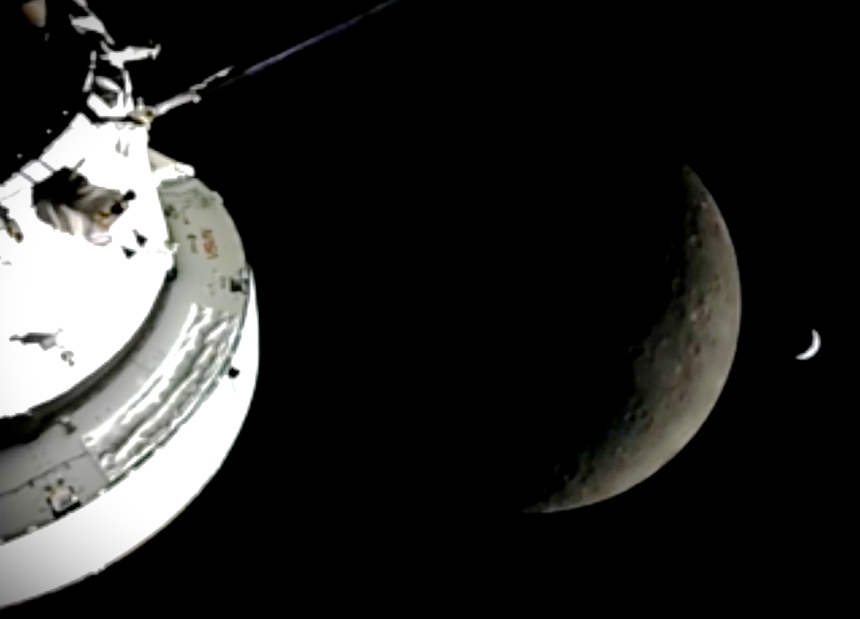
Four astronauts today became the first humans to make a trip around the moon since the Apollo era — and added new pages to history books for the Artemis era.
The Artemis 2 crew reached a maximum distance of 252,756 miles from Earth, surpassing the record that was set by Apollo 13’s crew in 1970 by more than 4,000 miles.
NASA astronaut Christina Koch marked the occasion in a radio transmission from NASA’s Orion space capsule, named Integrity. “We most importantly choose this moment to challenge this generation and the next to make sure this record is not long-lived,” she said.
Koch made history as the first woman to travel beyond Earth orbit. One of her crewmates, NASA pilot Victor Glover, is the first Black astronaut to take a moon trip, and Canadian astronaut Jeremy Hansen is the first non-U.S. astronaut to do so.
The main purpose of the 10-day Artemis 2 mission is to serve as an initial crewed test flight for the Orion spacecraft, which traced a similar round-the-moon course during the uncrewed Artemis 1 mission in 2022. A successful Artemis 2 mission will prepare the way for a lunar lander test flight in Earth orbit as early as next year, potentially followed in 2028 by the first crewed moon landing since Apollo.
Seattle-area tech workers have played a role in getting Orion off the ground — and bringing it back home. L3Harris’ Aerojet Rocketdyne facility in Redmond worked on the spacecraft’s main engine and some of its thrusters, while Karman Space Systems’ Mukilteo facility provided mechanisms for Orion’s parachute deployment system and emergency hatch release system.
Artemis 2’s flight plan took advantage of orbital mechanics and a precisely timed firing of Orion’s main engine to send the astronauts on a free-return trip around the moon and back. The moon’s gravitational pull caused Orion to make a crucial U-turn around the far side, at a minimum distance of 4,067 miles from the lunar surface, and then slingshot back toward Earth.
A scientific swing around the moon
Scientists enlisted the astronauts to make up-close geological observations of the lunar surface during the flyby. Because the Artemis astronauts had a wider perspective on the moon than Apollo astronauts did five decades ago, they could see parts of the far side that had previously gone unseen by human eyes.
NASA’s mission commander, Reid Wiseman, found it difficult to break away from moongazing to discuss his observations over a radio link with Kelsey Young, Artemis 2’s lunar science lead. “You’re pulling me away from the moon right now, so let’s go,” he told Young.
Back at Mission Control in Houston, Young took it all in good stride. “I have to say that ‘moon joy’ is the new term that’s already become our team’s new motto,” she told Wiseman.
The astronauts focused on features of scientific interest — including Orientale Basin and Hertzsprung Basin, two multi-ring impact craters that document different geological eras on the far side. They noted subtle shades of green and brown on the mostly gray moonscape. They also took a close look at the south polar region, which is the target for the Artemis program’s first crewed landing.
“The view of the south pole is quite amazing,” Glover said.
Koch marveled over the bright young craters that stood out on the lunar surface. “What it really looks like is a lampshade with tiny pinpricks, and the light is shining through,” she said. “They’re so bright compared to the rest of the moon.”
Emotional moments
Hansen told Mission Control that the astronauts were proposing new names for two craters they spotted on the surface below. “Integrity” was chosen as the name for one of the craters, in honor of the crew’s spacecraft. The other crater was dubbed “Carroll,” in honor of Wiseman’s wife, who died in 2020. After Hansen spelled out Carroll’s name, the astronauts came together to give Wiseman a comforting hug.
That wasn’t the flyby’s only emotional moment. Koch said she felt an “overwhelming sense of being moved by looking at the moon” and comparing it with Earth. Her description of the feeling was similar to astronauts’ accounts of a phenomenon known as the Overview Effect.
“Everything we need, the Earth provides,” she said, “and that is in itself something of a miracle, and one that you can’t truly know until you’ve had the perspective of the other.”
Just before Orion was due to pass behind the moon for a temporary blackout, Glover took the opportunity to refer to the Christian commandment to love your neighbor as yourself. “As we prepare to go out of radio communication, we’re still able to feel your love from Earth. And to all of you down there on Earth, and around Earth, we love you from the moon,” he said. “We will see you on the other side.”
About 40 minutes later, Orion emerged from the other side of the moon, and communication was restored. “It is so great to hear from Earth again,” Koch told Mission Control.
“We will explore, we will build ships, we will visit again, we will construct science outposts, we will drive rovers, we will do radio astronomy, we will found companies, we will bolster industry, we will inspire,” Koch said. “But ultimately, we will always choose Earth.”
Earthset, Earthrise and an eclipse
The behind-the-moon turnaround provided the crew with opportunities to capture images of Earthset and Earthrise — and marked the beginning of Orion’s homeward journey. Back at Mission Control, the support team turned their double-sided mission patches around to change the focus of the patch’s design from the moon to Earth.
But the workday wasn’t yet finished: For the grand finale, the astronauts donned protective glasses and watched as the sun passed behind the moon to create an unearthly kind of solar eclipse. As the sun sank beneath the lunar horizon, they captured pictures of the solar corona.
Glover reported that the corona created a bright halo “almost around the entire moon,” with the lunar surface illuminated ever so faintly by Earth’s reflected light. “It is quite an impressive sight,” he said. “Earthshine is very distinct, and it creates quite an impressive visual illusion. Wow, it’s amazing.”
The sun’s re-emergence from behind the moon marked the end of today’s seven-hour lunar observation session. “I can’t say enough how much science we’ve already learned, and how much inspiration you’ve provided to our entire team, the lunar science community and the entire world with what you were able to bring today,” Young told the crew. “You really brought the moon closer today, and we can’t thank you enough.”
High-resolution images and reports about the observations are due to be downlinked and distributed in the days ahead. Planetary scientists will be poring over the data long after Orion and its crew make their scheduled splashdown in the Pacific Ocean on Friday.
After the flyby, President Donald Trump congratulated the crew over an audio link. “Today you’ve made history and made all America really proud,” he said. “No astronaut has been to the moon since the days of the Apollo program. … At long last, America is back.”
Read the full article here