
REDMOND, Wash. — For more than three years, much of the focus on AI in education has been on the implications of handing students what amounts to a technological cheat code.
But what if this disruptive force could be used to improve education instead?
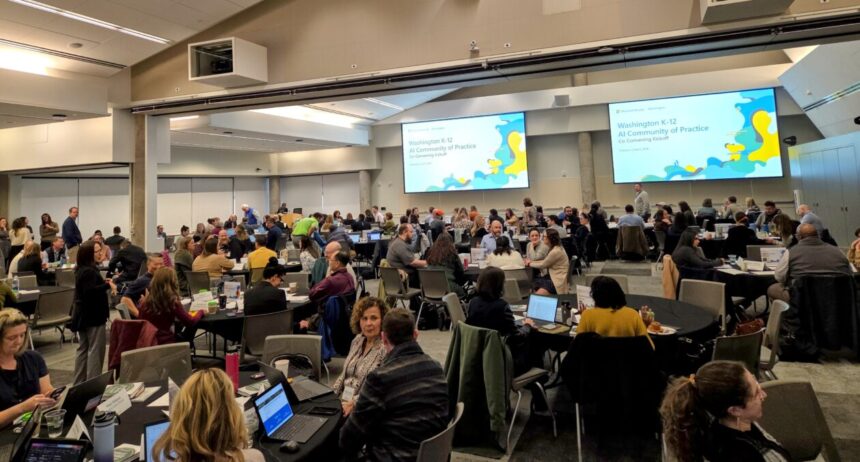
That’s the idea behind an effort now getting under way in Washington state. Last week, school districts gathered at Microsoft in Redmond for the start of a two-year “community of practice” focused on AI in education. More than 150 educators and administrators filled the room.
The event brought together two programs. Microsoft’s Elevate Washington initiative, announced last October, awarded $75,000 grants to 10 districts to plan and implement AI projects. The Gates Foundation is funding a separate cohort of 10 districts focused on AI infrastructure and data systems.
The Microsoft Elevate grants also include up to $25,000 in funding for technology consulting. The districts are expected to share what they learn with each other and across the state.
The focus is on practical applications, such as AI-powered tutoring in Bellevue, K-12 literacy frameworks in Highline and Quincy, and chatbots for students and families in Kennewick.
IEPs in Issaquah
In Issaquah, the goal is to use AI to help special education students manage the psychological burden of moving from teacher to teacher with an individualized education plan (IEP).
The project was inspired by listening sessions with high school students who receive special education services. It can be stressful and burdensome for students to explain their needs to each new teacher, ensuring that their accommodations and goals are being met.
Dr. Sharine Carver, the district’s executive director of special services, said the goal is to “empower students, reduce that psychological burden and put them in the driver’s seat of really understanding their IEP and being able to advocate for themselves.”
Diana Eggers, the district’s director of educational technology, said the IEP project is different in that it goes beyond seeking efficiency in existing activities to instead build AI for a new purpose.
“How can we use AI to reshape what we do?” Eggers said. “We’re not there yet, but we need to figure out how we can do that.”
An ‘unreal’ pace of change
All of the districts are navigating the unknown in one way or another. Jane Broom, senior director of Microsoft Philanthropies, who grew up in Washington public schools, told the group that they are on the front lines of an unprecedented transformation.
“This is the fastest change I’ve ever seen, and this company is one that changes constantly,” she said. “These last two or three years have been pretty unreal.”
The 10 Microsoft grantees range from Seattle, the state’s largest district with about 49,000 students, to Manson, a rural district in Chelan County with about 700 students. Collectively, the grantees serve about 17 percent of Washington’s K-12 students.
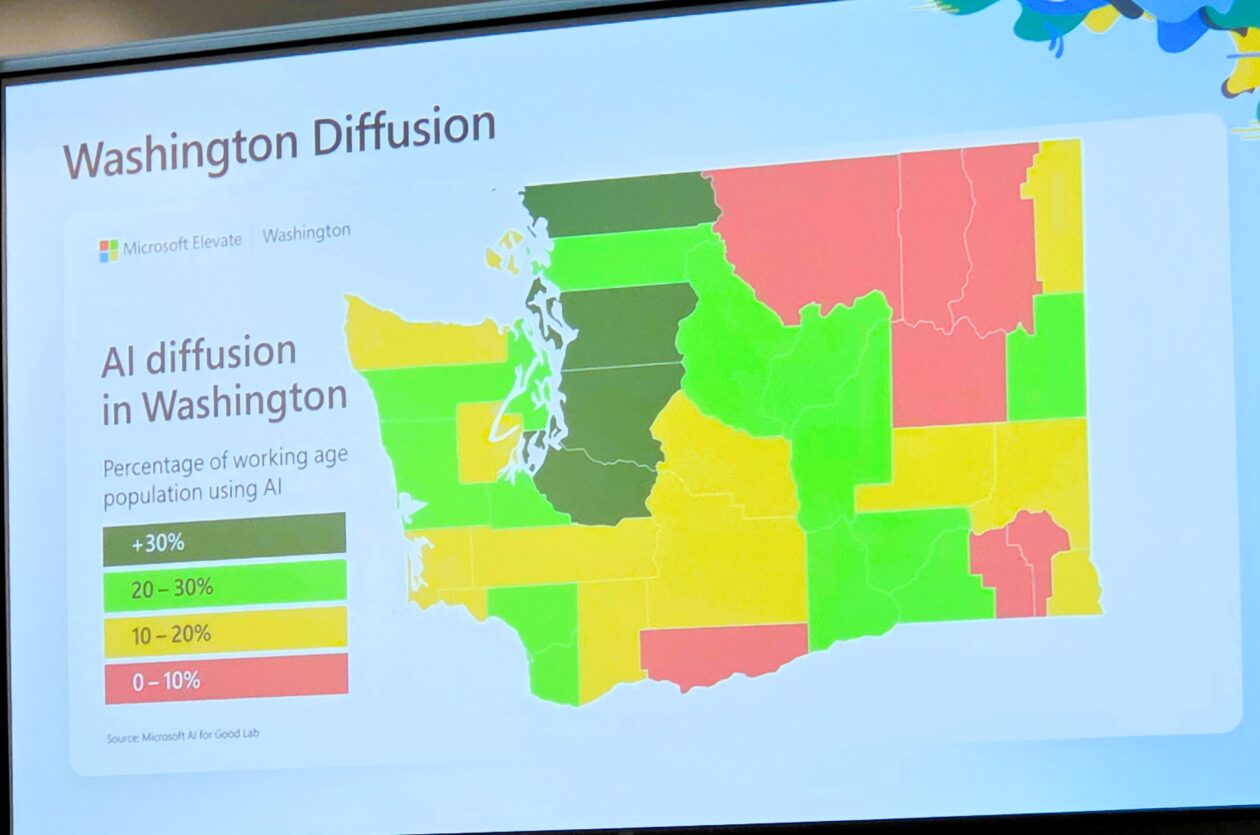
Broom pointed to a major gap in AI usage across the state, with more than 30% of the working-age population using AI in the Seattle region vs. less than 10% in some rural areas. Microsoft highlighted this divide when it launched the Elevate program last fall.
Early stages of understanding
The opening session Thursday morning came with an additional reality check: National research presented at the event showed that even the most ambitious districts are still in early stages, and struggling to answer a basic question: is any of this actually working?
Bree Dusseault, principal and managing director at the Center on Reinventing Public Education at the University of Washington, presented findings from a national study of early-adopter school districts. Her team surveyed 119 systems (with 45 responses), interviewed leaders at 14, and profiled 79 for a database of districts pushing ahead on AI adoption.
The picture that emerged was mixed. Districts have moved quickly to put infrastructure in place, but significant gaps remain:
Infrastructure is largely in place. More than 80% of districts in the national survey have the technical basics like devices and broadband. About two-thirds have data privacy protocols and dedicated AI staff. Six in 10 have a formal AI policy.
Evaluation is lagging far behind. Only 24% of the surveyed districts have any system for measuring whether their AI efforts are working. Only 9% have updated learning standards to reflect new student competencies.
The work is overwhelmingly focused on teachers. Every early-adopter district in the study trains teachers and approves them to use AI. Fewer than half provide any training to students. Only 16% engage parents or families.
Students are already moving on their own. A separate RAND/CRPE survey from September 2025 found that 54% of students use AI for schoolwork. Among high schoolers, 61%. But only 19% report getting any guidance on how to use it.
Most early adopters aren’t using AI to rethink education. About two-thirds of these districts are using it to do what they already do more efficiently. Another 30% are using it to support existing reform efforts. Only a handful are trying anything fundamentally new.
Addressing that last point is the idea behind the AI initiatives that got under way last week. The districts in the Microsoft program will work on their projects through the next school year, running through June 2027.
Read the full article here