
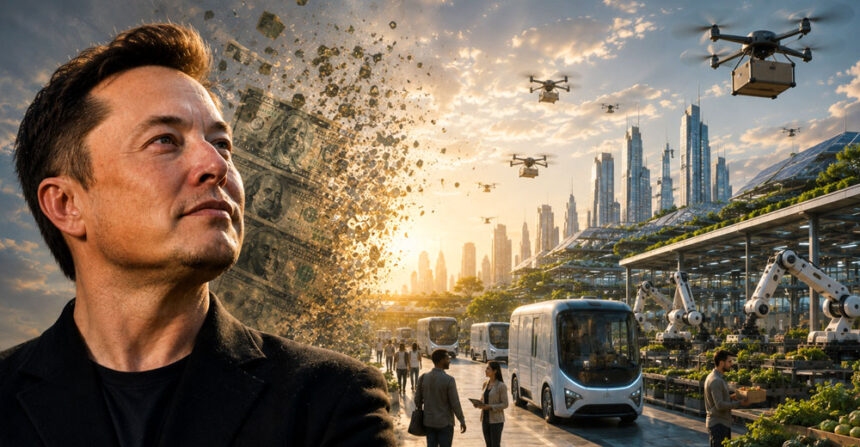
Technology executives are known for bold predictions, but Elon Musk’s latest forecast is unusually sweeping: He believes money could become obsolete within the next decade.
Musk has a history of setting aggressive timelines for technologies ranging from autonomous driving to Mars colonization, many of which have taken longer than predicted.
His argument rests on advances in artificial general intelligence (AGI) and robotics eventually making much human labor unnecessary while dramatically reducing the cost of producing goods and services.
However, eliminating money would require far more than technological abundance. It would also fundamentally change how resources are distributed and how economic power is exercised.
Let’s examine what a moneyless economy might actually require, how automation could change the distribution of economic power, and whether Musk’s 2036 timeline is remotely plausible. We’ll close with my Product of the Week, a hardware wallet designed to give users greater control over their digital assets.
The Basis for Musk’s Prediction
Musk’s prediction is based on the convergence of increasingly capable AI and autonomous machines. He has suggested that sufficiently advanced automation could make traditional employment and, eventually, money unnecessary.
Musk argues that AI and autonomous robots could eventually drive the cost of producing goods and services toward zero. In that theoretical model, machines perform most production, transportation, and maintenance, reducing the economic value of human labor and, with it, the need for wages and traditional currency.
That scenario depends on highly capable AI and robotics operating across nearly the entire economy, from extracting raw materials to manufacturing goods, constructing housing, and transporting products. Only at that scale would the traditional exchange of labor for wages and wages for goods begin to break down.
The larger unanswered question is how the output of that automated economy would be distributed. If relatively few companies own the AI systems, robots, energy infrastructure, and production capacity, technological abundance alone would not guarantee broad access to it.
A Moneyless Economy and the Shift in Power
If money did become obsolete, economic power would not necessarily disappear with it. Instead, control over AI platforms, computing capacity, energy, robotics, manufacturing, data, and physical infrastructure could become even more important, potentially concentrating enormous economic influence among relatively few companies.
Such concentration could give the owners of AI infrastructure, robotic manufacturing, and energy systems substantial influence over resource allocation. Governments would also need new mechanisms for taxation, public services, and economic policy if wages and conventional monetary transactions were greatly diminished.
A post-money economy would still need mechanisms for allocating scarce resources. Those could include universal access to basic goods and services, public ownership models, or other systems that do not yet exist at meaningful scale.
The challenge would be preserving individual choice and economic mobility when employment is no longer the primary means of acquiring resources. Any viable post-work economic model would have to address that problem, not simply assume automation solves it.
The Likelihood of a 2036 Transition
How likely is a moneyless economy by 2036? I consider the probability extremely low. A decade is an extraordinarily short period in which to replace economic systems that have developed over centuries.
AI and robotics are likely to disrupt labor markets substantially over the next decade, but eliminating currency would require something much closer to a post-scarcity economy, and we are nowhere near that today.
Significant constraints remain in power generation, semiconductor production, raw materials, and infrastructure. Large-scale automation requires enormous amounts of energy and computing capacity, while AI data centers are already adding pressure to electrical grids.
Recent market intelligence indicates that grid supply is struggling to keep pace with AI workloads, noting reports that wholesale electricity costs have risen by 267% near major U.S. data centers. The analysis identifies insufficient grid capacity as a growing constraint on AI expansion.
Governments and central banks would also face significant practical and institutional challenges in abandoning currency-based economic systems. A more plausible outcome by 2036 is an economy in which automation creates substantial productivity gains while disrupting employment and concentrating some of those gains among the owners of AI and automation.
AI could eliminate or substantially change millions of white- and blue-collar jobs while generating significant wealth for companies that develop and deploy the technology. The more immediate question, therefore, may not be whether money disappears but how the economic gains from automation are distributed.
Securing Your Future in an Automated Age
Even if Musk’s timeline proves unrealistic, greater automation is likely to change the value of many existing skills. Workers and businesses should prepare for an economy in which human expertise increasingly complements AI rather than competes directly with it.

Skills involving complex physical work, judgment, interpersonal communication, leadership, and the effective use of AI are likely to remain valuable as automation expands.
Automation could also increase the importance of owning productive assets rather than relying solely on income from labor. Property, investments, business ownership, and other income-producing assets could provide additional economic resilience as technology changes how value is created and distributed.
The More Likely Future
Musk’s prediction is useful less as a timetable than as a thought experiment about where increasingly capable AI and robotics could eventually lead. But technology alone cannot create a moneyless economy.
Automation could reduce the cost of many goods and services while diminishing demand for some forms of human labor. Eliminating money, however, would also require entirely new systems for allocating scarce resources, distributing economic gains, and preserving individual choice.
Money is unlikely to disappear anytime soon, but the relationship among technology, labor, ownership, and economic opportunity is already beginning to change. Preparing for that transition is far more urgent than preparing for the end of money.

Ledger Stax
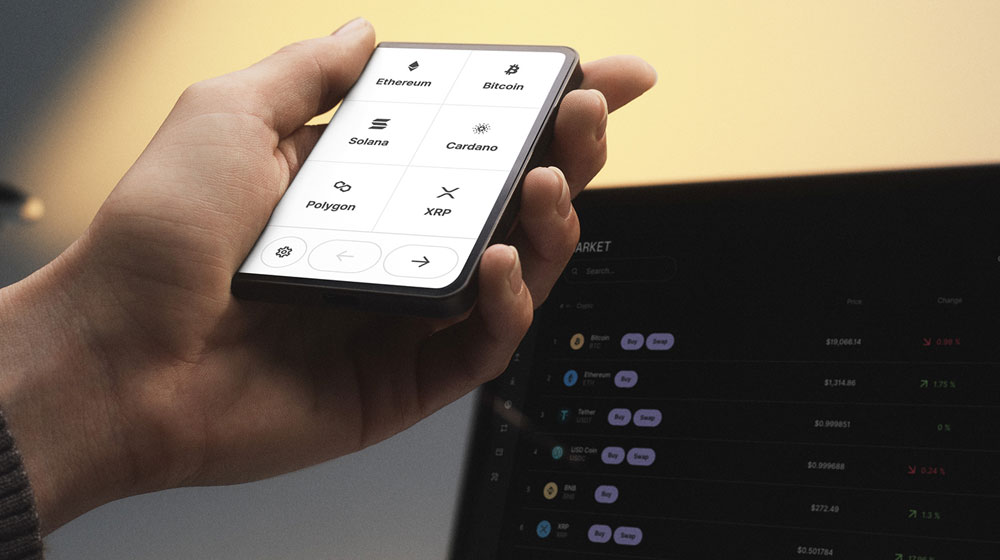
Image Credit: Ledger SAS
As AI and automation change how value is created and distributed, individuals may place greater importance on maintaining direct control over some of their financial assets. That makes the Ledger Stax, a hardware wallet designed for secure self-custody of cryptocurrencies and other digital assets, a fitting Product of the Week.
Designed by iPod co-creator Tony Fadell, the Ledger Stax features a curved E Ink touchscreen that wraps around the device, providing a larger, more readable interface than traditional hardware wallets while consuming relatively little power.
The Ledger Stax can connect to smartphones through Bluetooth while keeping private keys isolated within the device’s Secure Element, allowing users to manage and approve transactions without exposing those keys to the connected phone.
The primary benefit of a hardware wallet is self-custody. Rather than entrusting private keys to a cryptocurrency exchange or other third party, users retain direct control of them. That reduces reliance on intermediaries, although it also places greater responsibility on users to protect their devices and recovery credentials.
Usability Beyond Security
The 3.7-inch display also addresses one of the usability limitations of smaller hardware wallets by providing more screen space for reviewing transaction details. A Milk Road review praised its Kindle-like touchscreen and gave the device a 4.8-star rating, while also highlighting its CC EAL6+ security certification.
The Ledger Stax also supports NFTs, and its E Ink screen can display an NFT or other personalized image even when the device is turned off.
Embedded magnets allow multiple Stax devices to snap together for convenient storage and organization.
The Ledger Stax fits this column’s larger discussion about technology, ownership, and economic independence. Whatever happens to money over the next decade, maintaining control over digital assets is likely to remain important for those who choose to own them.
Combining strong security with an approachable interface, the Ledger Stax offers a practical option for self-custody of digital assets. Its balance of usability and direct control makes it my Product of the Week.
Read the full article here