


Vijaye Raji wanted to figure out how to keep up with the firehose of Slack messages. After a couple prompts, he had a solution.
Raji, OpenAI’s CTO of applications, vibe-coded his own personal tool using Codex, OpenAI’s coding agent. It runs on his laptop and summarizes his messages, emails, and notifications every 15 minutes.
His story reflects how software in the age of AI agents is becoming something anyone can create on the fly — which could have major implications in the way “applications” are designed, built, and used.
“Everyone is going to be a builder,” said Raji, speaking at GeekWire’s Agents of Transformation event in Seattle on Tuesday. “You’re going to lower the threshold of what building is.”
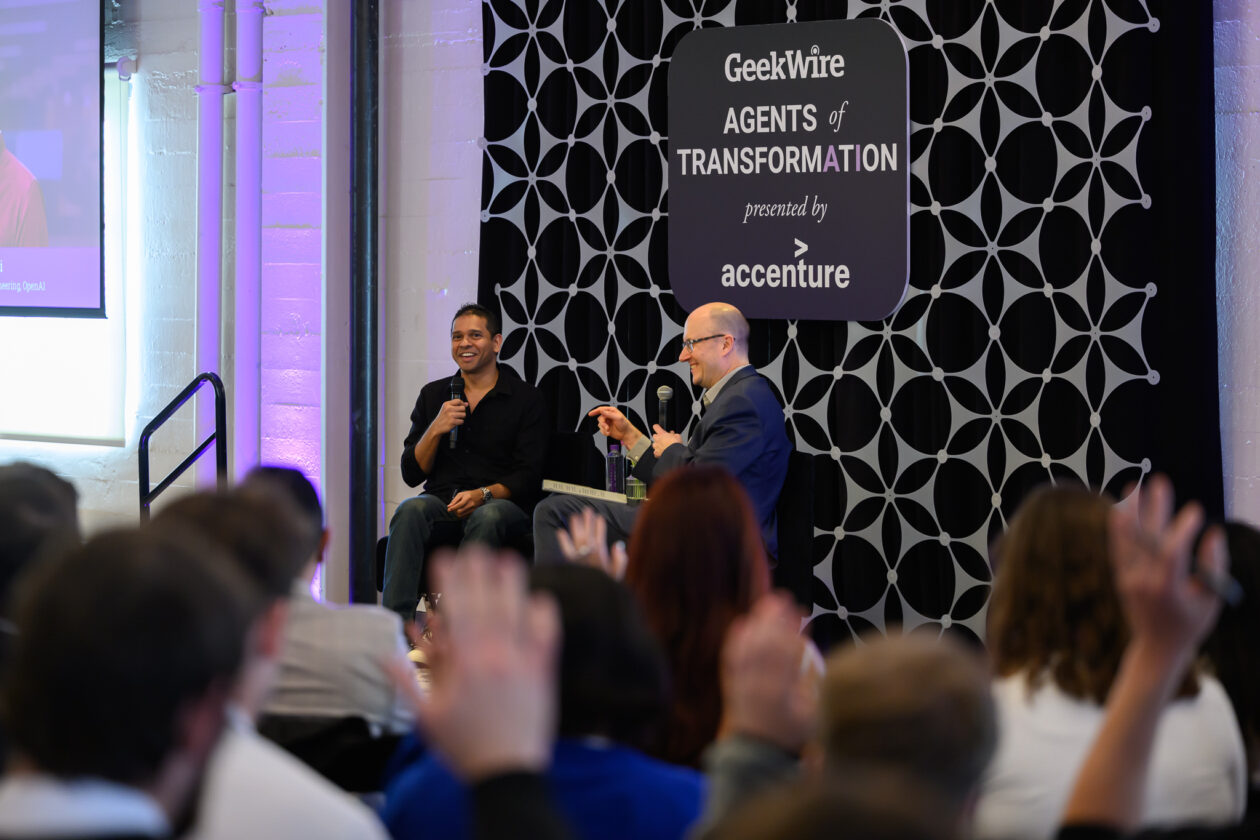
Raji said that when he has a new idea now, his first instinct isn’t to pitch it to a team and ask someone to code it up. Instead, he starts prototyping it himself using Codex.
That habit has become the norm across OpenAI, he said.
“People come to meetings, right before they start the meeting they send a prompt out, keep the laptop slightly open, and when the meeting ends you go back and see what it’s built,” Raji said.
During an earlier fireside chat, Charles Lamanna, Microsoft’s executive vice president of Business Applications & Agents, said he’s starting to see agents change the way his teams share information internally — shifting from static documents to lightweight, bespoke “mini web apps.”
In one recent example, a discussion about investment changes and team structure would have traditionally produced a spreadsheet and a PowerPoint deck. Instead, his group spun up an interactive web app that pulled live data from Microsoft’s employee directory and funding systems, letting leaders click through different scenarios in real time.

He described a similar shift in customer meeting prep, where a set of internal agents automatically assembles product telemetry, CRM data, and account notes — work that used to take hours of manual effort.
The broader potential impact goes beyond any single tool. And the underlying technology continues to improve at a rapid pace. Raji described the current era as “capability overhang” — the idea that models can do far more than people are asking of them.
“People need to start adapting and learning,” he said. “What more could they do with these models? What more could they do with these agents? The people that are able to do that and go to that level are many, many times more productive and many more times able to accomplish larger tasks than those that haven’t.”
Read the full article here