

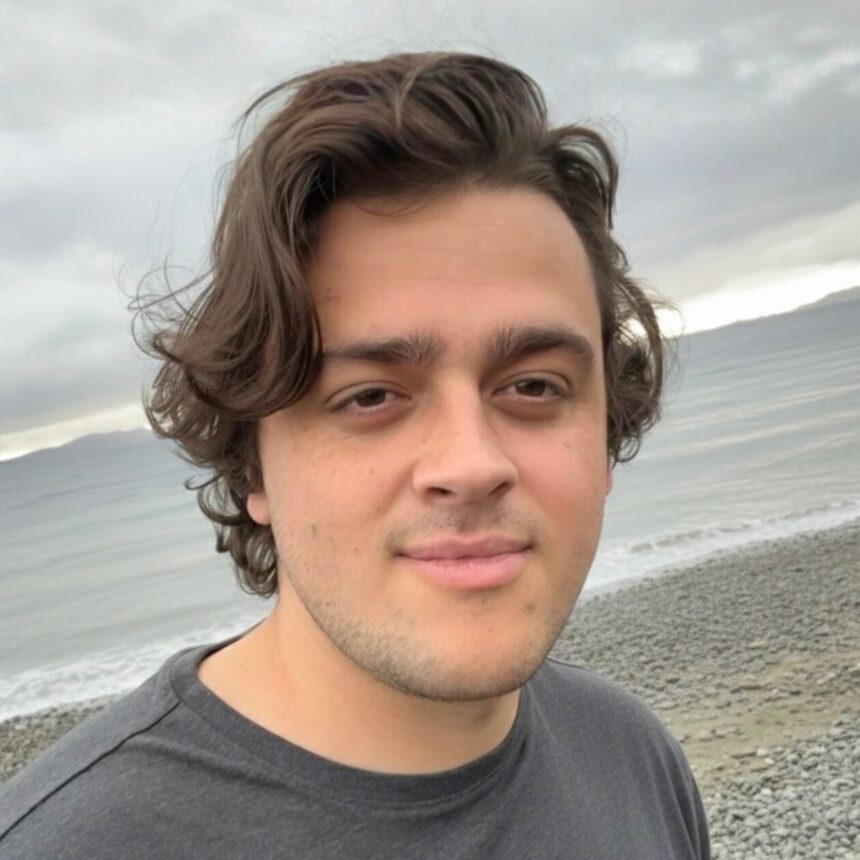
Xhuliano Brace quickly realized that venture capitalists weren’t going to write big checks for two under-30 founders pursuing what he describes as a “contrarian” approach to using AI to design new drugs.
So he’s making the bet himself.
After four years of working on AI projects at Amazon, Brace left the tech giant to self-fund his vision. Using personal savings and proceeds from online trading, he invested a six-figure sum into Rhizome Research, a Seattle-based startup developing made-to-order, small drug-like molecules.
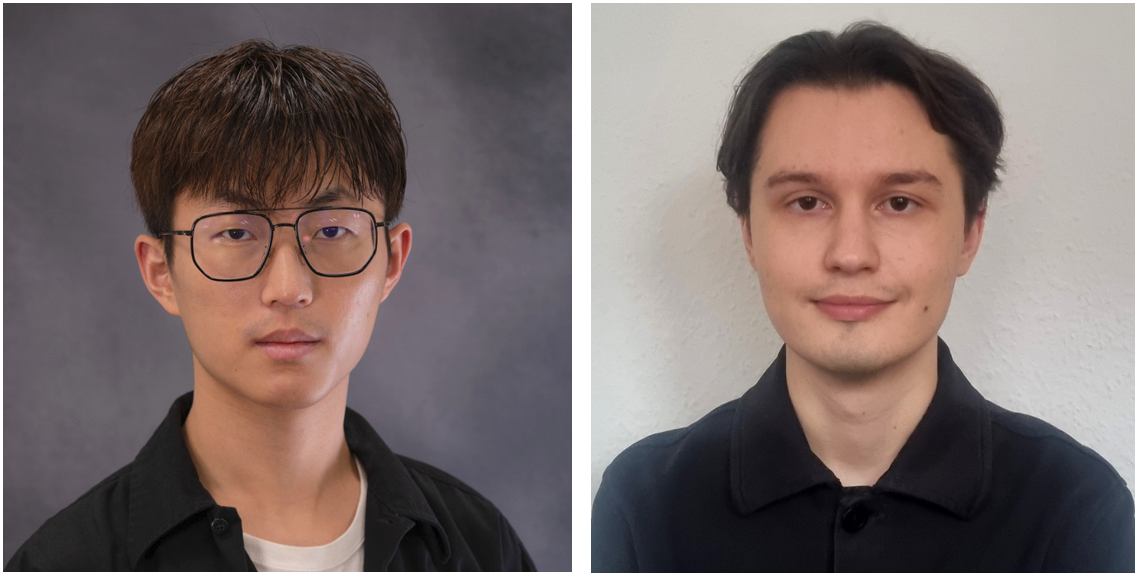
After launching last year, the five-employee startup recently came out of stealth. In addition to CEO Brace, who has degrees in math, computer science and economics from the University at Albany, Rhizome’s leadership includes:
- Yiwen Wang, co-founder and chief scientist, who has a PhD in chemistry from Carnegie Mellon University.
- Gregory Sinenka, chief technologist, who is a physics PhD and worked at a European research center and Johnson & Johnson.
- John Proudfoot, a former U.S.-based director in the Medicinal Chemistry Department at Boehringer Ingelheim, is serving as a scientific advisor.
A different approach to drug discovery
Rather than working from existing molecule-building tools, Rhizome has built its own fine-tuned foundational model, named r1. The technology is a “graph neural network” and was trained on more than 800 million small drug-like molecules.
The approach is different from the popular RoseTTAFold model created by the University of Washington’s Institute for Protein Design, which at its core is based on the amino acids that build proteins.
The r1 model focuses on the atoms and bonds that make up a molecule and its topography. That’s where the graph idea comes in — the atoms are analogous to the points in a graph while the bonds are akin to its connecting lines.
The team aims to provide fragment-based drug discovery, creating small molecules optimized to bind to customer-specified targets. They will ensure each drug candidate can be synthesized efficiently in the lab and is suitable for patent protection.
Rhizome last week released ADAMS, an open-source, automated AI tool that uses natural language instructions for simulating the binding between biological molecules. It also plans to share MolSim, which is a physics-based simulation that uses advanced, free-energy calculations that predict how strongly a small molecule will bind to its target. MolSim won’t be open source.
Vision for a Seattle hub
Rhizome recently established partnerships with wet labs that can validate the real-world performance of the potential drugs it designs, and it’s exploring customer relationships.
Brace is operating out of Foundations, the Seattle-based startup community launched by entrepreneur and investor Aviel Ginzburg. Rhizome’s other employees are working remotely, but the plan is to bring folks to Washington.
“I really want to make Seattle kind of a hub for small molecule drug discovery,” Brace said.
He pointed to the Allen Institute, the Institute for Protein Design and other Seattle-area organizations as key players. The region is also home to a slate of related drug design startups that include Pauling.AI, Synthesize Bio and Xaira Therapeutics, which is based in San Francisco and has labs in Seattle.
Brace said he’s energized by the opportunity to work on a project that could have a meaningful impact on humanity and has no regrets in ponying up his own money for the effort. He’s bullish in general on the use of AI for designing molecules, whether for health care or fields such as materials science and advanced manufacturing.
“This is the most interesting problem space to be in,” Brace said.
Read the full article here