


Build with intentionality. Lead with authenticity. Prioritize customers over your ego. And focus on the problem you’re solving — with flexibility on the solution.
That’s part of the playbook Matt Oppenheimer followed as he helped grow a three-person Techstars Seattle startup into one of the world’s leading remittance platforms.
After nearly 15 years leading Remitly as CEO, Oppenheimer announced Wednesday that he’s stepping down as CEO and moving to a board chair role. He’s passing the baton to Sebastian Gunningham, a longtime tech and finance leader who previously led Amazon’s marketplace and payments businesses.
“I feel wonderful, honestly,” Oppenheimer told GeekWire on Thursday. “One thing that has always driven me from the moment I started the business 15 years ago is impact and purpose and doing things with a sense of intentionality. And I feel like that’s how we’ve done this succession planning.”
The Remitly story began more than a decade ago after Oppenheimer had just returned from Kenya, where he was working for Barclays and realized how hard it was for families to send and receive money overseas.
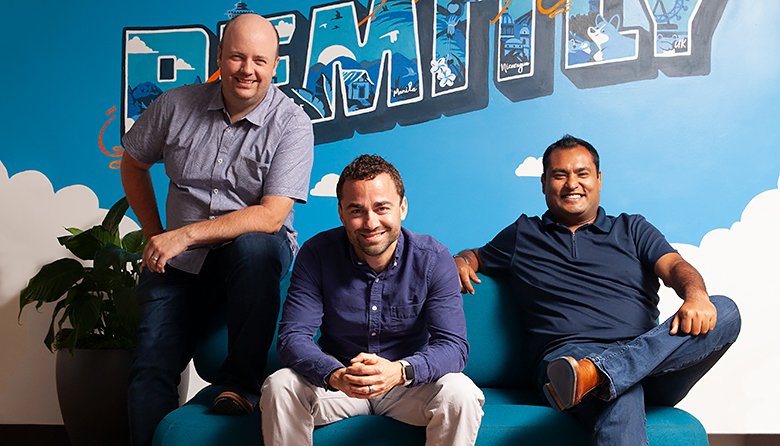
He teamed up with co-founders Josh Hug and Shivaas Gulati, navigating an early pivot before landing product-market fit and raising around $400 million. The company went public in 2021 at a valuation of nearly $7 billion.
Remitly’s mobile technology lets people send and receive money across borders, eliminating many of the forms, codes, and in-person agents traditionally associated with international transfers. It’s used by more than 9 million people. The company reported revenue of $442.2 million in Q4, up 26% year-over-year, and had its first full year of GAAP profitability in 2025.
We spoke to Oppenheimer about lessons learned from Remitly’s journey and his advice for entrepreneurs. Here are some key takeaways.
Fall in love with the problem, not your product
Oppenheimer remembers the frustration he saw and felt watching families struggle to send money across borders. That sparked the idea for Remitly. The key, he says, was locking onto that problem — not any one product idea. The danger is when founders apply their grit in the wrong place.
“If they channel that perseverance in the wrong area — the product or trying to force something into existence that customers don’t care about — they fail,” he said. “They run out of time, energy, or money.”

Get close to customers
In the early days, Remitly set up a booth at Southcenter Mall near Seattle outside a legacy remittance location, complete with scotch-taped signage.
Oppenheimer referenced a phrase from Airbnb co-founder Brian Chesky: “find marketing channels that don’t scale.” The goal wasn’t growth, but rather insight.
They learned why customers weren’t using Remitly. That feedback drove a big pivot from mobile wallets to cash pickup, bank deposit, and door-to-door delivery.
“We had to follow customers,” Oppenheimer said. He added: “If we would have been stubborn about only doing mobile wallets — that’s what our pitch said — then we would have failed.”
Define culture as behaviors — and keep rewriting it
Oppenheimer said many companies stop at a short list of vague values. “Culture is how people in a company or institution interact to deliver for their customers,” he said.
Before Remitly launched its product, the founding team did an offsite to define the culture on a whiteboard. Early values like “relationships” were well-intentioned but too broad. Remitly refreshed its values every six months and now every couple of years, evolving them into more specific behaviors such as “be a compassionate partner,” “lead authentically,” and “constructively direct.”
Customer centricity sits at the top as the single overarching value. Oppenheimer said the test is whether values show up in concrete decision-making: “Once you’ve got it defined, [you embed it] into the interview process and the performance review process.”
Find complementary co-founders
Oppenheimer said Remitly wouldn’t exist without his co-founders, pointing to Hug’s product skills and Gulati’s engineering chops.
“It’s important for all founders to surround themselves with complementary skills and respect those skills deeply,” he said.
In the very early days, his own contribution was often clearing obstacles: money transmission licenses, office leases, even taking out the trash. “My job was to help them build,” he said. Oppenheimer stressed the importance of shared values but different strengths.
Raise more capital than you think you need
Remitly raised hundreds of millions of dollars on its way to an IPO across multiple rounds. None were easy.
“It requires getting a lot of no’s,” Oppenheimer said. “It requires that grit, tenacity and perseverance that is critical for any entrepreneur to be successful.”
He advised treating fundraising as a two-way conversation, not a one-sided pitch. “Investors can sniff desperation,” he said. Make sure investors are asking the right questions, and think about whether you want them on your board.
When the partner is right, Oppenheimer leans toward raising a bit more. “Things always take a little bit longer than you imagine,” he said. For companies pursuing bold visions, “if you’ve got the right partner, you can raise enough capital, then it’s worth the dilution to be able to make progress against accomplishing that vision.”

Treat your own growth like a product, with reviews and roadmaps
As he focused more on management, Oppenheimer built a formal process for his own development as CEO, especially as Remitly grew from a handful of people to more than 3,000.
He started asking each new investor who joined Remitly’s board to run his performance review. “I’d like you to talk to all other board members. I’d like you to talk to my leadership team,” he’d tell them. “And then I’d like your insights.”
He turned that input into a written development plan, shared it with the company, and then found coaches and mentors to help him work on specific gaps. “It took a lot of intentionality to grow as a leader,” he said.
That work continues in his new role as chairman. “After mission and purpose, my second biggest motivator for me personally is growing as a human,” he said. “That’s what I’ve loved about the journey, and it continues in this next role.”
Don’t underestimate the role of community
Seattle is a huge part of Remitly’s story. Techstars Seattle helped launch Remitly (back when it was called Beamit Mobile); talent from the region’s tech ecosystem helped scale it.
“The talent we’ve been able to recruit from some of the largest technology companies has been foundational,” Oppenheimer said. With fewer growth-stage companies in the city than in some other hubs, he believes Remitly could attract people looking to join a mission-driven startup with scale ambitions.
Last year the company moved into a new headquarters in downtown Seattle. Oppenheimer said he and Remitly remain committed to Seattle, noting that he wants to make sure “that’s the case for the next decade to come.”
Read the full article here