
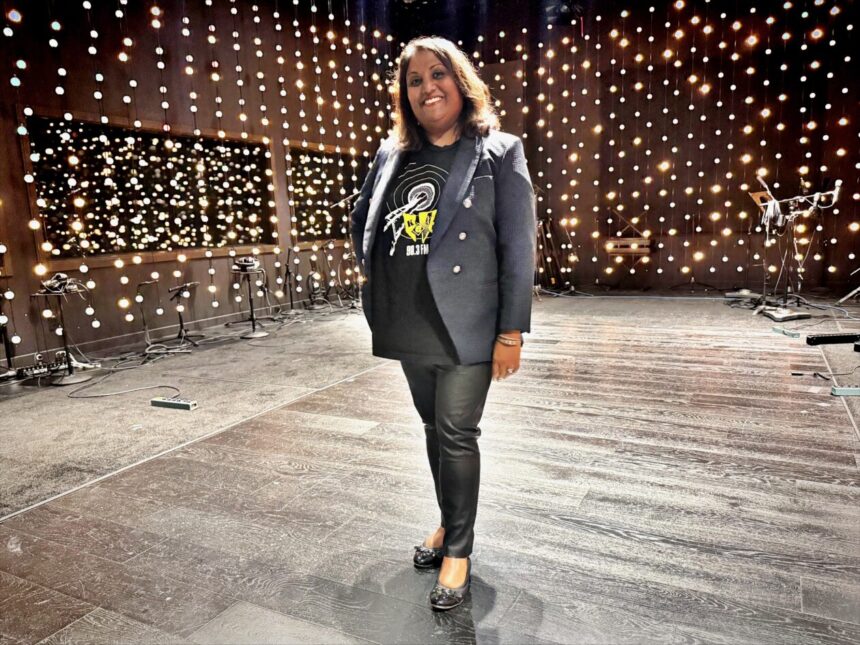
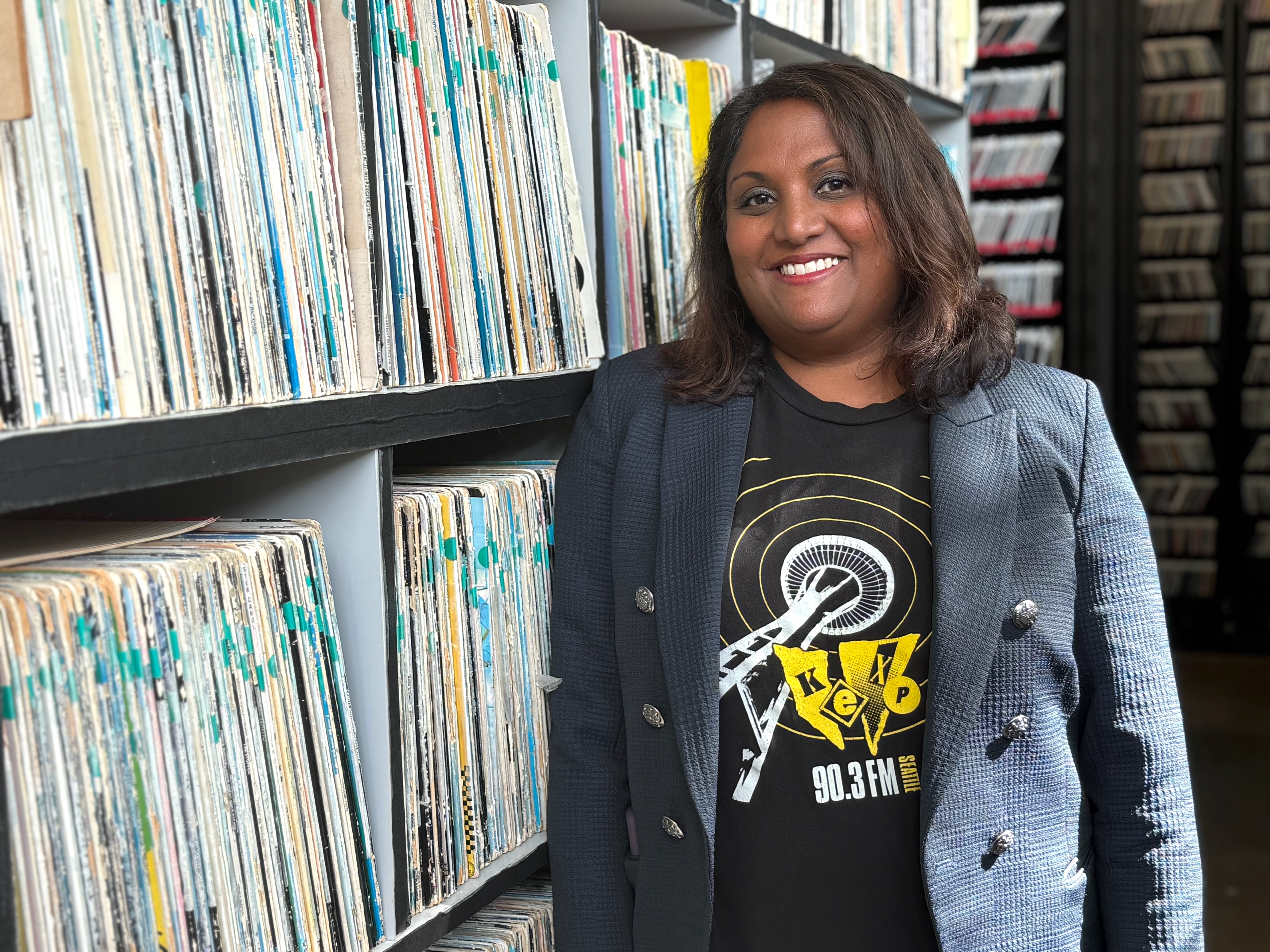
Seattle indie radio powerhouse KEXP has hired tech veteran Jyoti Shukla as its first chief product and technology officer, with an unusual mandate in an era ruled by automated playlists: to build digital products that put human connection ahead of AI algorithms.
A Seattle native who graduated from the University of Washington’s Foster School of Business, Shukla grew up singing and performing classical music and playing in bands.
She was most recently senior vice president of product design at SiriusXM, with earlier leadership roles at Nordstrom and Starbucks working on user and mobile experiences. She began her career at Microsoft.
For Shukla, taking on the KEXP role feels like coming home.
“Music has just been the center of me as a human being, and growing up in Seattle,” she told GeekWire.
Her formal involvement with KEXP began years ago on the volunteer side. While at Nordstrom, she joined the station’s digital committee, and later joined KEXP’s board around the time she moved to SiriusXM.
Now, she’s taking the product strategy skills developed at those major companies and applying them full-time to a station she has relied on as a fan for decades.
At commercial platforms, product strategy often centers on algorithms designed to maximize screen time and automate recommendation loops. But at KEXP, Shukla’s focus is inverted: using technology to elevate — rather than replace — the station’s human DJs.
Over 50 years into its operation, the station relies on real people in the booth orchestrating playlists on the fly based on personal emotion, global discovery and community connection. For Shukla, that human element is a vital counterweight to an increasingly automated world.
That philosophy is grounded in her own daily listening. She recalls tuning in recently when DJ John Richards was interviewing a local band and discussing loss — a moment that hit home just months after Shukla lost her mother.
“He was referring to the songs that were being played and the emotional connection that was being built in that conversation,” Shukla said. “It immediately created a connection with me. That’s so incredibly important in our time and age right now … when we think about things like loneliness being an epidemic. This piece of having a human curate what I’m listening to has a real impact.”
That anti-automation ethos isn’t just an internal compass. It’s a high-profile public campaign. In the San Francisco Bay Area, where KEXP expanded its broadcast footprint with the 2023 purchase of 92.7 KREV, the station put up yellow transit billboards reading simply: “Some things are better without AI.”
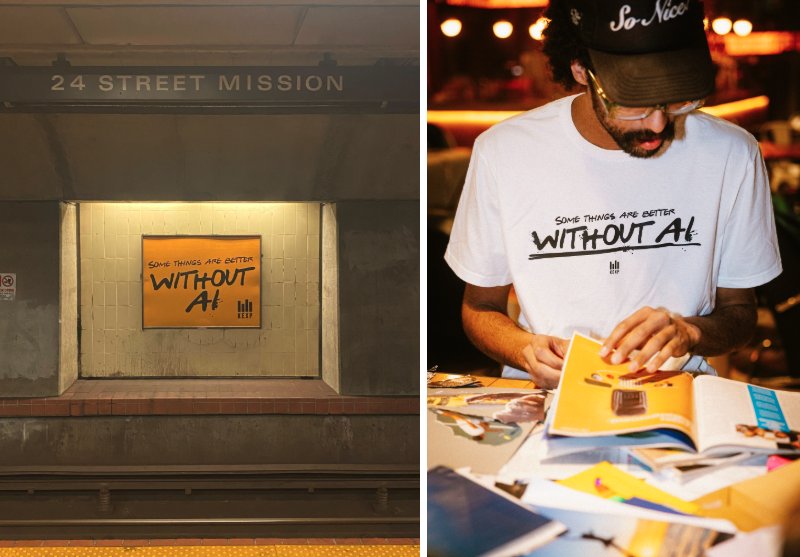
It’s a pointed statement in the heart of Silicon Valley where AI-related tech company billboards are the norm. But Shukla emphasizes that rejecting AI for music curation doesn’t mean rejecting modern tech altogether. Instead, her challenge is deciding where technology should step in to streamline operations and elevate the listener experience.
“There are some things we’ll look at to help support the things that we’re trying to do, but never would it be the creativity and the curation,” Shukla said. “Keeping that curation and creativity focused on the human, and having technology serve that — it’s really what I’m looking at.”
In the newly created CPTO role, Shukla oversees a core team of 12 to 15 people spanning UI/UX design, frontend and backend engineering, digital products, and broadcast engineering — the technical backbone of KEXP.
For Shukla, defining “product” at an institution like KEXP goes well beyond a mobile app or a website update. It encompasses the end-to-end listener and donor journey across a web of touchpoints, from YouTube videos and social feeds to live radio streams and the physical Gathering Space at KEXP’s Seattle Center headquarters.
That multi-touchpoint approach draws directly on her background in digital retail. At companies like Nordstrom and Starbucks, product teams obsess over seamless “omnichannel” experiences — ensuring a customer’s transition from a mobile app to a physical store counter or fitting room feels cohesive. Shukla sees the exact same dynamic at play for a modern media organization.
“If you think about Nordstrom and Starbucks being multi-channel, you’re walking into a store, talking to a salesperson, and then walking home and using the app,” Shukla said. “How do we create that connection across the board? You actually leave the app and come into the Gathering Space. How do we connect some of those dots so it’s a really inclusive experience?”
Looking ahead, her roadmap centers on removing friction for users while introducing modern product development practices. She plans to bring regular usability testing, A/B testing, and listener co-creation into KEXP’s feature planning.
Top priorities include reimagining the “first-run” onboarding experience for brand-new app users, improving how digital experiences connect listeners to live studio performances, and continuously refining internal tools so DJs can interact with listeners and publish unscripted playlists in real time without technical hurdles.
Connecting those software upgrades across KEXP’s physical and digital touchpoints is key because the station’s footprint extends far beyond Pacific Northwest airwaves. That scale is most visible on YouTube, where KEXP has built a global powerhouse with 4 million subscribers, over 2.1 billion total views, and an audience that is 86% international.
Nothing illustrates the station’s discovery pipeline better than a session KEXP recorded with the Quebec duo Angine de Poitrine at the Trans Musicales festival in Rennes, France, in December. After the station posted the footage in February, the masked, microtonal two-piece went viral — the video has drawn more than 18 million views on YouTube — and the band has since sold out shows across North America and Europe.
For Shukla, moments like that showcase how human taste and physical curation can launch global cultural phenomena that no algorithm could have predicted.
“Connecting all those platforms and dots together to create an experience is, I think, the exciting opportunity here,” Shukla said. “We want to bring light to all kinds of artists, globally.”
Read the full article here