

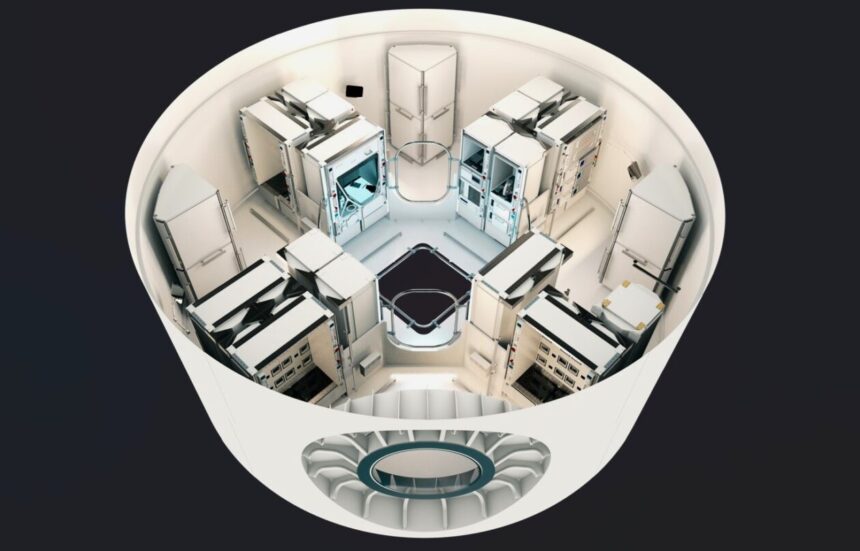
How do you design a living space where there’s no up or down? That’s one of the challenges facing Teague, a Seattle-based design and innovation firm that advises space companies such as Blue Origin, Axiom Space and Voyager Technologies on how to lay out their orbital outposts.
Mike Mahoney, Teague’s senior director of space and defense programs, says the zero-gravity environment is the most interesting element to consider in space station design.
“You can’t put things on surfaces, right? You’re not going to have tables, necessarily, unless you can attach things to them, and they could be on any surface,” he told GeekWire. “So, directionality is a big factor. And knowing that opens up new opportunities. … You could have, let’s say, two scientists working in different orientations in the same area.”

Over the next few years, NASA and its partners are expected to make the transition from the aging International Space Station to an array of commercial space stations — and Teague is helping space station builders get ready for the shift.
Space is one of the newer frontiers for a company that’s celebrating the 100th anniversary of its founding this year. Teague is best-known for helping to design the interiors of Boeing airplanes as well as the first Polaroid camera and Microsoft’s first Xbox gaming console.
In the 1980s, Teague helped Boeing and NASA with their plans for Space Station Freedom, an orbital project that never got off the ground but eventually evolved into the International Space Station. Teague also partnered with NASA on a 3D-printed mockup for a Mars habitat, known as the Crew Health and Performance Exploration Analog.
Nowadays, Teague is focusing on interior designs for commercial spacecraft, a business opportunity that capitalizes on the company’s traditional expertise in airplane design.
Mahoney said Teague has been working with Jeff Bezos’ Blue Origin space venture on a variety of projects for more than a decade. The first project was the New Shepard suborbital rocket ship, which made its debut in 2015.
“We partnered with their engineering team to design for the astronaut experience within the New Shepard space capsule,” Mahoney said. “It’s all the interior components that you see that come together, from the linings to the lighting. We created a user experience vision for the displays as well.”
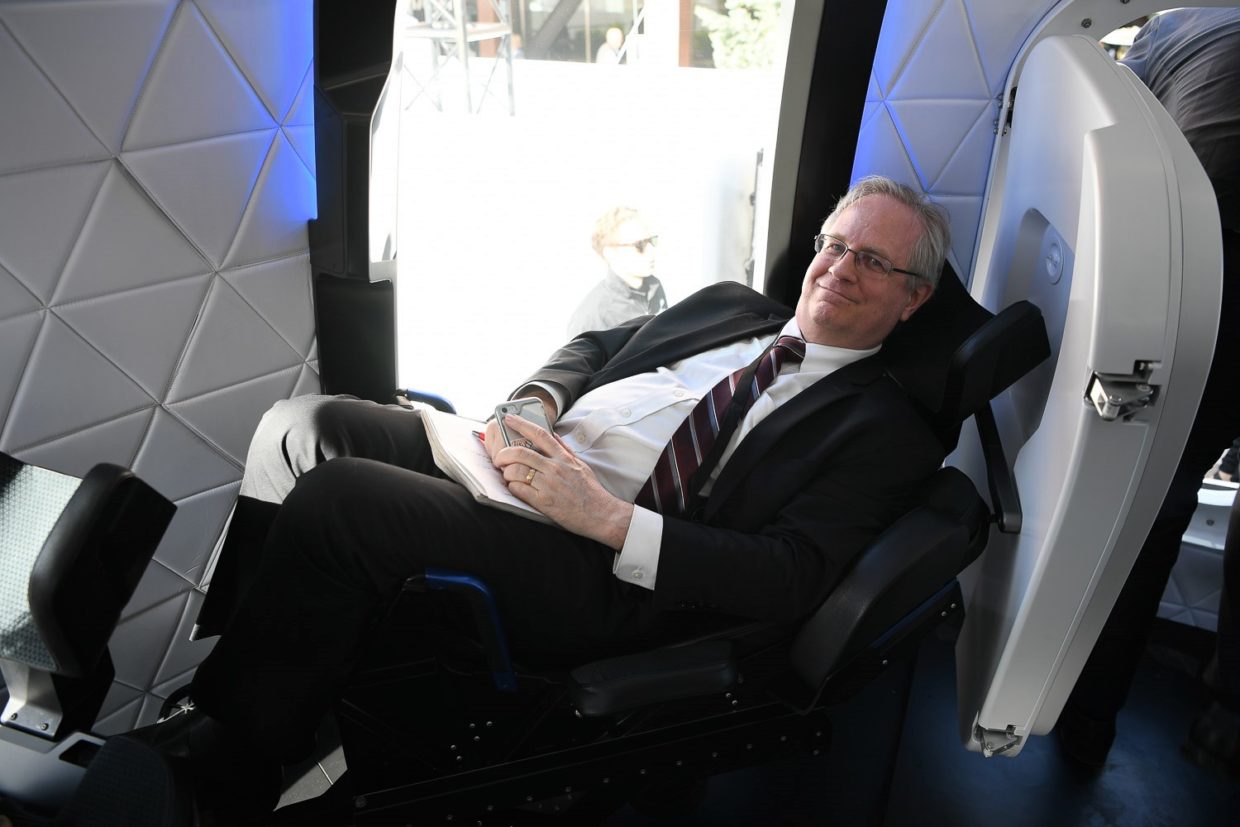
Teague also worked with Blue Origin on design elements for the Orbital Reef space station and the Blue Moon lunar lander. “We were involved in initial concepting for the look and feel of the vehicles,” Mahoney said. “In other cases, we designed and built mockups that were used for astronaut operations and testing. How do we navigate around the lunar lander legs? How do we optimize toolboxes on the surface of the moon?”
Other space station ventures that have benefited from Teague’s input include Axiom Space (which also brought in Philippe Starck as a big-name designer) and Starlab Space, a joint venture founded by Voyager Technologies and Airbus.
Starlab recently unveiled a three-story mockup of its space station at NASA’s Johnson Space Center in Texas. The mockup is built so that it can be reconfigured to reflect tweaks that designers want to make in the space station’s layout, before launch or even years after launch.
“One of the things that’s been very helpful along this development path has been working with Teague, because you have to have a really good idea on how you lay out this very large volume so that you can optimize the efficiency of the crew,” said Tim Kopra, a former NASA astronaut who now serves as chief human exploration officer at Voyager Technologies.
Kopra compared the Starlab station to a three-story condo. “The first floor is essentially like the basement of a large building that has the infrastructure,” he said, “It has our life support systems, avionics and software, the toilets, the hygiene station — which encompasses both the toilet and a cleaning station — and the workout equipment.”
The second floor serves as a laboratory and workspace, with a glovebox, freezer, centrifuge, microscope and plenty of racks and lockers for storage. “We are very focused on four different industries: semiconductors, life sciences, pharmaceuticals and materials science,” Kopra said.
He said the third floor will be a “place that people will enjoy … because Deck 3 has our crew quarters, our galley table, our windows and a little bit more experiment capacity.”
The galley table is a prime example of how zero-gravity interior design differs from the earthly variety. “No chairs,” Kopra said. “Just like on the ISS, all you need is a place to hook your feet. There are little design features, like where do you put a handrail, and how tall is the table?” (He said the designers haven’t yet decided whether the table should be round or square.)
Kopra said one of his top design priorities is to use the station’s volume, and the astronauts’ time, as efficiently as possible. “Time is extremely valuable on the ISS. They calculate that crew time is worth about $135,000 per hour,” he said. “Ours will be a fraction of that, but it really illustrates how important it is to be efficient with the time on board.”
Starlab is laid out to maximize efficiency. “We have a really cool design where the middle has a hatchway that goes all the way through the three stories,” he said. “So, imagine if it were a fire station, you’d have a pole that went from floor to floor. We don’t need a fire pole. We can just translate through that area.”
Mahoney said human-centered design will be more important for commercial space stations than it was for the ISS.
“In the past, space stations have been primarily designed for professionally trained, military background astronauts,” he said. “Now we’ll have different folks in there. … How do we think about how researchers and scientists will be using these spaces? How do we think about non-professional private astronauts? As the International Space Station gets retired, how do these companies step in to fill the void, serving NASA but also a lot of these new customers?”
-
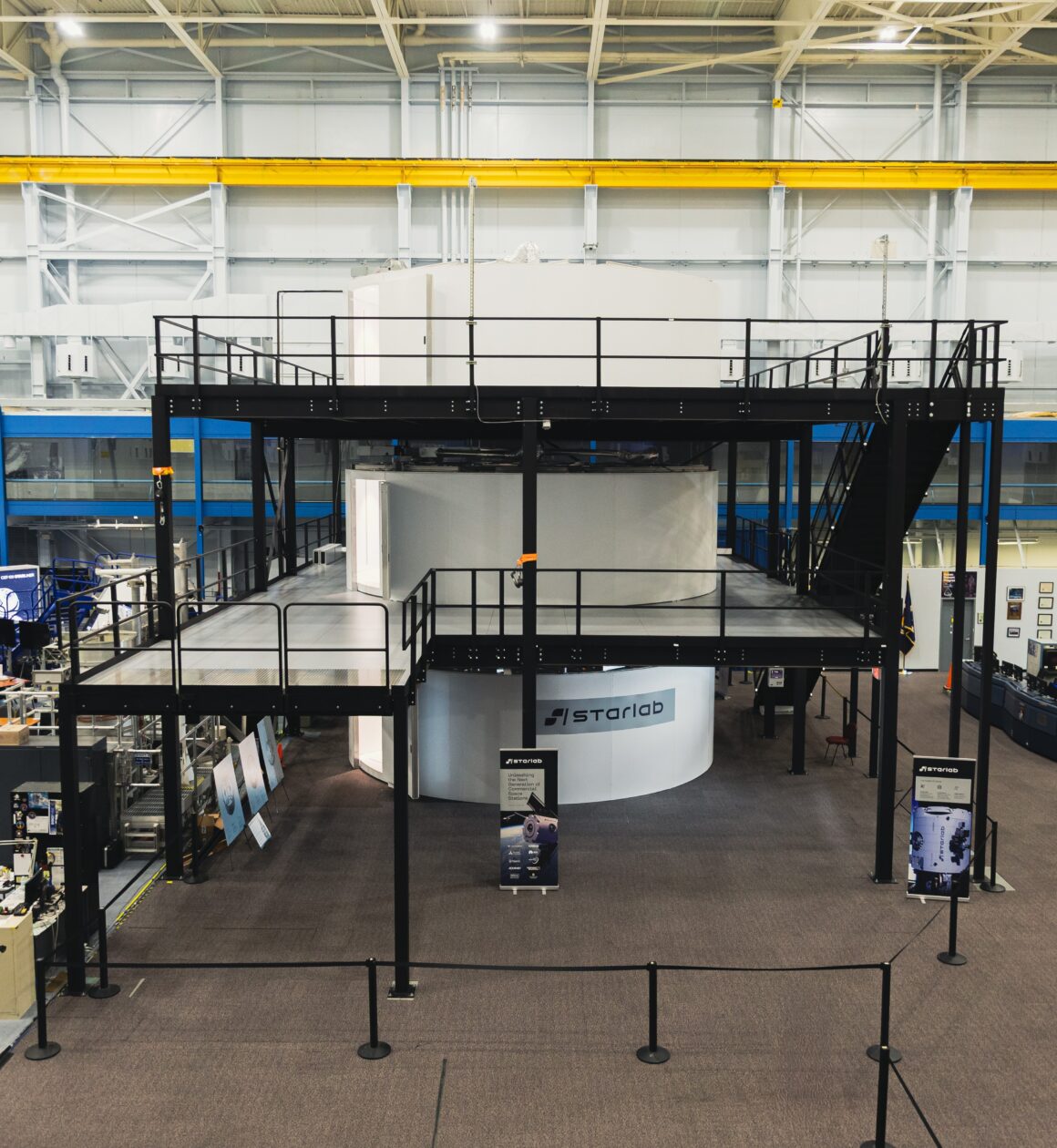
A three-story mockup of the Starlab space station has been installed inside a building at NASA’s Johnson Space Center in Texas. (Starlab Photo) -
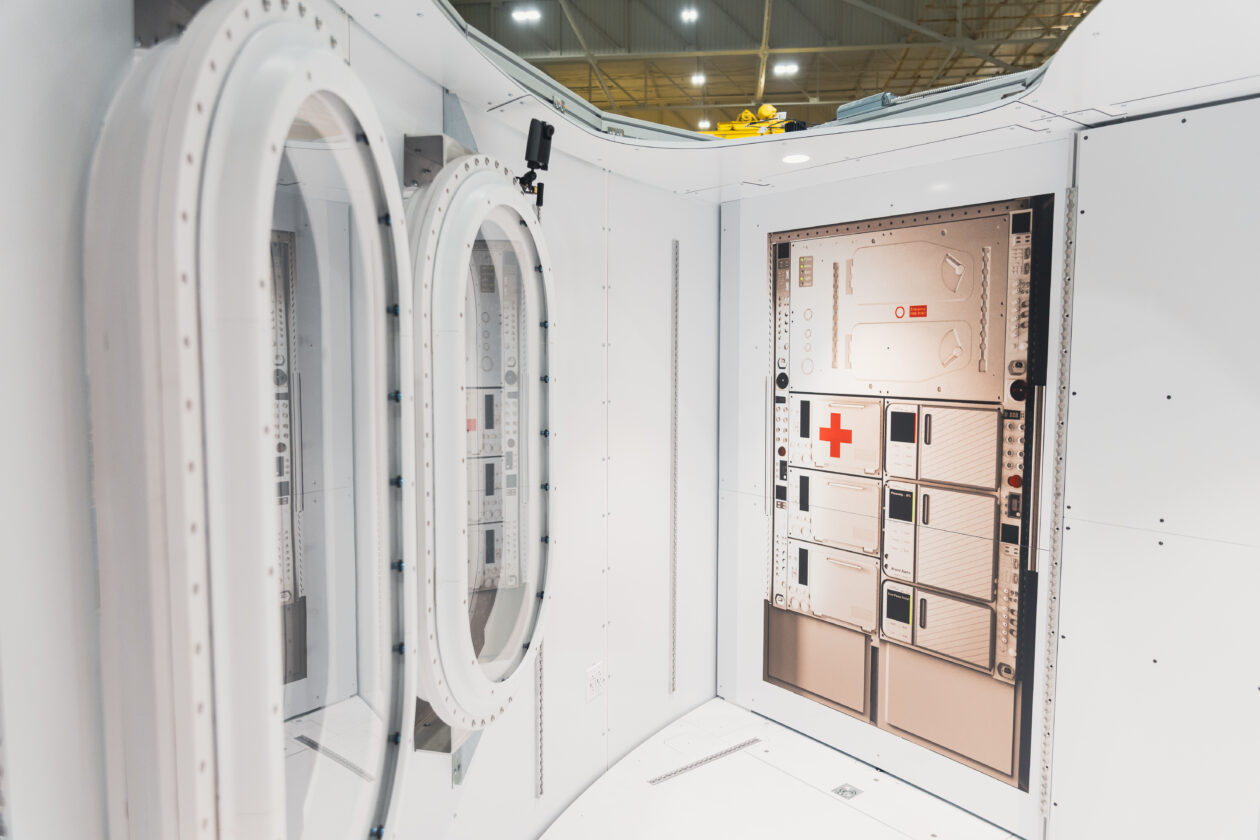
An interior view of the Starlab mockup highlights the large observation windows and emergency equipment. (Starlab Photo) -
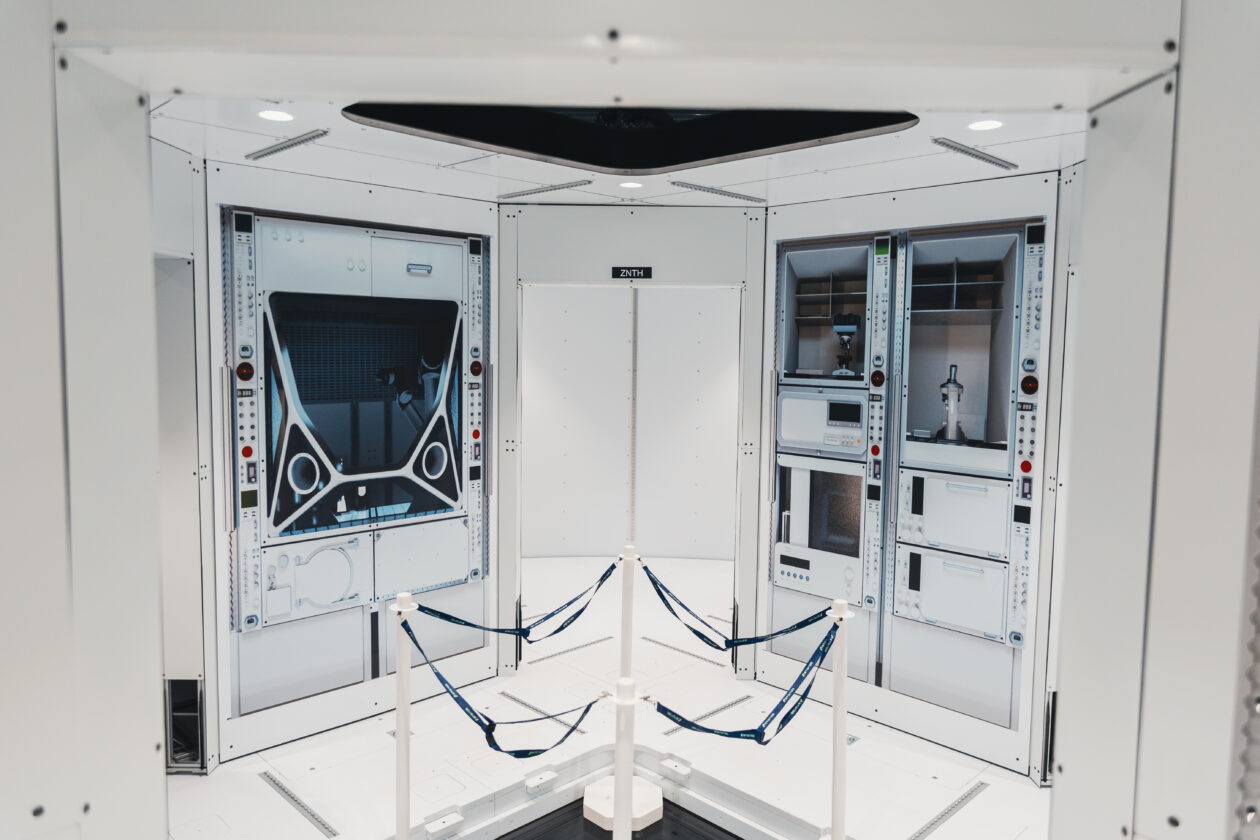
The Internal Payload Laboratory inside the Starlab mockup features a glovebox, cold stowage, an optical bench and a workbench. (Starlab Photo) -
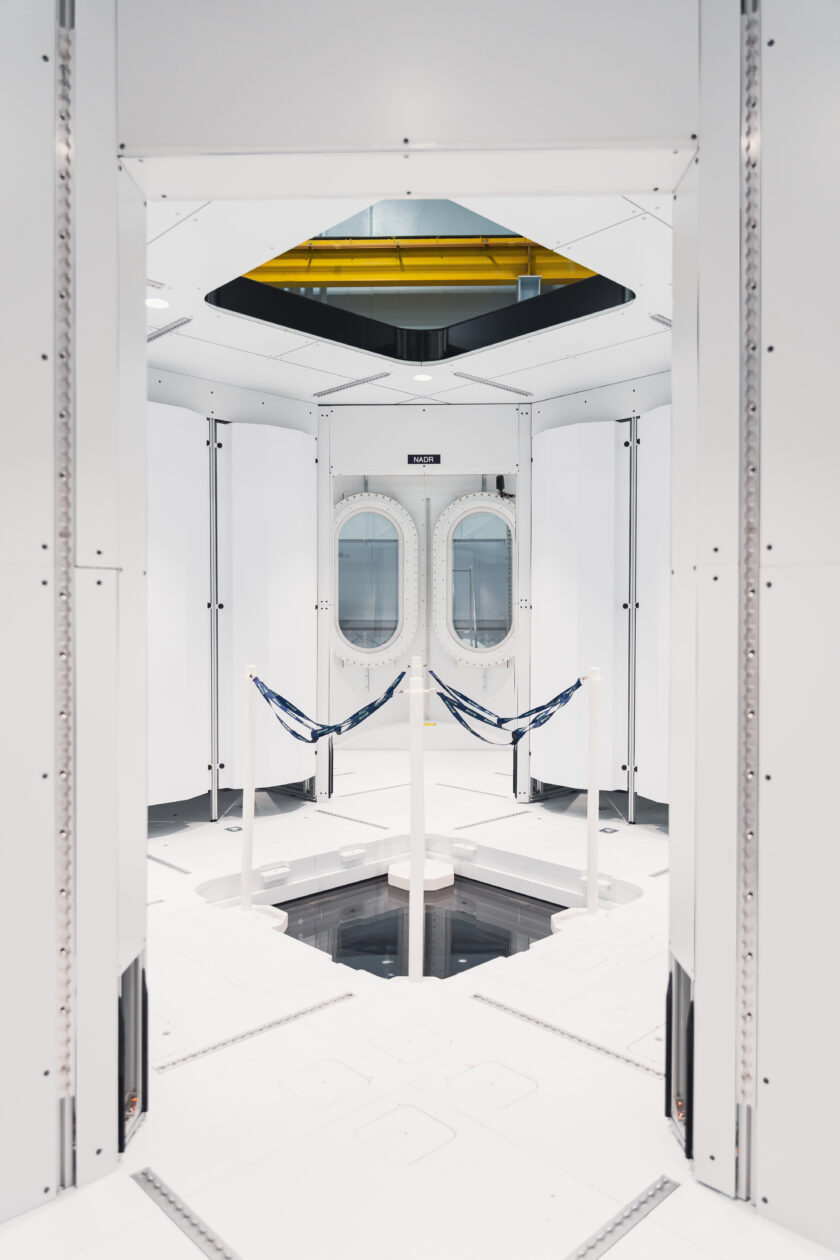
Level 3 of the Starlab mockup includes the crew quarters, galley and Earth viewing areas. Starlab Space’s partners include Hilton and Journey, the team behind the Sphere in Las Vegas. (Starlab Photo)
When will commercial space stations step in? The answer to that question is up in the air.
Last year, NASA reworked its process for awarding further funding for the development of commercial space stations. The revised plan was aimed at giving commercial partners a better chance of putting their orbital outposts in operation by 2030, the date set for the International Space Station’s retirement.
But NASA has been slow to follow through on the revised plan, sparking concern in Congress. Late last month, the space agency said it was still working to “align acquisition timelines with national space policy and broader operational objectives.” Now some lawmakers are calling on NASA to reconsider its plan to deorbit the ISS in the 2030-2031 time frame.
The timetable for the space station transition may be in flux, but Mahoney and other space station designers are staying the course — and taking the long view.
“We may not know right now how the space station is going to be used 20 years from now,” Mahoney said. “How do we start to future-proof and create a system within that’s modular and flexible, so that we can add technologies and add systems, or we can configure in different ways? … Those are the kinds of things that we’re thinking about designing for.”
Read the full article here