

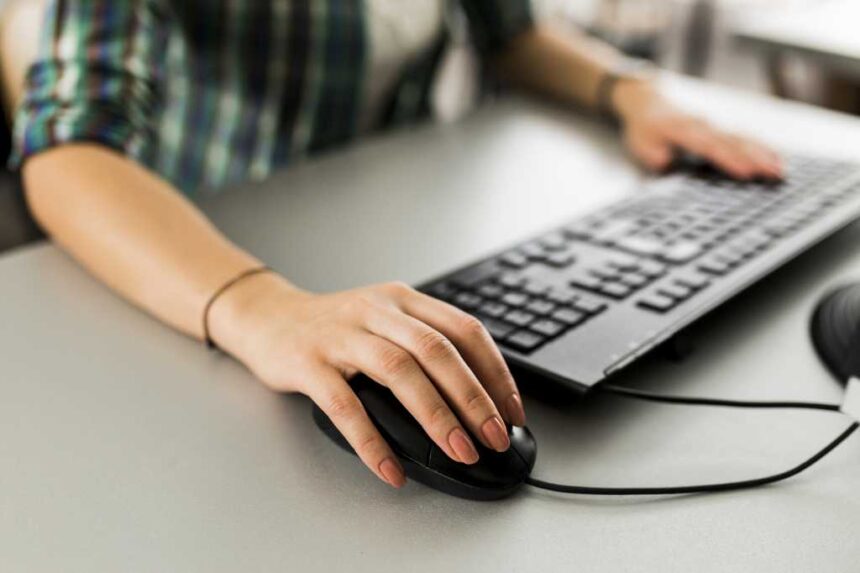
At CES 2026, HP introduced a desktop PC built into a keyboard chassis, a form factor the company said addresses the challenge of equipping workers who move frequently between workspaces.
The EliteBoard G1a Next Gen AI PC packs an AMD Ryzen AI 300 Series processor delivering over 50 TOPS of neural processing power into a keyboard that is 12mm thick and weighs 750 grams. The device connects to any display and functions as a standalone Copilot+ PC, enabling employees to carry desktop-class computing between locations without a traditional tower or notebook.
“Work is being redesigned in real time — where it happens, how it happens, and what tools employees need to stay productive,” Guayente Sanmartin, senior vice president and division president of commercial systems and displays solutions at HP, said in a statement.
HP added that the form factor addresses a growing mismatch between workers’ needs and the tools they have. Just 44% of workers believe their technology fits their working style, the company said, citing its 2025 Work Relationship Index. The company is betting that the EliteBoard G1a will address that gap for workers who split time between home and office but need full desktop performance at both locations.
But the form factor presents challenges for IT organizations that must manage and secure these devices.
IT management challenges
The keyboard-PC form factor blurs traditional asset management boundaries, according to Sanchit Vir Gogia, chief analyst at Greyhound Research.
“The moment you collapse the PC and keyboard into one object, you blur well-established asset tagging and classification boundaries,” Gogia said. “IT inventories have historically treated keyboards as peripherals, often untracked or low value. But in this case, failing to treat a keyboard-PC as a primary compute asset opens the door to security missteps and audit failures.”
The form factor creates support complications as well. A broken keyboard used to be a minor issue, but with this device, a single stuck key or liquid spill can mean full compute downtime, Gogia said. Support teams will need to learn new disassembly methods and inventory unique spare parts, he added.
There is also the question of physical security. If a device looks like a keyboard, many users may not treat it with the caution they would apply to a PC, Gogia said.
HP addressed some of these concerns with built-in security features. The device includes HP Wolf Security for Business with hardware-enforced protection against firmware attacks. The security framework has been designed to defend against emerging quantum computing threats, the company said. The EliteBoard also features a physical security tether and lockable cable option.
Beyond security and support, the question for IT organizations is where this device fits in their hardware portfolio.
Tactical deployment, not fleet-wide
The keyboard-PC is best understood as a tactical fit for specific roles, not a general-purpose device, according to Gogia. The most credible fit is in environments where employees operate at fixed workstations and move between just two consistent locations, such as call centers, service desks, and regulated environments where workstations are standardized, he said.
“In these scenarios, a keyboard-PC offers several advantages. It reduces desk clutter, eliminates the need for docking stations, and creates a cleaner support footprint,” Gogia said. But that appeal fades outside those conditions, he said. If an employee frequently works on the go or across various desk setups, a device that depends entirely on external monitors becomes more burden than a benefit.
HP designed the device with portability in mind. It includes dual microphones and speakers integrated into the keyboard housing, eliminating the need for separate peripherals in many scenarios, the company said. An optional built-in battery extends its utility for scenarios where desk-based power isn’t available, the statement added.
The device incorporates HP Smart Sense and AMD’s Auto State Management technology to adjust performance, cooling, and battery optimization based on workload, according to the company.
The question of whether the AI performance justifies the investment remains open.
AI capabilities and cost questions
These devices are built with NPUs to handle local AI workloads, but when you examine current enterprise usage patterns, very few roles truly benefit from that AI horsepower today, Gogia said. Most AI-enhanced workflows like meeting transcription or data summarization still happen in the cloud or require minimal local processing, he said.
“The keyboard-PC is not a budget play either,” Gogia said. “If the procurement team has to fund duplicate monitor setups or invest in unique spares for these devices, the cost structure could quickly exceed that of a good laptop or thin client setup.”
For organizations that do deploy the EliteBoard, HP announced a new monitor designed to pair with the device.
The Series 7 Pro 4K monitor features what HP described as the world’s first Neo:LED desktop display technology. The 31.5-inch monitor delivers IPS black panel performance with a 2,700:1 contrast ratio — double that of traditional IPS displays, the company said.
The monitor provides 140W power delivery through Thunderbolt 4 connectivity, enabling single-cable solutions for the EliteBoard and other compatible devices.
Both products are expected to become available in March, the company added in the statement.
Read the full article here