
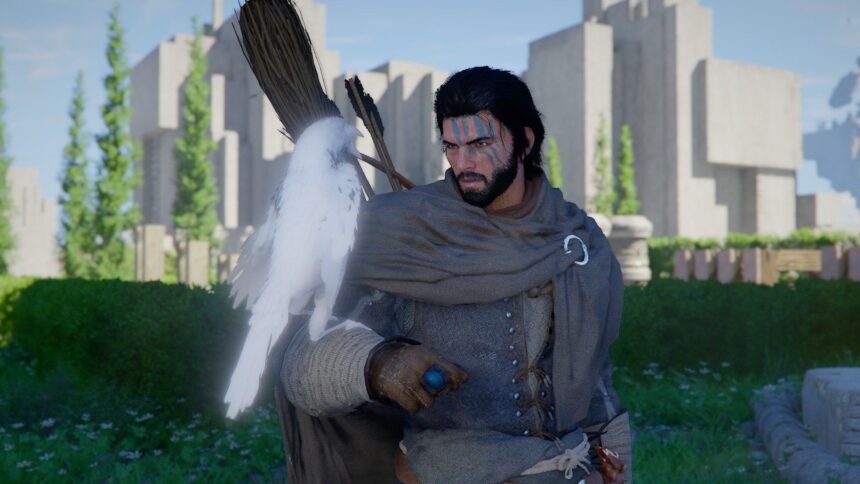
Prolific tweeter and take-haver Michael Douse, Larian’s publishing director, has delved into the Crimson Desert discourse. The man knows his RPGs (I know, I know, Pearl Abyss says it isn’t an RPG), so he offers an interesting and informed perspective. I just think he’s dead wrong this time.
“Crimson Desert is fun to play, but it is such a cynical amalgamation of borrowed mechanics,” he says in the original tweet. “It is Now That’s What I Call Gaming plucked off a gas station shelf, for better & worse. Expect a lot more of this in premium & F2P. There is less risk in it.”
Article continues below
Crimson Desert is fun to play, but it is such a cynical amalgamation of borrowed mechanics. It is Now That’s What I Call Gaming plucked off a gas station shelf, for better & worse. Expect a lot more of this in premium & F2P. There is less risk in it.March 28, 2026
This is a take I’ve seen quite a lot recently: that it’s fun, but it’s basically just a cynical hodgepodge of mechanics borrowed from other games. I get it—but it still strikes me as an unfair assessment of both Crimson Desert and other games that take advantage of popular mechanics and systems.
Videogame development is over 50 years old, and it’s rare to see something entirely unique. Baldur’s Gate 3 is one of the best games ever made, but there’s almost nothing truly new in Larian’s greatest RPG.
BG3 is full of nods to older CRPGs, the combat system is drawn from Larian’s previous games and D&D, and the smartest move the studio made was borrowing mechanics and concepts from tabletop roleplaying. All these things come together to create a singular RPG, but the ingredients are not unique.
And you’d look like a nutter if you called Baldur’s Gate 3 cynical.
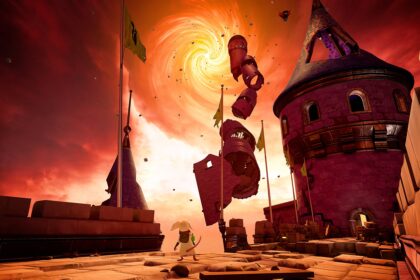
Granted, I do think there’s a valid argument that Crimson Desert is more cynical than BG3, but that doesn’t make it inherently cynical. All the sky island stuff feels like a last-minute addition inspired by Tears of the Kingdom, and it doesn’t remotely fit Crimson Desert—but aside from that, there’s very little in this open-world romp that seems to exclusively exist because of trend-chasing.
Pearl Abyss’s approach makes a lot more sense when you remember that this is an MMO studio, and that was the genesis of Crimson Desert.
This is a singleplayer game built on the philosophy of MMO design. Indeed, many of the mechanics that contribute to the game’s hodgepodge feel are directly lifted from Black Desert, Pearl Abyss’s previous game. The economic and trade goods system, for instance, is something I had a great deal of fun with in the MMO, where I turned into a potato baron. Is it cynical to take a popular system from your previous game and apply it to your new one? Or is that just common sense?
I’d be really surprised to see other games doing something similar outside of the MMO space, despite Douse’s assertion that we should expect it.
Crimson Desert is a rare game—one that was given the opportunity to flourish, full of dense systems as far as the eye can see. This is not normal! The time and investment required for a game like this is vast, and most publishers are risk averse, while independent studios are constantly learning that reining in the scope of their projects is the smartest thing they can do.
Indeed, I think one of the main reasons Crimson Desert is resonating with so many people is due to its big swings and the freedom it was given to take big risks. It is a messy and sometimes incomprehensible game, but its scope and ambition are unusual, and it’s been a treat to explore the world of Pywel and see what the game’s going to throw at me next.
Cynical games aren’t fun. I sincerely believe that most gamers are savvy enough to recognise when a game’s been designed just to check some boxes—this is an era obsessed with authenticity. So the only cynicism I’m detecting is coming from the folk who have tarred Crimson Desert with this brush.
Read the full article here