

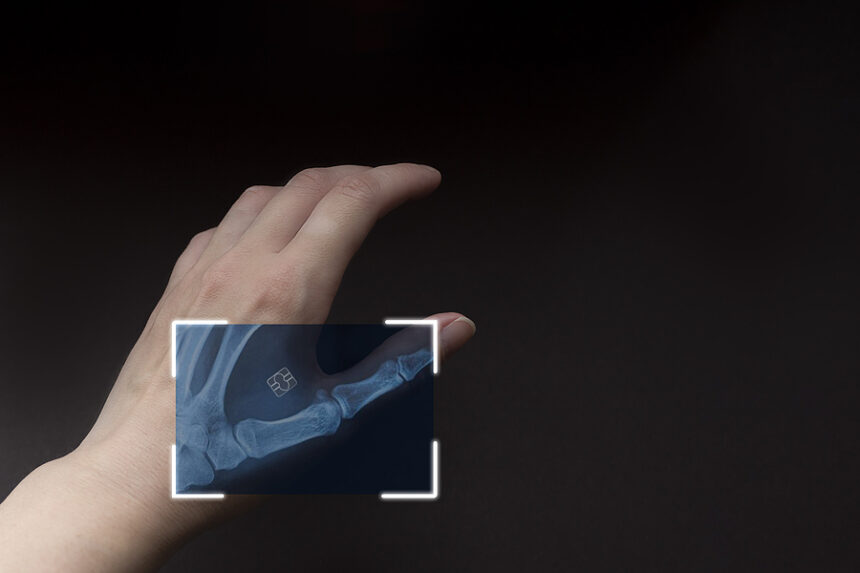
A bill introduced in the Washington state Legislature would ban employers from requiring or pressuring workers to be microchipped, a practice lawmakers want to prohibit before it ever becomes an issue.
House Bill 2303 was prefiled this week by Reps. Brianna Thomas (D-34) and Lisa Parshley (D-22).
The bill would prohibit employers from requiring, requesting or coercing employees to have microchips implanted in their bodies as a condition of employment, and would bar the use of subcutaneous tracking or identification technology for workplace management or surveillance.
It aims to protect worker privacy and bodily autonomy by establishing strict penalties for violations, including civil penalties starting at $10,000 and the right for aggrieved workers to sue for damages and injunctive relief.

While there’s no known instance of an employer seeking such action, Thomas told GeekWire the bill is a preemptive move.
“We are getting out ahead of the problem because the practice of requiring these chips is too dangerous to wait for it to show up in Washington,” she said Thursday via email. “An employee with a microchip stops being an employee — they are essentially being dehumanized into corporate equipment.”
The Carnegie Council for Ethics in International Affairs reported that internationally, more than 50,000 people have elected to receive microchip implants to serve as their swipe keys, credit cards, and more. The organization noted that the technology is especially popular in Sweden, where chip implants are more widely accepted for gym access, e-tickets on transit systems, and to store emergency contact information.
HB 2303 would add a new section to Chapter 49.44 of the Revised Code of Washington (RCW), titled “Violations — Prohibited Practices.” The chapter serves as a catch-all for labor regulations that define and prohibit specific unfair or illegal activities by employers, employees, and labor representatives.
The legislation is similar to laws passed in Arkansas, California, Missouri, Montana, Nevada, New Hampshire, North Dakota, Oklahoma, Utah, Wisconsin, Indiana, Alabama, and Mississippi.
“Workers cannot legitimately consent to a program because of the power dynamic between them and the employer,” Thomas said. “Implanted chips have no place in a work environment.”
Nevada is “arguably the most restrictive” on microchip implants and permanent identification markers, according to the Carnegie Council. Its law prohibits people from voluntarily electing to receive such markers in Nevada.
Thomas said HB 2303 does not go as far as Nevada’s restrictions, noting that workers would still be free to make their own choices outside the workplace.
Thomas said she believes companies will eventually pitch the technology to their employees by telling them it’s more convenient and easier — you don’t have to worry about forgetting your work access badge, etc.
“Many times convenience causes people to view things too narrowly and they don’t see the big picture,” she said. “The power dynamic between an employer and an employee makes true, uncoerced consent impossible. This is about making sure workers not only have the option but also consider all the factors when these programs are presented to them.”
The Carnegie Council also reported on the privacy, data security, and health safety concerns that microchips present, including from technologists who worry about IoT vulnerabilities in sensors and network architecture that could be exploited by hackers.
While the Washington proposal targets simple Radio Frequency Identification (RFID) tags, a more sophisticated wave of “brain-computer interfaces” (BCIs) is rapidly moving toward the mainstream.
Elon Musk wants to ramp up production of his Neuralink brain‑computer interface chips in 2026. He envisions the technology helping people with neurological conditions while eventually enabling humans to interact directly with computers. The company plans to make the surgical implantation process nearly fully automated to scale the procedure.
Washington’s HB 2303 is scheduled for a public hearing Jan. 14 in the House Committee on Labor & Workplace Standards.
Read the full article here