

Pacific Northwest tech and cancer researchers are publicly releasing an AI tool that can perform sophisticated tumor analysis in a fraction of the time and cost of existing methods, potentially making cutting-edge cancer insights available to far more patients.
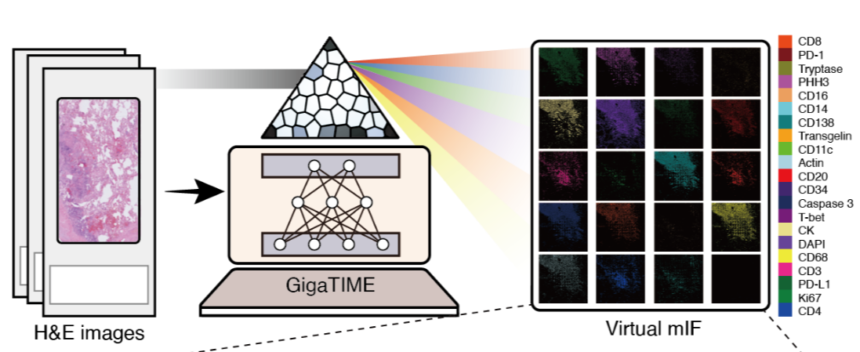
The GigaTIME model uses artificial intelligence to virtually generate detailed immune system data from standard pathology slides — analysis that would normally require days of lab work and thousands of dollars per sample.
The breakthrough could accelerate the shift toward precision medicine, where treatments are tailored to each patient’s specific cancer biology, said Hoifung Poon, general manager of Microsoft Research’s Real-World Evidence program.
Traditional pathology slides show tumor and immune cells but offer limited insights into whether a patient’s immune system is actively fighting cancer. A more sophisticated technique called multiplex immunofluorescence (mIF) analysis peers closely into the tumor’s microenvironment, adding information about whether immune cells are working based on which proteins are present.
But mIF analysis “just for one sample, could easily take days and cost thousands of dollars,” Poon said, severely limiting its use in routine care.
GigaTIME bypasses that bottleneck by generating the information virtually by simply analyzing standard pathology slides.
“GigaTIME is about unlocking insights that were previously out of reach,” said Dr. Carlo Bifulco, chief medical officer of Providence Genomics and a medical director at the Providence Cancer Institute.
The project brings together researchers from Microsoft; Providence facilities in Renton, Wash., and Portland; and the University of Washington’s Paul G. Allen School of Computer Science and Engineering. They’re publishing a peer-reviewed study today in the journal Cell and releasing the tool online for free on Hugging Face, GitHub and Microsoft Foundry.
The work reflects growing Seattle-area efforts to integrate complex health datasets using AI to facilitate advances in health and medicine. The Allen Institute last month released the Brain Knowledge Platform for neuroscience research, while biotech startup Synthesize Bio has built tools for designing experiments and predicting their outcomes using publicly available data. And the Fred Hutch Cancer Center helped produce a privacy-protecting, data-sharing model through the Cancer AI Alliance.
The scale of the GigaTIME project is giant:
- Researchers trained the model on a Providence dataset of 40 million cells, pairing pathology slides with mIF data examining 21 different proteins.
- They applied GigaTIME to samples from 14,256 cancer patients across 51 hospitals and more than 1,000 clinics in the Providence system.
- The work produced a virtual population of approximately 300,000 mIF images that cover 24 cancer types and 306 cancer subtypes.
Poon has even bigger ambitions that include blending together data gleaned from cell and biopsy samples plus CT radiology reports, MRIs and other diagnostics to create a more holistic picture of a patient. These advanced models could potentially offer predictions about how a disease might progress or respond to treatment.
The new tools could one day help curb the massive costs and time associated with clinical trials by providing better insights for selecting drug candidates and designing studies.
The goal is making advanced cancer care both more effective and more widely accessible.
“I’m personally biased, but I think there can’t be a more exciting time than right now,” Poon said, pointing to the convergence of AI capabilities and digital medical records as “two really powerful forces.”
Authors of the paper “Multimodal AI generates virtual population for tumor microenvironment modeling” are Jeya Maria Jose Valanarasu, Hanwen Xu, Naoto Usuyama, Chanwoo Kim, Cliff Wong, Peniel Argaw, Racheli Ben Shimol, Angela Crabtree, Kevin Matlock, Alexandra Q. Bartlett, Jaspreet Bagga, Yu Gu, Sheng Zhang, Tristan Naumann, Bernard A. Fox, Bill Wright, Ari Robicsek, Brian Piening, Carlo Bifulco, Sheng Wang and Hoifung Poon.
Read the full article here