

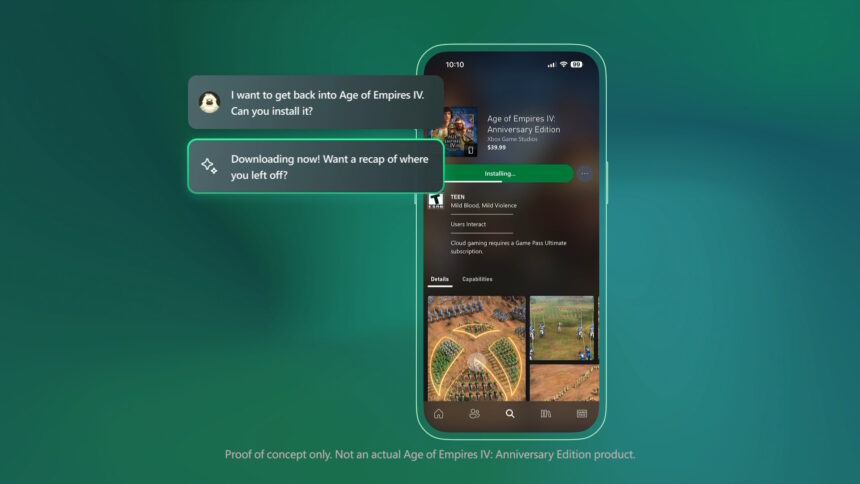
Microsoft’s Gaming Copilot plans to answer players’ in-game questions by searching the open internet for guide content and presenting it to gamers without attribution, at least based on a demo at last week’s Game Developers’ Conference in San Francisco.
This is a potentially seismic event for what’s left of the gaming press. Microsoft says it’s exploring ways to license guide content from creators, but the details are vague, and the demo told a different story.
A wide variety of writers (full disclosure: including me) work on creating on strategy guide content for video games, which can range from old-school .txt files on sites like GameFAQs to maintaining fan wikis to personal YouTube channels. It’s a big part of the gaming press, and one of its major remaining traffic drivers. Now Gaming Copilot plans to raid that store of knowledge.
This was illustrated during the Gaming Copilot demo that Microsoft’s Sonali Yadav and Haiyan Zhang put on at GDC. They showed off some of the LLM’s options, which include being able to ask it for advice through voice or text about what game to play next, or for tips on a current objective, such as a particular quest in Diablo 4.
You can also check with Gaming Copilot for details about your own account, such as when your Game Pass subscription is set to renew, or information such as your play time.
According to Ethan Gach at Kotaku, Yadav and Zhang said the company is exploring ways to license guide content from online creators. That addresses some of the more obvious issues.
In a perfect world, that would mean money actually changes hands here, whether it’s through sponsors, brand deals, or Microsoft simply writing some checks.
As Gach noted on Bluesky, however, the GDC demo had Copilot present that information to the user without attribution, and it’s unclear if that will change before it launches for Xbox consoles.
With this approach, Gaming Copilot provides another example of an AI initiative that’s eating its own seed corn. Should it take off in any measurable way, Xbox would be actively whittling away the audience for the online guides ecosystem that Copilot is specifically exploiting. If Copilot reduces the need for third-party guide websites, then before long, there won’t be any third-party guide websites for Copilot to draw upon.
It also creates a perverse incentive for bad actors to deliberately poison the well. Three years ago, World of Warcraft and Destiny players on Reddit made headlines by talking about a boss called “Glorbo” that didn’t actually exist in either game, in an attempt to trick scraper bots. At least one content mill fell for the scam, by auto-generating an article that acted as if Glorbo was a real upcoming boss in WoW.
Even with whatever content filters Microsoft has in place, Gaming Copilot is likely to come under similar attack within days of its release. It’s like Christmas for trolls.
The most obvious alternative is for Microsoft to build up its own online library of strategy guide content, so Copilot can stick to its own exclusive sources of information.
While it’d cost some money to hire a few dozen gaming freelancers to write guides for the roughly 7,200 games in Xbox’s 25-year-old library (give or take however many are no longer available), it would amount to a rounding error compared to the cash that Microsoft is throwing at AI research. In return, it’d dodge both the ethical and logistical issues that are inherent in the premise.
Initially announced almost exactly one year ago, Gaming Copilot (slightly rebranded from Copilot for Gaming) is currently available in beta for the Xbox PC and mobile apps and Microsoft’s portable console, the ROG Xbox Ally, which debuted back in October.
The feature is scheduled to launch on Xbox consoles later this year.
Copilot is one of three major AI-driven gaming features coming to Xbox, which also includes highlight reels and automatic “super resolution” for higher framerates. It also provides users with a sort of ersatz gaming buddy, so you’ve always got a virtual companion to chat with while you play.
At the end of the day, however, Gaming Copilot is a solution in search of a problem, like too many other AI-driven features. It addresses nonexistent issues in order to further a deeply unpopular initiative. In its current state, it’s difficult to imagine a situation where Gaming Copilot ends up as more than a curiosity.
Read the full article here