

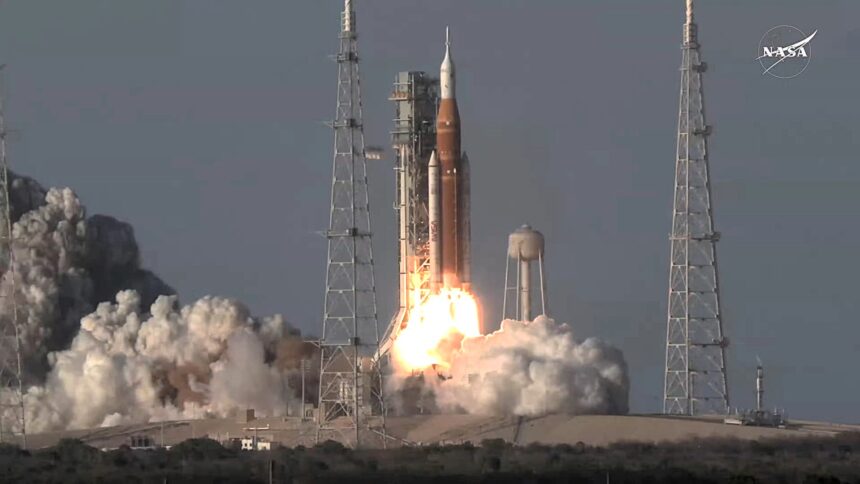
After years of postponements and close to $100 billion in spending, NASA has launched the first mission to send astronauts around the moon since Apollo 17 in 1972.
The 10-day Artemis 2 mission began today with the liftoff of NASA’s 322-foot-tall Space Launch System rocket from Launch Complex 39B at Kennedy Space Center in Florida at 6:35 p.m. ET (3:35 p.m. PT). NASA is streaming coverage of the flight via YouTube and Amazon Prime.
During the last two hours of the countdown, engineers addressed concerns about the rocket’s flight termination system and instrumentation for a battery on the launch abort system. “Godspeed, Artemis 2,” launch director Charlie Blackwell-Thompson told the crew just before liftoff. “Let’s go!”
Artemis 2 is the first crewed test flight in a series leading up to a moon landing that’s currently scheduled for 2028. It follows Artemis 1, which sent a crewless Orion around the moon in 2022. This time, four astronauts are riding inside Orion: NASA mission commander Reid Wiseman, NASA astronauts Christina Koch and Victor Glover, and Canadian astronaut Jeremy Hansen.
“Great view,” Wiseman told Mission Control during the rocket’s ascent. “We have a beautiful moonrise, we’re headed right at it.”
Koch will be the first woman to go beyond Earth orbit. Similar firsts apply to Glover as a Black astronaut, and Hansen as a non-American astronaut.
Although Artemis 2’s astronauts won’t be landing on the lunar surface, they’ll follow a figure-8 trajectory that will send them 4,700 miles beyond the far side of the moon and make them the farthest-flung travelers in human history.
Last week, NASA Administrator Jared Isaacman laid out a plan for establishing a permanent base on the moon and preparing for even farther trips into the solar system. Today, Isaacman said Artemis 2 would be “the opening act” of that golden age of science and discovery.
Senior test director Jeff Spaulding, a veteran of the space shuttle program, said he was looking forward to the mission. “I’m excited about going to the moon,” he told reporters on the eve of the launch. “I’m excited about establishing a presence there. It’s something that I have had a desire for, for a great many years — and then to get humans out to Mars as well.”
The mission timeline calls for Orion to adjust its orbit around Earth today and go through system checkouts. An hour after launch, Mission Control had to troubleshoot a dropout in communications with the crew. After a gap of several minutes, Wiseman reported that he could hear capsule communicator Stan Love “loud and clear.” The crew also worked with Mission Control to deal with a balky space toilet.
On Thursday, Orion is due to fire its main engine for about six minutes to leave orbit and head for the moon. The engine burn is designed to put the space capsule on a free-return trajectory, which takes advantage of orbital mechanics to slingshot around the moon for the return trip.
The health of the Artemis 2 astronauts will be monitored during the flight to gauge the effects of deep-space travel. The crew will also assess Orion’s performance and practice in-flight safety procedures. For example, they’ll rehearse the protocol for taking shelter from radiation storms that might flare up during trips beyond Earth’s protective magnetosphere. They’ll also participate in experiments and make observations of the moon’s far side.
The climactic lunar flyby is due to take place on April 6. “They’re going to be able to see the whole moon as a lunar disk on the lunar far side,” Marie Henderson, lunar science deputy lead for the Artemis 2 mission, said in a NASA video. “So, that’s a brand-new, unique perspective that humans haven’t been able to look at before.”
At the end of the trip, the crew and their Orion capsule are due to splash down in the Pacific Ocean off the California coast. They’ll be brought to a recovery ship for medical checkouts and their return to shore, following a routine that became familiar during the Apollo era.
Artemis 2 is about the history of America’s space program as well as its future. The round-the-moon mission profile matches that of Apollo 8, which served as a unifying event for a nation riven by the social tumult of the time. That mission’s commander, Frank Borman, reported receiving a telegram reading, “Congratulations to the crew of Apollo 8. You saved 1968.” Notably, less than a third of Americans living today were around when Apollo 8 flew.
The main motivation for the Apollo program was America’s superpower competition with the Soviet Union, and today, the geopolitical stakes are similarly high. NASA and the White House are seeking to jump-start progress on Artemis in part because China is targeting a crewed moon landing by 2030.
Sen. Maria Cantwell, D-Wash., said this week during a visit to Seattle-area suppliers for the Artemis program that it’s important for America to get to the moon first. “We’re trying to get the best real estate on the moon,” she said. “So, to do that, you’ve got to get up there to claim it.”
The course of the Artemis program, which is named after the goddess of the moon and the twin sister of Apollo in Greek mythology, hasn’t always run smooth. When the program was given its name in 2019, the Artemis 2 mission was planned for 2022 or 2023, with the moon landing scheduled for 2024. The cost of the program has been estimated at $93 billion through 2025, with each Artemis launch costing $4.1 billion.
Artemis 2’s launch team ran into several challenges during this year’s preparations for launch. Liftoff was initially scheduled for February, but a liquid hydrogen leak forced NASA to reset the launch for March. The launch date was reset again when a helium pressurization problem required a rocket rollback for repairs. The problem was resolved, and the SLS was brought back out to the pad on March 20.
Several companies with a presence in the Seattle area are banking on Artemis’ success. For example, a facility in Redmond operated by L3Harris (previously known as Aerojet Rocketdyne) builds thrusters for the Orion spacecraft and is already working ahead on the Artemis 8 mission.
Boeing is the lead contractor for the SLS rocket’s core stage. Karman Space & Defense in Mukilteo provides hatch release mechanisms and parachute deployment hardware for Orion. And Jeff Bezos’ Blue Origin space venture, based in Kent, is developing a Blue Moon lander that future Artemis crews could ride to the lunar surface.
Blue Origin’s New Glenn rocket is expected to send an uncrewed cargo version of its lander to the moon sometime in the next few months.
This report has been updated frequently during the countdown and mission.
Read more: Artemis 2 gets a push from Pacific Northwest tech
Read the full article here