

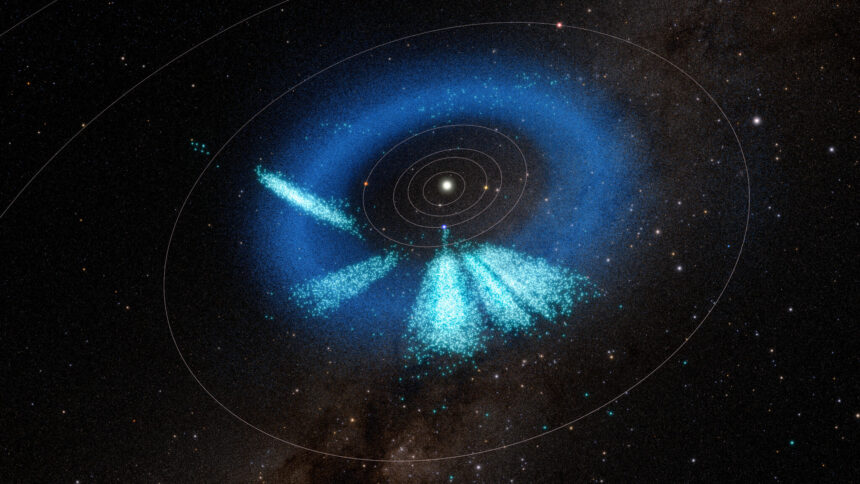
The Vera C. Rubin Observatory’s science team has discovered more than 11,000 new asteroids — a feat made possible by the Simonyi Survey Telescope’s advanced capabilities and data-crunching software developed at the University of Washington.
Rubin’s deluge of discoveries, based on a million early-stage observations that were collected over the course of a month and a half last summer, includes roughly 380 trans-Neptunian objects, or TNOs, and 33 previously unknown near-Earth objects. (Don’t panic: None of those near-Earth objects poses a threat to Earth.)
The data set also includes more than 80,000 previously known asteroids, some of which had been “lost” to science because of uncertainty about their orbits. The findings were confirmed by the International Astronomical Union’s Minor Planet Center, the global clearinghouse for small solar system objects.
These aren’t the first finds for the $800 million observatory in Chile, which made its “First Look” debut last June. Astronomers previously reported finding more than 1,500 asteroids during earlier test rounds.
“This first large submission after Rubin First Look is just the tip of the iceberg and shows that the observatory is ready,” UW astronomer Mario Jurić, who heads Rubin’s solar system team, said in a news release. “What used to take years or decades to discover, Rubin will unearth in months. We are beginning to deliver on Rubin’s promise to fundamentally reshape our inventory of the solar system and open the door to discoveries we haven’t yet imagined.”
The observatory’s centerpiece is the Simonyi Survey Telescope, named after the family of Seattle-area software billionaire Charles Simonyi. Equipped with the world’s largest digital camera, it can generate 20 terabytes of raw data per night. That data is analyzed and interpreted by scientific institutions around the world — including UW’s DiRAC Institute. (DiRAC stands for “Data-Intensive Research in Astrophysics and Cosmology.”)
“Rubin’s unique observing cadence required a whole new software architecture for asteroid discovery,” said Ari Heinze, a UW astronomer who worked with graduate student Jacob Kurlander to create the software that detected the asteroids. “We built it, and it works. It seems pretty clear this observatory will revolutionize our knowledge of the asteroid belt.”
Once it ramps up to full operation, the Rubin Observatory is expected to identify almost 90,000 new near-Earth objects, or NEOs, in the zone around our planet’s orbit. Some of those NEOs could be hazardous, and early detection would give scientists, engineers and policymakers a head start on the development of planetary defense strategies.
The trans-Neptunian objects that were found in the broad zone of the solar system beyond the orbit of Neptune include two icy bodies that appear to have extremely elongated orbits. The Rubin team says these two objects — designated 2025 LS2 and 2025 MX348 — reach distances that are roughly 1,000 times farther out from the sun than Earth. That would place them among the 30 most distant known celestial objects of their kind.
If the far reaches of the solar system harbor a large trans-Neptunian object — a hypothetical world known as Planet Nine or Planet X — Rubin should be able to detect it.
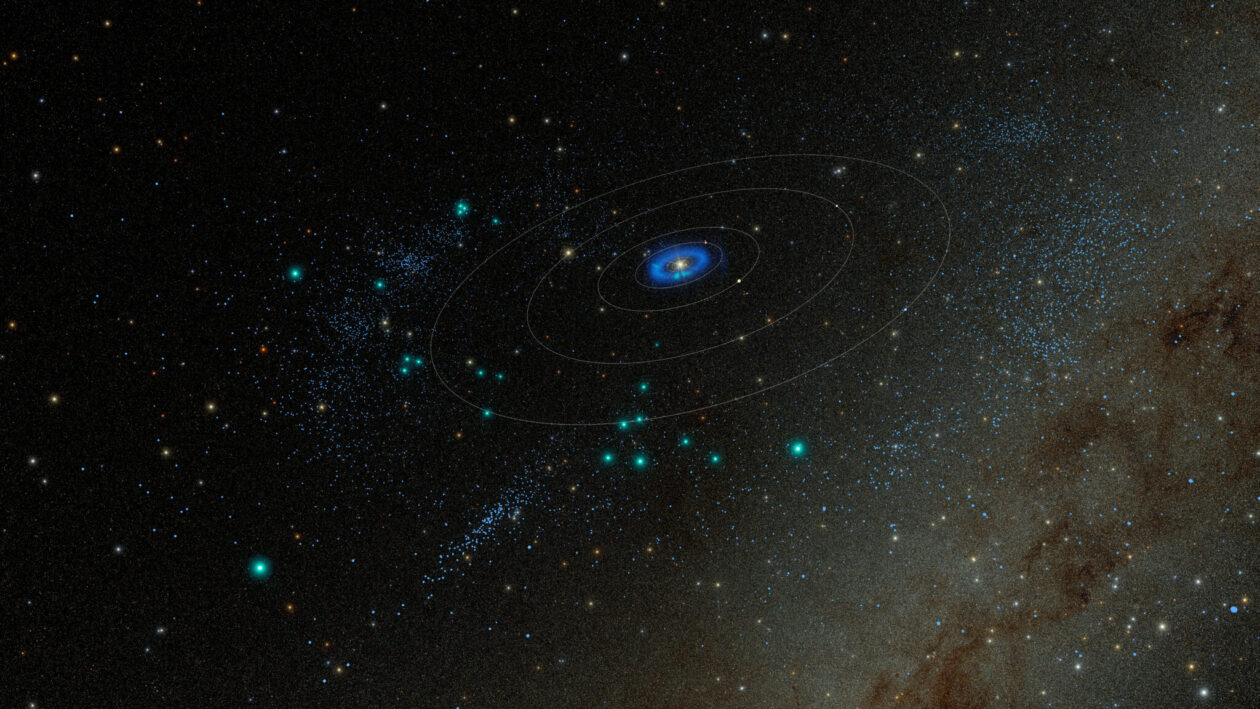
“Searching for a TNO is like searching for a needle in a field of haystacks,” said Matthew Holman, a senior astrophysicist at the Harvard & Smithsonian Center for Astrophysics and former director of the Minor Planet Center. “Out of millions of flickering sources in the sky, teaching a computer to sift through billions of combinations and identify those that are likely to be distant worlds in our solar system required novel algorithmic approaches.”
Holman worked with Kevin Napier, a research scientist at the Center for Astrophysics, to develop the algorithms for detecting distant solar system objects with Rubin data.
The Rubin discoveries that have been announced to date are only a prelude to Rubin’s 10-year Legacy Survey of Space and Time. Simulations suggest that over the course of the coming decade, the Rubin Observatory will find millions of previously undetected asteroids.
Operations of the Vera C. Rubin Observatory are funded by the U.S. National Science Foundation and the U.S. Department of Energy’s Office of Science.
This research is available at the Rubin Asteroid Discoveries Dashboard. In addition to Jurić, Heinze, Kurlander, Holman and Napier, the research team members include Pedro Bernardinelli, a former DiRAC postdoctoral fellow at the UW, now at the Institute for Astronomy, Geophysics and Atmospheric Sciences of the University of São Paulo; Joachim Moeyens, a UW research software engineer and B612 Asteroid Institute team member who earned his doctorate in astronomy at the UW; Siegfried Eggl, a former UW postdoctoral researcher in astronomy, now at the University of Illinois Urbana-Champagne; and Erfan Nourbakhsh at Princeton University.
Read the full article here