

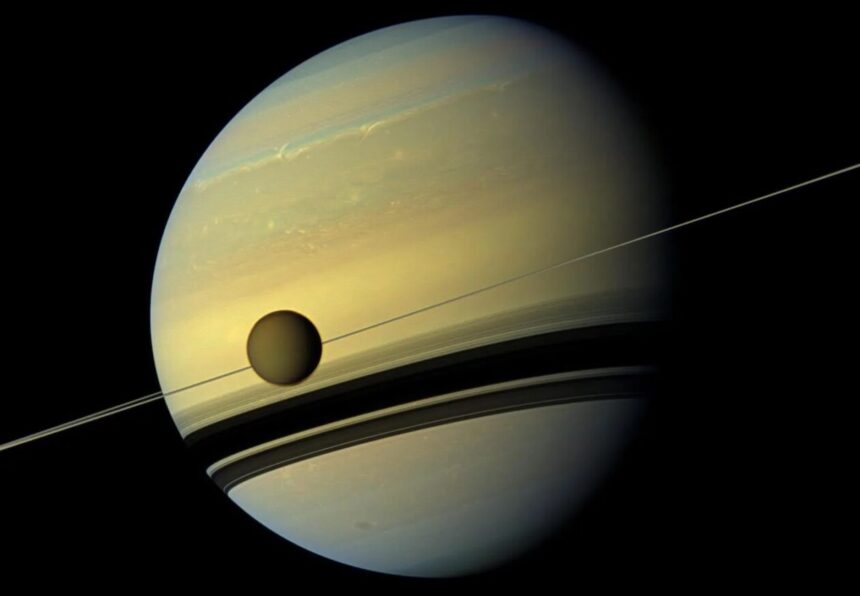
A fresh analysis of tidal perturbations on Titan challenges a long-held hypothesis: that the cloud-shrouded Saturnian moon harbors an ocean of liquid water beneath its surface ice. But the scientists behind the analysis don’t rule out the possibility that smaller pockets of subsurface water could nevertheless provide a home for extraterrestrial life.
“The search for extraterrestrial environments is fundamentally a search for habitats where liquid water coexists with sustained sources of energy (chemical, sunlight, etc.) over geological time scales. Our new results do not preclude the existence of such environments within Titan, but rather, further support their plausibility,” University of Washington planetary scientist Baptiste Journaux, a co-author of the study published in Nature, told GeekWire in an email.
Journaux acknowledged that the results don’t match up with conventional wisdom. He said they represent a “true paradigm shift” in how scientists think Titan is put together.

“When the first indications from the new data analysis suggested the absence of a global ocean within Titan, the result prompted extensive discussion, careful double- and triple-checking, and contacting colleagues outside the team for critical feedback, even before submission for anonymous peer review,” he said. “We were all surprised, to say the least.”
The hypothesis about Titan’s hidden ocean goes back to NASA’s Cassini mission, which gathered data about Saturn and its moons between 2004 and 2017. “The Cassini spacecraft’s numerous gravity measurements of Titan revealed that the moon is hiding an underground ocean of liquid water,” according to the current version of NASA’s webpage about Titan.
Journaux and his colleagues used improved, up-to-date techniques to put Cassini’s radiometric measurements through a fresh round of analysis — and came to a different conclusion.
The earlier round of research proposed that there was a layer of liquid water potentially measuring hundreds of miles in thickness, sandwiched between Titan’s outer shell of low-pressure ice and a denser layer of high-pressure ice. That hypothesis was based on the best information available at the time about how tidal stresses propagated through Titan’s interior.
In contrast, the newly published research finds insufficient evidence for a liquid layer that large. Instead, it suggests that there’s an upper layer of low-pressure ice, roughly 106 miles (170 kilometers) thick, which transitions into a 235-mile-thick (378-kilometer-thick) layer of high-pressure ice.
Pockets of slush and liquid water could exist within and between layers of ice, or between the deepest layer of ice and Titan’s core. That gives Journaux cause for hope.
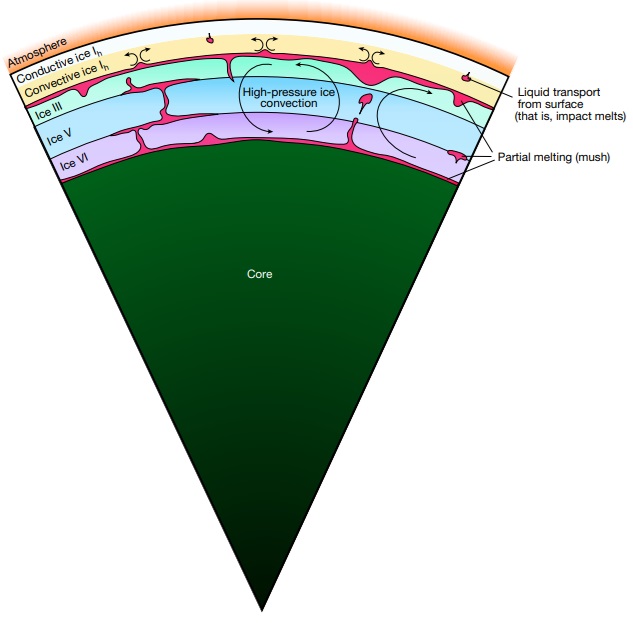
“Even a conservative melt fraction of 1% of the hydrosphere (to account for the observed tidal dissipation) would still correspond to total volumes of liquid water inside Titan comparable to that of the entire Atlantic Ocean, implying the presence of vast potential habitable spaces,” Journaux said.
Journaux pointed out that ice tends to exclude salts and other dissolved materials as it freezes, which means “these slushy, near-melting environments would be enriched in dissolved species and nutrients for life to feed on, as opposed to a dilute open ocean.”
“For these reasons, there is strong justification for continued optimism regarding the potential for extraterrestrial life on Titan,” he said.
Such life would probably be most similar to the types of organisms found in sea-ice ecosystems on Earth. “This realization helps constrain the range of plausible life forms and signatures to target, thereby sharpening and strengthening our search strategies,” Journaux said.
Titan’s interior is by no means the Saturnian moon’s only region of interest: Titan also has lakes of liquid ethane and methane, plus an atmosphere that’s rich in hydrocarbons. If life exists on the surface, most astrobiologists say it would be nothing like life as we know it today.
NASA’s Dragonfly mission, which is due to lift off from Earth in 2028 and touch down on Titan in 2034, could provide new insights about the moon’s surface conditions and its interior structure.
Looking beyond Titan, there are several other icy moons in our solar system that are thought to harbor hidden reservoirs of water, including the Saturnian moon Enceladus and three of Jupiter’s moons: Europa, Callisto and Ganymede. Those three Jovian worlds will get a close look from the European Space Agency’s Juice spacecraft (launched in 2023) and NASA’s Europa Clipper (launched in 2024).
Journaux hopes the results announced today will help other scientists get a better sense of what they should be looking for on all of these icy moons. “As our understanding of their interiors will become much more accurate and refined with upcoming missions … this result shows us how we can, with new measurements, place much stronger and more precise constraints on the types of habitable environments that may exist,” he said.
Flavio Petricca of NASA’s Jet Propulsion Laboratory is the corresponding author of the study published in Nature, “Titan’s Strong Tidal Dissipation Precludes a Subsurface Ocean.” In addition to Journaux, co-authors include Steven D. Vance, Marzia Parisi, Dustin Buccino, Gael Cascioli, Julie Castillo-Rogez, Brynna G. Downey, Francis Nimmo, Gabriel Tobie, Andrea Magnanini, Ula Jones, Mark Panning, Amirhossein Bagheri, Antonio Genova and Jonathan I. Lunine.
Read the full article here