


“All this started with a really hot summer day in ’21,” said Chris Muench, sitting in a small conference room at Hyviva, his startup based in Redmond, Wash.
The Pacific Northwest was being scorched in a heat dome and Muench’s power went out at his home in nearby Duvall. The experience led him to purchase solar panels, but he also wanted to capture the excess power that was generated when the sun was shining its brightest, socking it away for when it wasn’t.
That led Muench and his wife, Sanja, to launch Hyviva in 2023 to build modular, hydrogen-powered energy storage units that essentially produce electricity from water. This month, the business is shipping its first devices to customers.
Hyviva is initially targeting residential solar installations, a potentially ripe market as long-standing policies allowing homeowners to sell unused solar power back to utilities are being phased out in many places. That excess power can total 20% or more of a household’s daily energy generation, according to a solar trade group.
“That’s the catalyst for storage,” said Paul Owen, chief marketing officer. “You’ve got this opportunity that’s going to waste right now.”
Stored solar power can also reduce a home’s reliance on utility-provided electricity — which is getting more expensive — and keep the lights on and fridge running during power outages.
A hydrogen storage solution
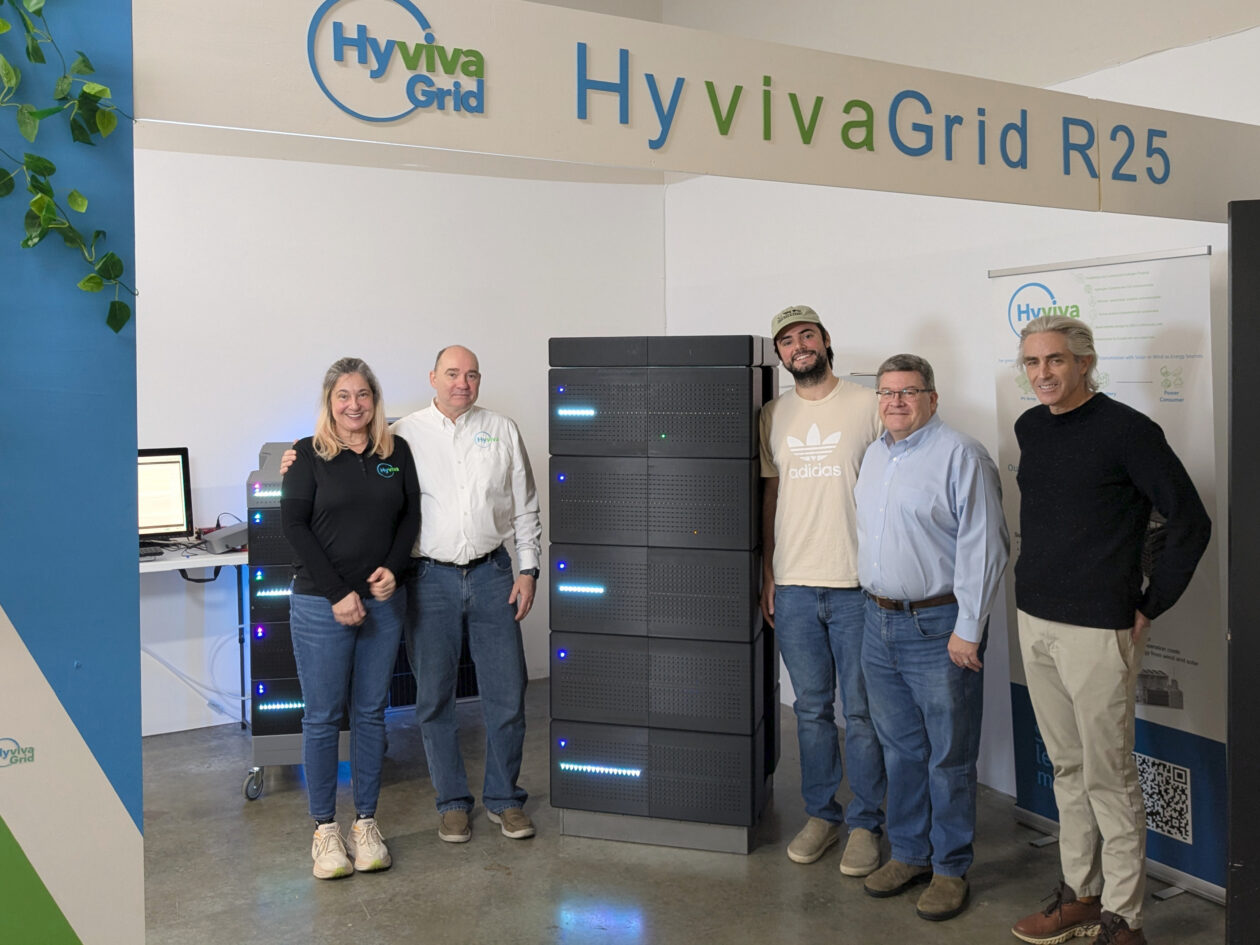
Hyviva’s device is a little narrower than a standard refrigerator, built from stacked units with a shiny black casing. Here’s how it works:
- Water plumbed into the system goes into an electrolyzer that splits it into hydrogen and oxygen.
- The hydrogen flows into slender, stainless steel tanks containing a metal that binds the gas, forming a metal hydride that stores the hydrogen.
- When power is needed, the metal hydride is heated, releasing the hydrogen that flows into fuel cells that convert it to electricity.
- All of the electrical and plumbing hardware are integrated into the structure of the unit, so installation requires little skilled labor.
- Because of their modularity, the systems are easy to expand to increase storage capacity.
“Every module can be plugged into another module without the need of a hydrogen expert,” Chris Muench said. “Just ‘Lego brick’ them together, and then you decide how much power draw do you want, how much storage do you want, how much hydrogen you want to generate.”
The five-person company is promoting its technology online and was at the CES (Consumer Electronics Show) in Las Vegas last January. Hyviva’s initial customers are in Europe and the first units are being built in Germany. The startup can also do manufacturing in Redmond for U.S. customers.
Costs and competition
Hyviva’s biggest U.S. rival is the Tesla Powerwall system that uses conventional lithium-ion batteries to hold power. The company reported $7.4 billion in revenue last year from energy generation, and that number has continued to climb.
Hyviva touts its product’s competitive features across performance, safety and longevity. The startup’s basic system holds more power — 33.6 kilowatt hours to Tesla’s 13.5 kWh. While blazes are uncommon, lithium ion batteries pose a fire risk that’s greater than the hydrogen present in a Hyviva device for short periods. And conventional batteries lose capacity over time, while the metal hydride retains its hydrogen storage capabilities for decades.
The startup, however, faces big hurdles when it comes to costs.
Tesla’s Powerwall 3 costs roughly $15,000, including the system and installation costs, while a Hyviva unit is priced at about $40,000.
But when it comes to scaling the storage capacity, the cost advantage flips as it’s cheaper and easier to add hydrogen storage to the Hyviva system. So a 90-kilowatt hour setup is about $50,000 for the startup, while the company estimates a comparable Tesla system would cost $82,000 installed.
To put the capacity in perspective, a U.S. single-family household consumes around 80 kilowatt hours of power per day on average.
The broader picture
As power demand keeps expanding globally, experts estimate that $1.2 trillion worth of battery energy storage will be needed through 2034. That escalating need is reflected in pockets of growth in the sector, including a Texas startup called Base Power that leases batteries to homeowners and recently announced $1 billion in new funding. And energy storage is being paired with data centers to reduce their power grid impacts, including at an Oregon campus that’s installing 31 megawatts of batteries.
At the same time, Hyviva and others face political headwinds at the federal level as the current administration pushes policies and budgets that hobble renewable energy companies and deployments.
But the startup is attracting interest, said Chief Operations Officer John Traynor. It has funding from an angel investor and reports having dozens of potential customers, with commercial sites and utilities reaching out as well.
“That’s given us the confidence that we’re on the right track,” Traynor said.
Read the full article here