
Seattle is witnessing a curious role reversal in its economic narrative. While the city finally gains ground on perennial challenges like crime and transportation, its traditional growth engine — the tech sector and downtown employment — is beginning to sputter.
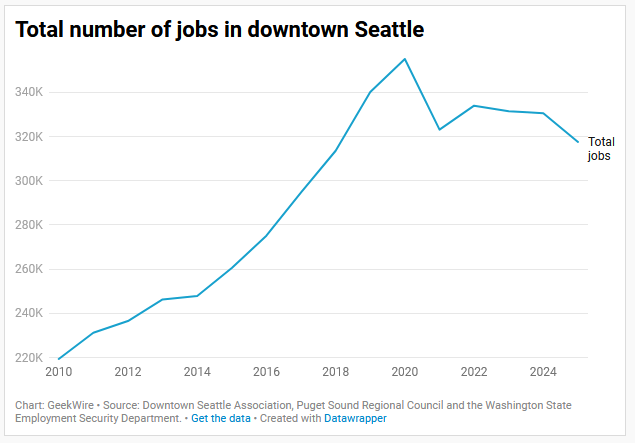
The city has for years been a tech, retail and arts hub, but its total downtown jobs peaked in 2019 with more than 340,000 workers. Since the pandemic, that number has been creeping downwards, hitting approximately 317,000 jobs — which is roughly on par with 2018 numbers, according to a new report from the Downtown Seattle Association (DSA).
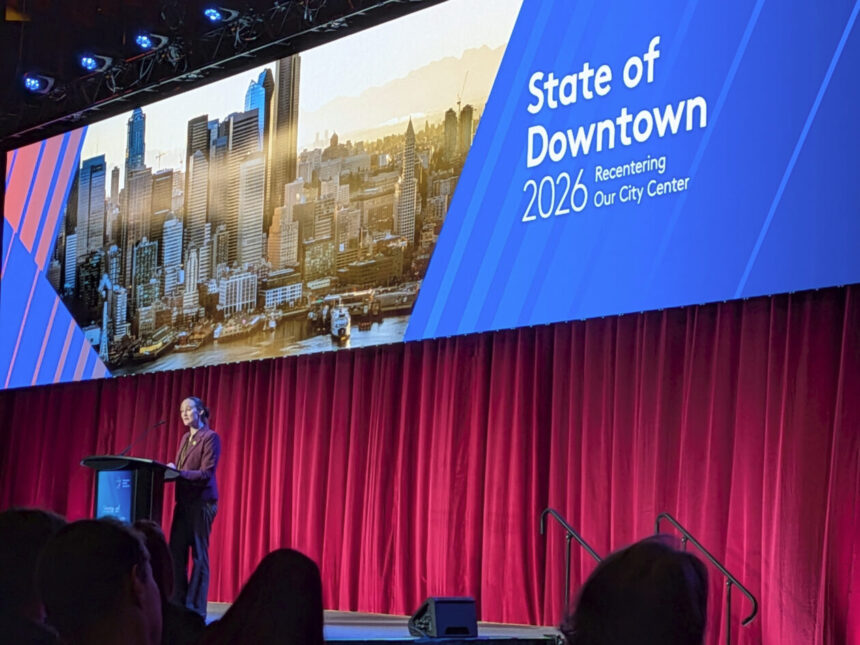
“We’re going in the wrong direction,” said Jon Scholes, DSA president and CEO, at the organization’s annual State of Downtown event on Wednesday.
“Over this period where we’ve seen a decrease in jobs, we’ve seen a record increase in taxes that employers in the city of Seattle are paying — that employers aren’t paying in Bellevue and other cities in our region,” he added. “We have become an outlier when it comes to the cost of doing business in our city.”
Those costs include the city’s JumpStart tax, which targets the payrolls of large employers with high‑earning employees, as well as last year’s restructuring of Seattle’s tax on gross revenue that shifted the burden from smaller businesses to large ones. Also on the horizon is the new state income tax on wealthier individuals that lawmakers just passed.
Taxes are taking a lot of the blame, but other major forces are at work as well. Across the country, companies are cutting headcount as AI tools replace some roles, economic uncertainty lingers, and leaders move to trim what they see as pandemic-era corporate “bloat.”
That said, key elected leaders on Wednesday acknowledged concerns about rising taxes and government budgets.
“I very much appreciate that it is not ideal for our tax environment for businesses to be wildly out of step with neighboring jurisdictions,” Mayor Katie Wilson told the packed hall at the Seattle Convention Center.
Wilson and King County Executive Girmay Zahilay both pledged to scrutinize their governments’ budgets. Wilson said she expects to make “significant” cuts and Zahilay plans to build the county’s spending plans “from the ground up” rather than following the model of rolling past budgets forward.

The fiscal caution comes even as the city’s social metrics trend upward. The 2025 DSA report highlighted several bright spots:
- Crime: Incidents and violent crimes have decreased downtown since a 2021 peak.
- Residential Growth: The number of downtown residents has reached nearly 110,000 — an 80% increase over the past 25 years.
- Visitors: More than 15.3 million unique visitors came to downtown — an increase from 2019, but flat compared to the year before. People are also visiting more frequently.
- Transit: Light rail boardings at downtown stations jumped 23% over 2024.
And yet that residential and visitor energy hasn’t yet translated into a full-scale recovery of the Monday-through-Friday workforce. Despite return-to-office mandates, daily worker foot traffic averages just 145,000 — still well below the 226,000 workers on average who filled downtown streets each day in 2019, according to DSA.
Amazon has helped with the rebound, but multiple rounds of layoffs have dampened the effect.
Once Seattle’s largest employer, Amazon recently lost that crown to the University of Washington, the Seattle Times reported. The company had a peak of about 60,000 workers in the city in 2020, but that headcount has slumped to less than 50,000. That figure could dip further as Amazon this spring is vacating a seven-story, 251,000-square-foot leased space in downtown.
Beyond the tech giants, the broader commercial landscape is struggling with a growing volume of empty office spaces. Downtown vacancies reached a new high of 34.7% in the last quarter of 2025, according to CBRE. Before the pandemic, that number was hovering around 8%.
Despite these headwinds, the contractions aren’t universal. Some firms are doubling down on the city’s core: Impinj recently renewed and increased its downtown office space while DAT Solutions and Docker both took sublease space along the city’s waterfront.
In an interview after the event, Scholes emphasized that the health of the entire economic ecosystem depends on these major anchors.
“We need big employers in the city,” he said. “I was with some small businesses earlier this week, and they said, ‘You know, our best customers are big employers. They are our lifeblood … If you’re a restaurant, if you’re a barbershop downtown, you’re relying on people in those upper floors.”
Read the full article here