
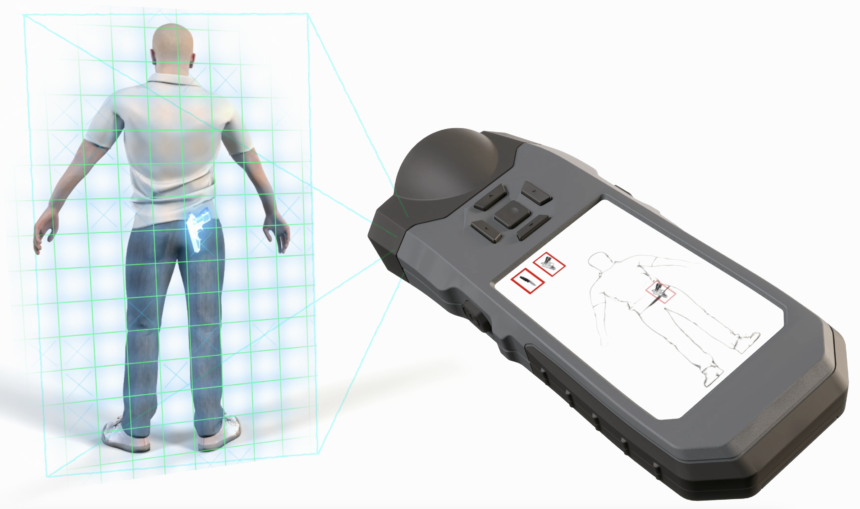
A Bellevue, Wash.-based startup is moving closer to commercialization of a handheld scanning device that it says could change one of the most dangerous and controversial procedures in policing: the physical pat-down for weapons.
Lassen Peak‘s radar-based imaging system allows officers to detect concealed guns, knives and other weapons from several feet away, without touching a person. The technology — similar to full-body scanners used in airport security checkpoints — is built around a custom-designed semiconductor chip that operates at extremely high radio frequencies, enabling detailed imaging through clothing.

Intended for use by law enforcement, military, and private venues, the device could help reduce use-of-force incidents during pat-downs — known as Terry frisks — while addressing long-standing concerns about privacy, bias and officer safety.
“We want to reduce the use of force. That’s our goal,” Lassen Peak Chairman and CEO Hatch Graham told GeekWire. “And to help build trust between society and law enforcement. Hopefully this does that. That’s our mission.”
Graham, a longtime inventor, engineer and entrepreneur, co-founded the company in 2019 alongside Chief Scientist Dr. Ehsan Afshari, a professor at the University of Michigan and an expert in ultra-high frequency microelectronics.
The company announced $10 million in debt and equity financings this week led by Menlo Park, Calif.-based Structural Capital. Lassen Peak, which was a finalist for Innovation of the Year at the 2025 GeekWire Awards, is also backed by Seattle-based Madrona Venture Group, among others, and has raised about $40 million to date.
Radar at 300 gigahertz
At the heart of Lassen Peak’s system is a proprietary imaging radar chip that operates in the so-called “terahertz gap,” at frequencies around 300 gigahertz — far higher than conventional radar used in autonomous vehicles or wireless communications.
At those frequencies, the wavelength of the signal shrinks to about a millimeter, allowing dozens of antennas to be integrated directly onto a standard chip.
The current chip integrates 24 receiver antennas and eight transmit antennas, enabling the system to capture multiple perspectives of an object simultaneously. The approach works similarly to human vision, using triangulation to infer shape and location.
“You close one eye and somebody hits you a baseball, it’ll hit you in the forehead,” Graham said. “But by having two eyeballs, you can triangulate.”
Raw radar data is processed using a combination of digital signal processing and artificial intelligence software that reconstructs images and highlights suspicious objects, such as the outline of a handgun or a knife. The system is designed to show only abstract shapes and bounding boxes, rather than anatomical details.
The system also includes a cloud-based backend that stores scan data, images and metadata such as time and location. That data can be retained for evidentiary purposes, similar to body-camera footage.
Safer alternative to pat-downs
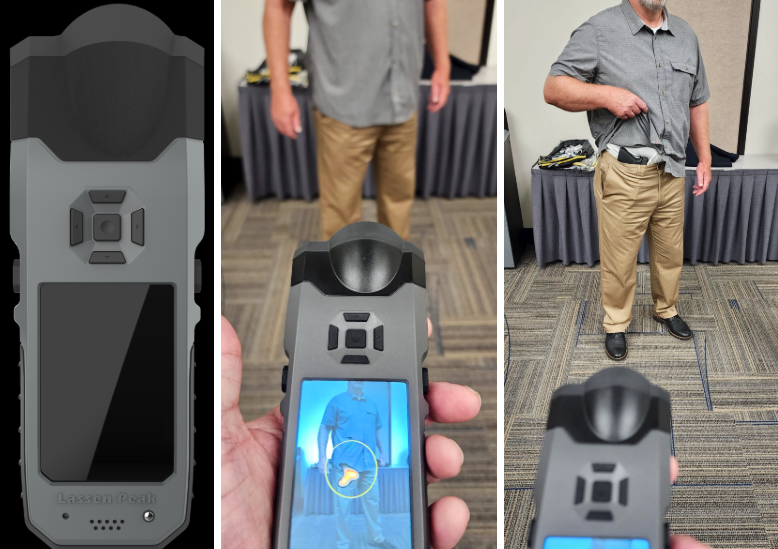
The Terry stop and Terry frisk, named for a 1968 Supreme Court case, are brief detentions and pat-downs that allow officers to conduct an outer-clothing search for weapons when they have reasonable suspicion of criminal activity.
The frisk has long been criticized as invasive and is widely regarded by officers as one of the most dangerous moments in an encounter.
It’s when officers and those being detained can get hurt, according to Carl Rushmeyer, Lassen Peak’s vice president of public safety and a former law enforcement officer.
Instead of putting hands on a detainee, an officer standing six or eight feet away can remotely scan and verify an individual using the Lassen Peak device.
“You’re still going to do a secondary search before you get them in a patrol car,” Rushmeyer said. “But this is a very, very good initial search without having to contact or touch somebody.”
Demand and next steps
Graham said Lassen Peak has been endorsed by a number of law enforcement professionals as well as rights advocates. The scanner has generated interest from law enforcement agencies across the U.S. and internationally, especially in the U.K. and countries where knife violence is a rising concern.
The company has focused on large police departments with more than 1,000 sworn officers, narrowing its initial target market to about 160 agencies nationwide. Graham said Lassen Peak has met with 62 of them in the past year.
The company has about 15 employees and another 10 consultants and is not generating revenue yet, but expects to do so through a subscription model. Lassen Peak plans to conduct demonstrations and beta testing with police departments in early 2026, with initial shipments targeted for midyear.
While the first commercial product is a handheld scanner, Lassen Peak’s long-term vision centers on the chip itself, which can be embedded into multiple platforms. These include drones that could assess a potentially dangerous situation from the air or ceiling-mounted dome cameras with “eyes” on a hospital, school, courthouse or other sensitive location.
“It has to be a product that goes out into the world and does not come back,” Graham said. “And that’s as difficult in these life-and-death applications as anything. We’re heading into 2026 and we believe we’re in the final stages of commercializing.”
Read the full article here