

I wasn’t sure it would work. When it falls, a Derelict Fortress damages every enemy in front of it, but I’ve only seen that happen when one dies. Right now, my opponent—a devil with a face like a shivering circle of little wings made of gold—has a bunch of weedy enemies in a row I’d love to drop a tower on.
The Stunted Spawn card in my hand replaces a creature with a goopy monster that has higher stats, but will playing it on my Derelict Fortress trigger that on-death effect? If a tower falls in a goo swamp, does it cause damage? I have no way of knowing, and someone’s soul is on the line if I get it wrong.
The Killing Stone’s card game has a structure right out of Slay the Spire’s dungeons, where you pick paths that might let you upgrade cards, add new ones to your deck, or choose between fighting a trivial minion battle or an elite boss battle. Fortunately the actual game doesn’t feel as much like Slay the Spire, which is rare in a deckbuilder. For starters, there are no defend cards, and block effects seem uncommon—it’s typical for most if not all of the creatures on one side of the board to get wiped every turn. It’s just a matter of how much excess damage goes through to the big eyeball that represents the owner’s health behind all those creatures.
There’s also a reserve mechanic that lets you play cards above creatures on the battleline. Maybe a spare creature that slots down into place when the one beneath it dies, or an incantation that buffs the creature beneath. Creatures in reserve still trigger effects, so if a Flask of Thoughts is safely in reserve its healing power will still go off every turn.
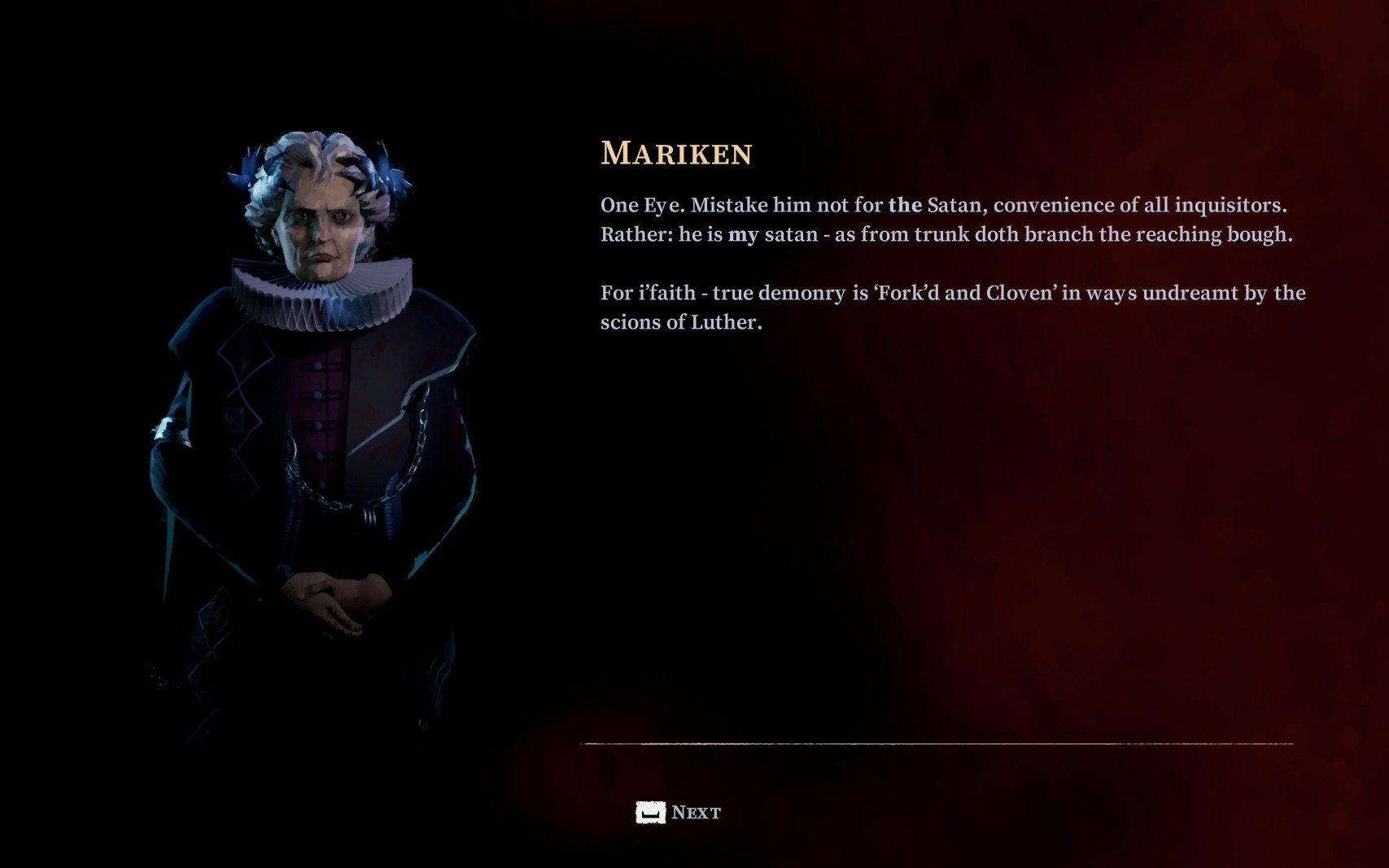
Between matches, I run around the mansion talking to the descendants of my mistress, Mariken, unwittingly caught in the infernal legal battle playing out in their basement. Mariken’s familiars are a chatty bunch, and when I pay respects to Mariken’s corpse (by pressing F, of course) she has a good natter in my ear as well.
Mariken’s voiced by Emma Gregory, who you’ll probably recognize as Minthara from Baldur’s Gate 3, while the chief devil is voiced by Critical Role’s Liam O’Brien, who has a good line in evil chuckles. Everyone else communicates purely in text. You can choose whether the dialogue—audio and text, or either individually—is delivered in old-fashioned yet broadly Modern English, or full-on 17th century Period English.
The English Lit. major in me loves this. I did eventually turn Period English off, though—at least for the text. I still get to hear Gregory and O’Brien declaiming like they’re in Hamlet, but accompanied by subtitles that present things a little more plainly. I feel like that guy from Shakespeare in Love begging Will to stop speaking in verse, but between the occult mystery I’m trying to unravel and the card game I’m trying to learn, my brain didn’t have enough leftover horsepower to also deal with people who say “perchance”.
It’s not that The Killing Stone is hard. If anything, it’s too easy, and I was only challenged once in the hours I’ve spent playing it. It’s not the difficulty of the rules, but the amount of them. There are some nodes where your familiars earn revelation points by poring over the legalese—the idea of a dog, a cat, and a bird all working together to find oversights in contract law is delightful—and those points can be spent during the bargaining rounds where you and a devil vote on which boons and banes to add to the game.
But revelations can also be spent to reroll options you’re given when upgrading your deck, which you can do either by adding new pacts or improving the ones you’ve got. Pacts are the sets of three or four cards your deck is made of—you’re rarely ditching or adding an individual card, but instead manipulating entire chunks of deck designed to encourage specific playstyles, or balance good cards with mediocre ones.
On the game board you’ll need to deal with tunneling effects, which let creatures bypass some of the opponents lined up against them, and blast ones, which let creatures damage enemies behind their target in addition to it. And sliding effects, which move them along the line. And the difference between effects that trigger on Resolve, and ones that trigger on Deploy. I haven’t even mentioned curse cards, which not only waste your time when you draw them, but also prevent you from removing pacts that contain them. Or the way each familiar has a different ability that’s set off when you discard.
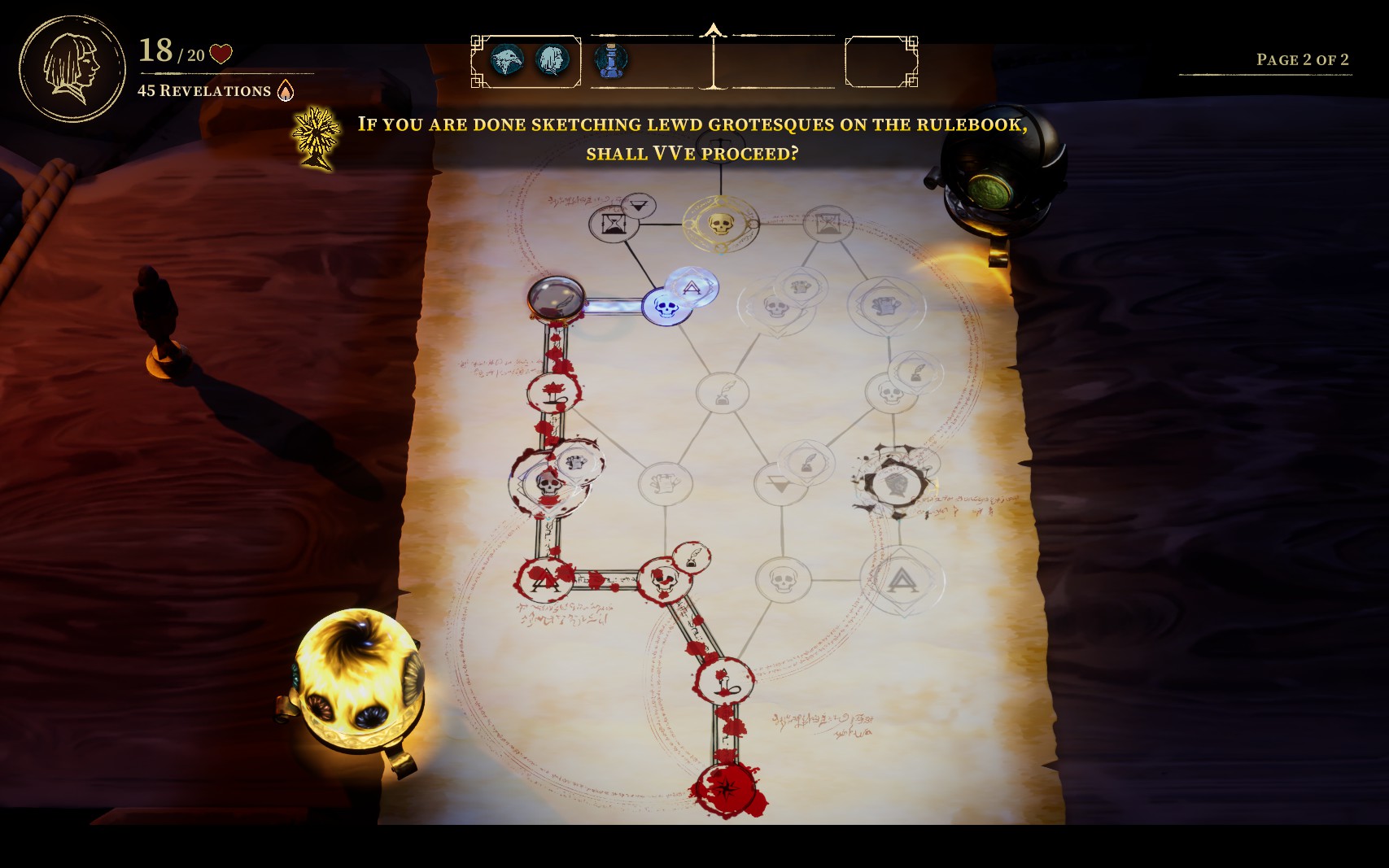
All these rules, and many more, contribute to the feeling of being a mystical accountant. But they also mean that, several hours into The Killing Stone, I still feel like I’m in a prologue. When it took time out to explain lethal effects, a real “baby’s first Magic: The Gathering keyword” kind of rule, I laughed at the screen. I keep waiting for The Killing Stone to let me do things with the mountain of rules it’s throwing at me, but only occasionally do I get to combine them like I did with the Derelict Fortress, and even more rarely do I need to. One boss battle made itself hard by forcing a card into my hand that killed one of my own creatures and which I had to play, but that felt like an external intrusion to ramp the difficulty up rather than something that emerged from the existing rules.
The Killing Stone was initially going to release in a full 1.0 version this month, but instead has been released in early access. I’m glad it was, because intriguing as the concept and story are, the pacing feels off and that’s made it a chore to play. You can check The Killing Stone out for yourself with a demo on Steam.
Read the full article here