

Mark Zuckerberg’s “The Future is for Everyone,” published last week, lays out an expansive vision for personal superintelligence built around individual empowerment, invention, and the broad distribution of AI capabilities. Rather than concentrating advanced AI in the hands of governments, corporations, or a handful of technology providers, Zuckerberg argues that individuals should have access to powerful AI agents aligned with their own goals and values.
It is an ambitious vision, but it also asks readers to place considerable faith in Meta as one of the companies capable of delivering it. That creates an obvious tension. Meta is one of the world’s most powerful technology platforms, built largely on advertising, massive-scale data collection, and proprietary consumer services. The company advocating against excessive concentration of AI power is itself among the companies most capable of accumulating that power.
Let’s examine whether Zuckerberg’s vision can truly put more AI power in individuals’ hands without giving Meta even more control. Then we’ll close with my Product of the Week: a business laptop designed to support more AI processing locally.
Meta’s History Complicates Zuckerberg’s Vision
Zuckerberg’s argument for distributing AI power runs headlong into Meta’s own history. Facebook and Instagram are enormously successful platforms, but they are not examples of decentralized consumer technology. Meta controls their algorithms, interfaces, advertising systems, recommendation engines, and the rules governing access to their audiences.
That history does not invalidate Zuckerberg’s argument for personal superintelligence. It does, however, justify skepticism about who ultimately controls the infrastructure. Zuckerberg argues that concentrating superintelligence among a small number of businesses, governments, or individuals would produce outcomes less favorable to everyone else.
Meta itself is one of the relatively small number of companies with the capital, computing infrastructure, models, data, and global distribution needed to develop AI at this scale.
The important question, then, is not whether Meta supports open-source AI. It is how much meaningful control individuals would retain over their agents, data, models, and digital identities if Meta became a primary provider of personal superintelligence.
Who Controls the Personal AI Agent?
Zuckerberg envisions personal agents that understand their users’ goals, interests, health, finances, relationships, and other aspects of their lives. These agents would operate continuously, potentially becoming far more intimate intermediaries than today’s social networks or smartphone applications.
Zuckerberg says these agents will include strong privacy and security protections, and Meta plans to offer a fully private mode in which even the company cannot access a user’s information. That is an important commitment. It also highlights how consequential the underlying architecture will be.
If a personal AI agent becomes the interface through which people communicate, shop, work, learn, and make decisions, control over that agent could become more important than control over today’s operating systems or social platforms. Users would need meaningful control over their data, a clear understanding of how the agent operates, and practical ways to move their information elsewhere.
Personal superintelligence cannot genuinely empower individuals if changing providers means abandoning the digital history and knowledge that make an agent personal in the first place.
Personal AI Creates New Forms of Dependency
Zuckerberg is right that concentrating advanced AI within a few institutions creates risks. Distributing AI widely, however, does not automatically eliminate concentrated power if the models, computing infrastructure, identity systems, or distribution platforms remain controlled by a small number of companies.
Personal AI agents could become extraordinarily influential because they would do more than display information. They could recommend purchases, draft communications, manage schedules, conduct transactions, filter information, and increasingly act on a user’s behalf. The company operating that intermediary would occupy an unusually powerful position between individuals and the digital economy.
This makes transparency around incentives particularly important. If personal agents eventually incorporate advertising, commercial recommendations, or other monetization mechanisms, users will need to know when an agent is acting solely in their interests and when commercial considerations are influencing its recommendations.
Zuckerberg’s balance-of-power argument therefore needs to extend beyond access to AI. Individuals also need meaningful control over the agents acting on their behalf.
Digital Sovereignty Matters
Zuckerberg’s vision ultimately depends on whether personal superintelligence gives individuals more control or simply creates a more capable intermediary between people and the digital world.
Users should be able to control what personal information their agents retain, understand how that information is used, move their data between services, and choose alternatives without unreasonable technical or economic barriers. Open models can contribute to that goal, but openness at the model level does not by itself guarantee user autonomy.
The strongest version of Zuckerberg’s vision would therefore require more than broadly available AI. It would require meaningful portability, privacy, transparency, and user control throughout the technology stack.
Wrapping Up
Mark Zuckerberg’s manifesto raises the right fundamental question: Who should control increasingly powerful AI? His answer — broadly distributing that power to individuals rather than concentrating it within a handful of institutions — is appealing.
The unresolved question is whether Meta can help create that future without accumulating the kind of concentrated power Zuckerberg warns against. Open models are part of the answer, but genuine individual empowerment will also require privacy, portability, transparency, competition, and meaningful control over personal AI agents.
Zuckerberg argues that superintelligence can put more power in people’s hands. The measure of that vision will not be how widely Meta distributes AI, but how much control people retain after they receive it.

HP EliteBook X G2i 14
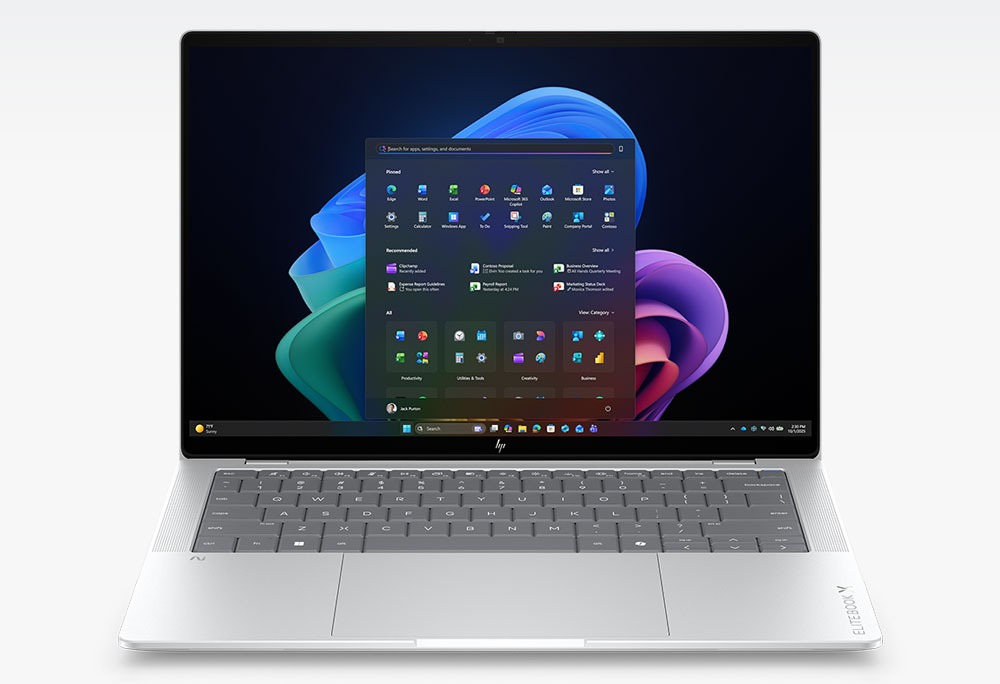
HP EliteBook X G2i in Glacier Silver (Image Credit: HP)
The HP EliteBook X G2i 14 is an ultraportable business laptop that combines strong performance, enterprise security, and support for running AI workloads locally. After using the Intel-based model, I found it particularly compelling for business users who want more processing to take place on the PC rather than relying entirely on cloud services.
The EliteBook X G2 family is available with Intel, AMD, and Qualcomm Snapdragon processors, giving buyers a choice of architectures for different performance, AI, and mobility requirements. The G2i model I tested uses Intel Core Ultra silicon.
The G2i is built around Intel Core Ultra processors, with integrated graphics and an NPU rated at up to 50 TOPS for supported AI workloads. Depending on configuration, the G2i supports up to 64GB of memory, giving the system enough headroom for demanding productivity work and some AI processing directly on the PC.
Portability is another strength. HP says some G2i configurations weigh less than one kilogram, making this an unusually light enterprise laptop for its performance class. Battery life varies substantially with configuration and workload, but the combination of low weight and long-running design makes the G2i well suited to frequent travel.
A convertible EliteBook X Flip G2i is also available for users who want tablet, tent, and presentation modes, although I did not test that version.
Display choices include bright, privacy-focused Sure View panels and OLED options for users who prioritize contrast and image quality. I particularly like the 800-nit Sure View configuration for its combination of brightness and integrated privacy features.
Enterprise Security and Serviceability
Security is a major part of the G2i’s enterprise positioning. HP Wolf Security for Business combines hardware-enforced protections with defenses operating from the BIOS through the operating system and browser, helping protect the PC against a range of modern threats.
Serviceability is another focus in the G2 generation. A top-mounted keyboard is designed to be easier for IT departments to replace, potentially extending the useful life of deployed systems. According to HP, more than 80% of the machine’s major parts contain recycled materials.
The EliteBook X G2 is available in Eclipse Gray, Glacier Silver, and Atmospheric Blue. HP sent me the Atmospheric Blue model, which is my favorite of the three. It gives the machine a distinctive appearance while remaining appropriately understated for a business laptop.
The configuration featured on HP’s product page was selling for $3,329 at the time of publication.
The EliteBook X G2i combines strong local processing capability, enterprise-grade security, excellent portability, and unusually good serviceability in a polished business laptop. For users who want more AI processing to happen locally while retaining the flexibility of a conventional Windows PC, it is an impressive package — and my Product of the Week.
Read the full article here