

The tradition of using new technology to shape political discourse goes back centuries in America, to the printing presses that enabled the spread of early publications like Common Sense and the Federalist Papers. Just imagine what Thomas Paine and Alexander Hamilton could have done with access to LLMs and a modest budget of AI tokens.
It might have looked something like Culliton2026.org.
No, a website that uses artificial intelligence to assess Washington state’s Supreme Court races won’t go down in history alongside the publications that helped launch a revolution and ratify a constitution. But at a basic level, its creator is attempting the same thing: reaching people at a key moment of decision, using the most powerful tools of the day.
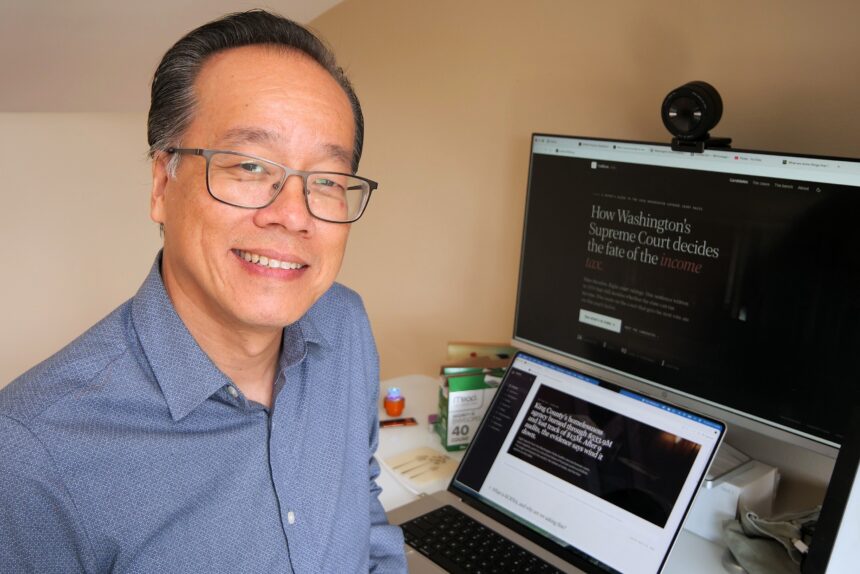
The modern-day pamphleteer is Viet Nguyen, a veteran Seattle-based technology communications executive and former political campaign manager.
He built the interactive website using AI to give voters a sense of how each candidate for the state’s high court — starting with those in the Tuesday, Aug. 4, primary — might rule on the state’s new “millionaires’ tax.” Its core feature lets visitors swap in different judicial candidates to see how the outcome could tip the court in either direction, depending on who’s elected.
The site is named after Culliton v. Chase, the 1933 ruling that struck down a graduated income tax in Washington state. The new tax, which some tech and business leaders have warned could drive high earners and businesses out of state, may test that precedent.
Nguyen opposes the new tax — which would apply a 9.9% statewide levy on income above $1 million — and wrote a Seattle Times op-ed calling it unconstitutional. (He noted that he has run political campaigns on both sides of the aisle, and wouldn’t owe the tax himself.)
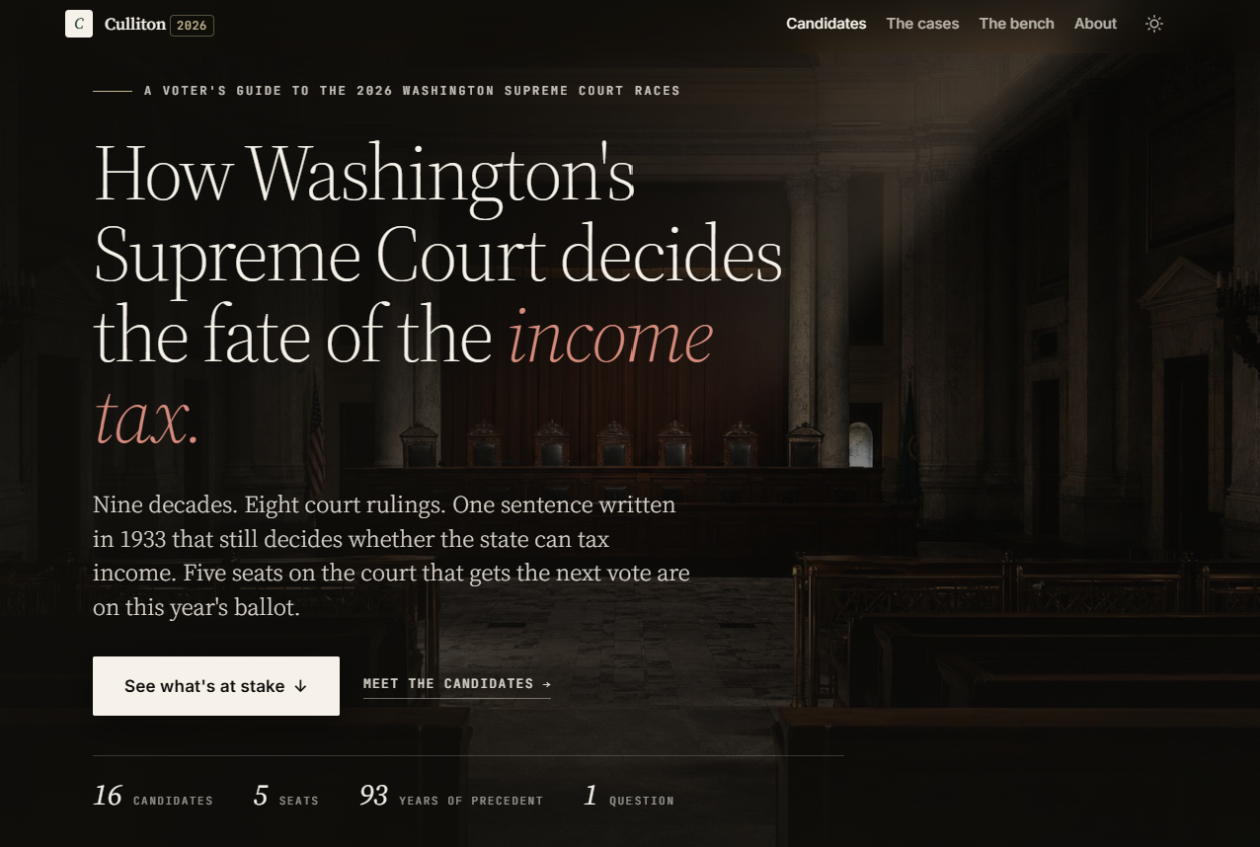
For each of the 16 candidates across the five races, the site gives a one-line read: likely to keep the landmark ruling, likely to scrap it, or too close to call. The analysis uses four criteria: who appointed the candidate, what they did before reaching the bench, how they describe their own judicial approach, and anything they’ve said or written about Culliton or the new tax.
“People don’t understand who their Supreme Court justices are,” Nguyen said, describing his motivation. “There’s just zero knowledge about where judges stand on a particular issue.”
A faulty premise? But that very proposition — that anyone or anything can forecast how a judge will rule — is exactly what critics dispute. In a fact-check published last week, Andrew Villeneuve of the Northwest Progressive Institute (NPI), which supports the tax, described Nguyen’s Culliton2026.org as “speculation dressed up as a voter’s guide.”
Judicial-ethics rules bar candidates from saying how they would rule on a case that could come before them. Hugh Spitzer, a retired University of Washington law professor and a leading authority on Culliton, told Villeneuve it isn’t possible to predict how the justices would rule.
“Rather than examining and scoring the candidates on a rubric of qualifications or issues, Nguyen has organized his whole project around attempting to guess how each candidate would rule in a single legal challenge that is not yet before the justices,” wrote Villeneuve, the organization’s founder and executive director, in the article.
NPI runs its own guide to the 2026 Supreme Court elections — the Washington State Supreme Court Elections Visualizer — which sorts candidates by their endorsements and voter-pamphlet statements, but does not make any guess at how they’d rule.
Culliton2026.org is described on its About Page as independent and nonpartisan. It says it doesn’t endorse candidates, isn’t affiliated with any campaign, and isn’t telling people how to vote.
Despite the site’s flagship feature — the “Balance of power” tool that lets visitors swap in candidates and watch the projected ruling shift — the About Page asserts that the site is “not a vote predictor” when it comes to how future Supreme Court justices might rule.
That disclaimer “seems like a tacit acknowledgment that his whole premise is faulty,” Villeneuve wrote in the NPI piece.
The response: Asked about the article, Nguyen called the feedback helpful and said he made a series of updates to address some of the issues raised by Villeneuve in the piece.
For example, he added a “note on the foundations” to the site’s case explainer, granting that Culliton rests on federal precedents the U.S. Supreme Court has since abandoned, and citing Spitzer’s own argument that a future court should weigh the question fresh.
“Reasonable people will disagree on the project’s premise, and that’s fine,” he wrote to Villeneuve in an amicable exchange that he shared with GeekWire.
The article describes Nguyen as right-wing, but he said he tries to stay “in the moderate lane.”
He said he wanted the site “to be less political and more educational, applicable to any voter wishing to know more about the judicial candidates.” In fact, it could be used just as easily by people wanting to align their ballots with the likelihood of upholding the new tax.
How he built it: Nguyen, who is not a software developer, used agentic AI to research the public records and build the entire site from scratch, directing it to rely on sources he considered legitimate (including court opinions, official filings, and news coverage) rather than random blog or Reddit posts.
He also set up a vetting process to fact-check entries before publication.
Nguyen uses Perplexity Computer, an agentic tool that operates a computer on its own (browsing the web, using software and building files) and divides a job among multiple AI agents working in parallel. He’s on the $200 a month Perplexity Max plan.
A sophisticated website or app like this might have required a small team and thousands of dollars in the past. Nguyen built it over the course of a few hours, for about $100 in AI tokens. He says it has attracted “a few hundred thousand page views” since its launch this spring.
“This is where agentic AI steps in and offers a whole roster of skills that I don’t have,” he said. “I would never be able to imagine that I could put something like this together.”
Legal landscape: The Legislature passed the 9.9% tax and Gov. Bob Ferguson signed it in March 2026. It applies to income earned starting in 2028, with the first payments due in 2029.
Culliton2026.org’s assessment is that six of the nine current justices on the court lean toward upholding the tax, two toward striking it down, and one is too uncertain to call.
Five of the court’s nine seats are on the ballot this year, four of them contested in Tuesday’s primary, with the top two in each race advancing to November. Three of the seats on the ballot are held by sitting justices seeking to stay on the court; the other two are open.
A case filed in Klickitat County Superior Court in April, led by former state Attorney General Rob McKenna and former state Supreme Court Justice Phil Talmadge, argues the tax is an unconstitutional income tax and is expected to reach the state Supreme Court. The number of contested seats means the election could reshape the court before the case arrives.
Voters will also weigh in directly in November. Initiative 645, backed by Let’s Go Washington — the group founded by hedge-fund manager Brian Heywood — would repeal the tax before it takes effect in 2028. It qualified for the ballot in July with more than 500,000 signatures.
Nguyen’s background: He arrived in Washington as a 17-month-old refugee from Vietnam in 1975, studied political science at the UW, and got his start in 1996 volunteering on Gary Locke’s campaign for governor, as he noted in the Seattle Times piece.
He ran local races before spending nearly two decades at Microsoft, T-Mobile and 5G Americas, the wireless industry trade group that he led until it wound down this year.
Culliton2026.org is just one of the civic sites Nguyen has built the same way. His Washington Accountability Registry catalogs 87 state and local government cases it labels fraud, conflicts of interest or oversight failures, and, like the Culliton site, calls itself independent and nonpartisan.
Others are more explicit in taking a side: a dashboard about the King County homelessness authority is headlined “One verdict: wind KCRHA down,” and an emergency-clause tracker titled “Locked Out” flags 19 bills the Legislature made “referendum-proof.”
He has also dabbled in AI-generated music videos, including one about Seattle Mayor Katie Wilson with the hook, “Hey Katie, get it together, the city’s falling apart.”
“All AI generated,” Nguyen said of his projects. “We live in a new world.”
Or, as Paine put it in Common Sense, “The birthday of a new world is at hand.”
Read the full article here