
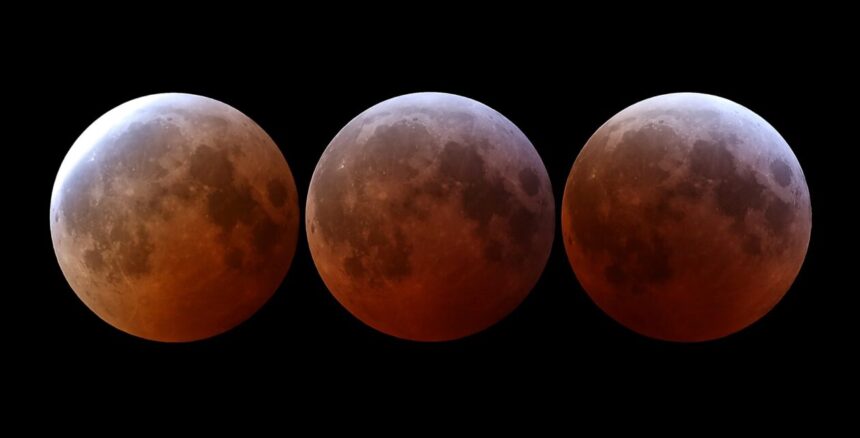
Tonight’s full moon will turn into a red moon during the last total lunar eclipse we’ll be able to see for the next two years — but whether we’ll truly be able to see it with our own eyes depends on the weather. And that’s an iffy proposition for Pacific Northwest skywatchers.
The good news is that total lunar eclipses, unlike a total solar eclipse, can be seen from an entire hemisphere at a time. They occur when the orbital mechanics are just right for Earth to pass directly between the moon and the sun. For about an hour, Earth’s shadow blots out the sun’s rays, except for reddish wavelengths that are refracted by our planet’s atmosphere. That’s what lends the moon its blood-red color.
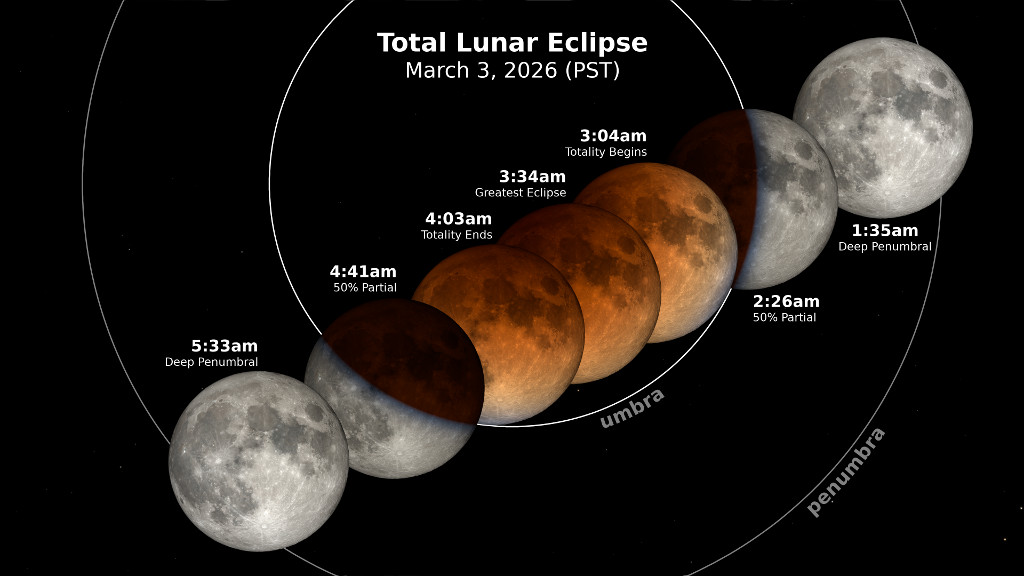
Tonight’s eclipse begins with a barely discernable penumbral phase at around 1:30 a.m. PT Tuesday, gets into its partial phase at 1:50 a.m. and enters totality at 3:04 a.m. The eclipse’s total phase ends at 4:03 a.m., and the partial phase winds down over the following hour or two.
The bad news, at least for night owls in the Seattle area, is that the skies are projected to cloud over just before the eclipse starts. To check the National Weather Service’s graphical forecast, follow this link and select “Sky Cover” for the desired time (1 to 4 a.m. PT Tuesday). The chart at ClearDarkSky.com can provide a second opinion. (Look at the “Cloud Cover” and “ECMWF Cloud” categories.)
Seattleites who are desperate to witness totality can improve their chances by heading east.
Looking ahead, there’s an almost total lunar eclipse on tap for August, but the next true dose of lunar totality is due to hit in 2028 on New Year’s Eve — and for what it’s worth, skywatchers in Seattle won’t be able to see the total phase.
Read the full article here