

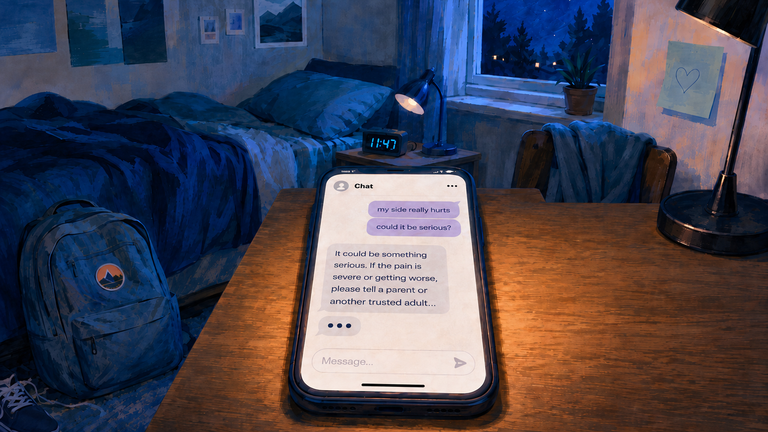
Kids are heading back to school across the country with a tool in their pocket that will do their homework, answer the questions they’re too embarrassed to ask an adult, and never tell anyone they asked.
MIT Technology Review asked kids aged 10 to 18 what they make of AI. Their answers had me plowing through every survey and interview with kids about AI I could find. Plenty of what kids do with it is ordinary: looking things up, homework, messing around.
This article is about the parts they keep to themselves.
1. Kids are taking their mental health to a chatbot, and telling nobody.
Nearly one in five Americans aged 12 to 21 has asked a chatbot for help when feeling sad, angry or nervous. RAND puts it at 8.2 million young people, and 63% of them told no one at all.
The silence is a calculation about what adults would do, as one teenager explained to YouGov’s researchers.
The most vulnerable kids use chatbots more.
- Internet Matters found that British children with a health condition requiring professional help are nearly three times as likely to use companion bots like Character.AI or Replika.
- A third of all child users say chatting with a bot feels like talking to a friend, and among the vulnerable that figure goes up to half.
- One in eight of all child users says they talk to a chatbot because there’s no one else, and among the vulnerable it’s nearly one in four.
2. Kids see both sides of AI in school.
Some teenagers see AI as a shortcut past the hard parts of schoolwork.
Others describe using it the opposite way.
Between May and December 2025, RAND watched homework use among middle school, high school and college students climb from 48% to 62%. Over a slightly longer stretch, from February, the share saying AI harms critical thinking climbed from 54% to 67%. The same students can hold both thoughts at once.
The Concord Monitor interviewed eight New Hampshire high schoolers this spring. They weren’t outraged at their classmates, but they described losing motivation to do the work themselves. One in ten teens tells Pew they do all or most of their schoolwork with a chatbot’s help.
Caledonia Mahon, a Concord High senior, watched a classmate stand up and admit he’d had ChatGPT write a personal reflection, and started wondering why she was still writing her own.
Her classmate Andrew Pfitzenmayer supplied the detail I can’t get out of my head, about a boy in his advanced history class.
Yet, the same technology can be positive for kids who don’t have much else.
By May 2025, 84% of American high schoolers were using AI for schoolwork at least occasionally. The kids who lean on it hardest have the least support around them, which is why telling them to quit doesn’t work.
If quitting isn’t the option, what’s left is changing what the tool does when a kid opens it. Two Seattle startups are trying that.
- Wild Zebra, started in 2024 by Edan Shahar and Erik Selberg, makes a math and reading tutor for grades 2 through 9 that answers a stuck student with a question instead of a solution. It’s gone from about 6,000 students in four pilot schools a year ago to tens of thousands now, and raised $6 million in August.
- Maximal Learning, built by Microsoft veterans Eran Megiddo and Liviu Asnash, ships an app called Wick that coaches planning, time management and study habits rather than producing homework. Neither company pretends teenagers will stop bringing AI to their assignments. Both are built so the student still has to do the thinking.
3. Kids are writing the rules adults haven’t.
Suspicion of AI runs strongest among the kids furthest from it: 78% of students who don’t use AI say it harms critical thinking, against 60% of those who do.
In July, 98 high schoolers from all 50 states spent three days in a replica of the U.S. Senate chamber in Boston and passed what Congress hasn’t. Their STUDENTS FIRST Act requires AI literacy, bars teachers from letting AI decide a grade on its own, lets a teacher ask a student to defend suspected work out loud, and gives any student the right to an alternative to an AI assignment.
A majority of educators told Education Week’s Research Center last fall that their district has no AI policy, or that they don’t know whether it does. At least seven states have a comprehensive one, by Education Week’s count.
Ashley Kannan has taught social studies for almost 30 years in Oak Park, Ill. He planned to ignore AI, then noticed that every conversation about it in his building was about catching students. He recruited nine eighth graders to spend a year working out what AI was actually good for. In April they briefed 60+ teachers and parents on the rules they thought were needed.
Hazel is 17, a rock climber in New York who wants to be an ecologist. She won’t touch AI, and her reason is specific: what data centers do to the water supplies of the towns they’re built in. Asked what advice she’d give other kids, she gave four words.
Hazel can afford that advice. Most kids can’t.
So the practical alternative is narrower than just telling them to quit: ask them what they use AI for, ask what they’ve decided not to use it for, and don’t make an honest answer cost them the tool. Right now 61% of young people say their parents rarely or never talk to them about AI, and 53% say the same of their teachers.
Hazel may walk away from AI. But Amira, describing a pain in her side to a chatbot, may not, and the odds are nobody in her house knows she’s doing it.
Read the full article here