

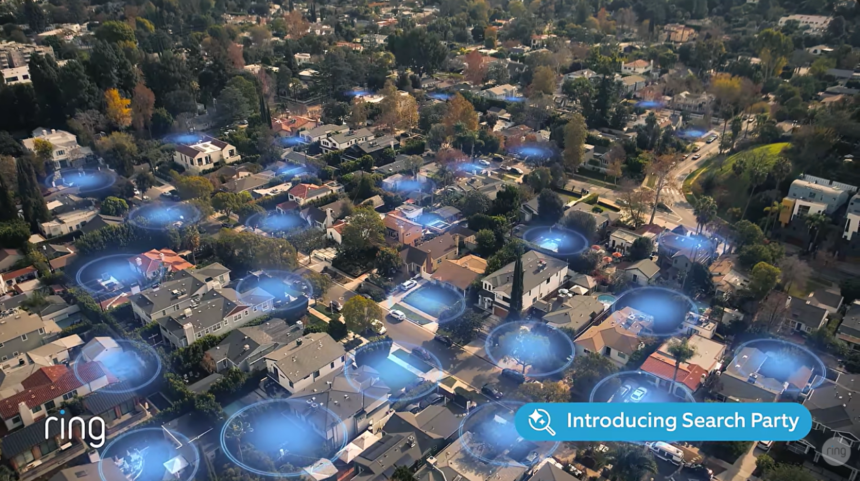
Reuniting families with their lost pooches, what’s not to like? Well, coordinated neighborhood surveillance, for one.
That sums up the reaction to the Super Bowl ad for Search Party, the AI-powered feature from Amazon’s Ring that mobilizes outdoor cameras across a neighborhood to help find lost dogs.
Search Party raised privacy concerns when it launched last year, focusing in part on the fact that the feature is turned on by default in eligible cameras, requiring users to opt out. But as with most things, the spotlight during the biggest game of the year took it to a whole new level.
Here’s how it works: When someone reports a lost dog in the Ring app, nearby outdoor Ring cameras with the feature enabled use AI to scan their saved footage for a potential match.
If a camera spots something, the camera’s owner (not the owner of the lost dog) gets a notification. They then decide whether to share the clip with the dog’s owner. Nothing is shared automatically. The search is temporary, expiring after a few hours unless renewed.
That kind of subtlety doesn’t exactly translate to a 30-second Super Bowl spot. But even with a fuller understanding of how it works, critics aren’t buying it. The ad is being tagged as “creepy” and “dystopian,” with critics pointing out the obvious: if Ring’s AI can scan a neighborhood’s cameras for a specific dog, what’s to stop it from doing the same for a specific person?
For the record, Ring says Search Party is not designed to process human biometrics, and that Search Party footage is not included in the company’s Community Requests service, which allows law enforcement to request video for voluntary sharing by Ring users.
In an interview with GeekWire last year, Amazon VP and Ring founder Jamie Siminoff described the Search Party feature as a breakthrough made possible by advances in AI, saying it couldn’t have been built at reasonable cost even two years ago.
Asked how the company was balancing these kinds of benefits against privacy concerns, he said Ring’s approach is to give customers full control. “You don’t balance it,” he said. “You give 100% control to your customers. It’s their data. They control it.”
But for critics, the issue isn’t really about what Search Party does now. It’s about what the underlying technology could be used for down the road.
That concern is amplified by Ring’s own recent moves. The company has also rolled out Familiar Faces, which lets users register images of family and friends so their cameras can identify specific people, but limited to those the camera owner knows.
Ring’s partnership with Flock Safety, the license-plate-recognition company used by thousands of police departments, is another lightning rod, even though Ring says the integration isn’t live yet. The partnership is part of Ring’s Community Requests tool, which lets local law enforcement request footage from nearby Ring users during active investigations. Users can choose to ignore those requests.
The company says it has no partnership with U.S. Immigration and Customs Enforcement and does not share video with the agency. But civil liberties groups, including the ACLU, have raised concerns that once footage reaches local police, there’s no guarantee it stays there, particularly given reports that some Flock-connected departments have performed lookups for ICE.
Siminoff, who returned to lead Ring last year after a hiatus, has been open about re-embracing the company’s original mission of making neighborhoods safer, including reinstating partnerships with law enforcement that had been scaled back during his absence.
In the GeekWire interview, he acknowledged that not everyone inside the company was on board with the shift, but said he’s “very convicted on the impact that we can have with Ring,” and on a much faster timeline than he might have thought in the past, due to AI.
Amazon says Search Party has reunited more than one lost dog a day with their families since launch. It’s committing $1 million to equip animal shelters with Ring cameras. But the bigger question fueling the backlash is whether finding lost puppies today is building the infrastructure for something less cute and cuddly in the future.
Read the full article here