
Adobe Summit 2026 made one thing clear: Adobe refuses to be seen as nervously adding AI to legacy products. It intends to build the operating model for customer experience and marketing in the agentic era.
That is a big swing.
To Adobe’s credit, the event did not feel like a vague AI pep rally. The company came to Las Vegas with a sharper story, more connective tissue between creativity and marketing, and a stronger read on where enterprise budgets are headed next.
The headline was “Adobe CX Enterprise,” which Adobe framed as an end-to-end, agent-based AI system for managing the customer lifecycle from acquisition to loyalty. That positioning matters because Adobe is no longer just talking about tools. It is talking about systems, governance, orchestration, and business outcomes.
Big Bet on Customer Experience Orchestration
The dominant theme of the event was clear: customer experience orchestration is the new battleground. Adobe President of Customer Experience Orchestration, Anil Chakravarthy, said, “Customer experience orchestration in the era of AI is here now.” Adobe believes AI will not just accelerate tasks — it will change how brands plan, create, deliver, personalize, and measure across many channels.
This framing is smart. It moves the conversation away from comparing image models. Adobe prefers to compete on workflow gravity, enterprise context, and execution across the stack — a stronger position overall.
Adobe Wants to Bridge Creativity, Marketing, and AI
The second theme: Adobe aims to integrate creativity and marketing into a single system. These worlds have talked but rarely worked together. Summit 2026 was the company’s attempt to erase that boundary. Adobe CEO Shantanu Narayen said there’s a need to “unify creativity, marketing and AI across the entire content lifecycle, from ideation to creation to personalization, orchestration and measurement.”
That’s not only a product roadmap — it’s the event’s thesis. You could see that in the Firefly announcements as well.
Adobe described Firefly as an “AI-first creative studio” as it unveiled a new Firefly AI assistant that lets creators direct complex multi-step workflows through an interactive interface. The point wasn’t merely faster image generation — it was collapsing the distance between intent and execution while keeping creators in control.
Adobe President David Wadhwani called this “a new era of agentic creativity,” and that phrase matters because Adobe is trying to position AI less like a slot machine and more like an intelligent production partner.
Brand Governance Matters More in the Agentic AI Era
That leads to the third big theme, and one of the more credible ones. Adobe knows speed alone is not enough. Narayen said, “Winning isn’t just about producing the most content. It’s actually about producing the right content on brand, at scale.” That is exactly the right argument for this market. The AI era is not creating a content shortage. It is creating a quality control nightmare.
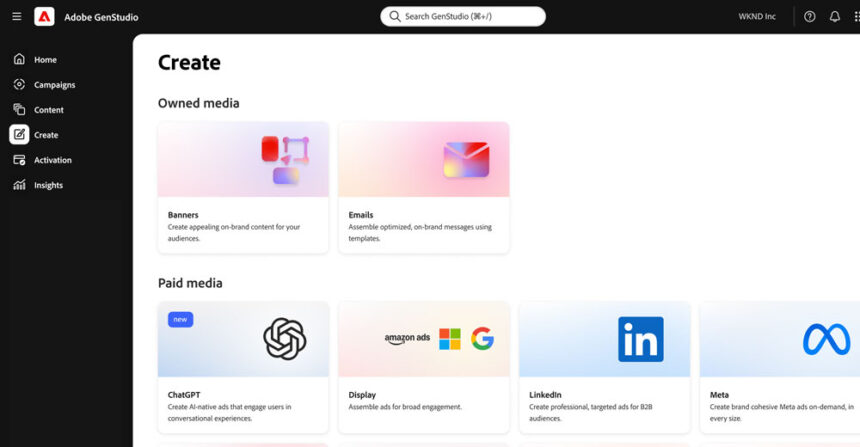
Adobe’s answer is Brand Intelligence and the expanded GenStudio content supply chain story.
Brand Intelligence is designed to move companies past static brand books into a living system that learns from approvals, rejections, annotations, and review-cycle feedback. In plain English, Adobe wants to turn brand governance from a PDF no one reads into a machine-readable context that agents can actually use. That is one of the more practical ideas to come out of Summit because enterprise AI falls apart fast when every output still has to be manually corrected by a brand team.
Varun Parmar, GM of Adobe GenStudio and Firefly for Enterprise, made the case clearly, saying the campaign process has long been “hampered by inefficient processes and broken workflows,” and Adobe is trying to fix that by unifying “brand intelligence, agentic automation and AI-powered workflows.”
That sounds like classic enterprise messaging, but in this case, it hits at a real pain point. Most marketing organizations do not have an AI problem. They have a workflow problem disguised as an AI problem.
Another part of this theme is trust. Adobe repeatedly emphasized governance, accountability, context, and commercial safety. That was not accidental. In an enterprise environment, the fastest model does not automatically win. The model or workflow that keeps legal, brand, and compliance teams from melting down has a very good shot at succeeding.
Open Ecosystems, Real Workflows, and the Pressure to Prove It
A fourth theme was openness and ecosystem pragmatism. Adobe does not expect to win by forcing customers into a closed system; instead, the company stressed interoperability.
Adobe CX Enterprise spans Adobe and partner environments, with expanded partnerships with AWS, Anthropic, Google Cloud, IBM, Microsoft, Nvidia, OpenAI, major agencies, and systems integrators.
Adobe VP of Ecosystem Development, Amit Ahuja, said marketers should not have to choose between enterprise AI tools and marketing outcomes. Adobe intends to bridge that gap with integrations and workflow extensibility.
This is where Adobe looked disciplined rather than defensive. The market has changed. No large enterprise is going to run on a single model, agent framework, workflow tool, or data environment. Adobe appears to understand that the real prize is becoming the layer that gives those moving parts commercial context, governance, and measurable output.
Nvidia CEO Jensen Huang reinforced that worldview from a different angle when he said, “The user interface of the future, all the front end of SaaS, is now agentic.” That comment landed because it supports Adobe’s broader argument that the interface is changing, but the enterprise still needs trusted systems underneath it.
AI Discovery Changes Brand Visibility
Another important angle was the rise of AI-mediated discovery and the growing importance of brand visibility inside LLM-driven environments. This may have been one of the most interesting parts of the keynote because it pushes beyond internal productivity into go-to-market risk.
Chakravarthy said LLMs and AI platforms are becoming a primary interface between customers and brands, citing Adobe’s data showing AI-driven traffic to U.S. online sites rose 269% year over year in March.
He added that 80% of businesses have significant gaps in how their brands appear on AI platforms. That is a serious warning shot. Search and discovery are changing, and paid media will follow.
Adobe’s response includes Brand Concierge, supply chain changes for conversational surfaces, and support for ChatGPT Ads in GenStudio for Performance Marketing. Adobe isn’t just watching new interfaces — it’s actively integrating the ad and content stack.
Enterprise Reality Slows AI Ambitions
There was also a current of enterprise caution running through Summit — a healthy counterbalance. Adobe’s own AI and Digital Trends report tempered any sense of triumphalism. It found that while organizations are seeing early wins from generative AI, many still lack the foundations to scale agentic AI.
Data remains fragmented. Alignment is uneven. Enterprise-wide deployment is still rare. Fewer than half of organizations say their data quality is adequate for AI, and only 39% have a shared customer data platform capable of supporting agentic AI. That is the inconvenient truth behind the keynote excitement.
Customers are equally unforgiving. Adobe’s report says 50% of customers give promotional content only two to five seconds, and half disengage if promotions are irrelevant or mistimed. AI can scale personalization. But poor data and fragmented workflows make AI accelerate failure.
Gap Between Vision and Execution
That tension may be the most important takeaway from Adobe Summit 2026. Adobe’s vision is ambitious and, in many ways, compelling. The company is making a serious play to own the connective tissue between creative generation, brand governance, data-driven decisioning, and agentic execution. It is also making the right enterprise argument that trust, governance, and interoperability matter just as much as model horsepower.
Narayen said, “Tools don’t create, people do,” and that line did a nice job of keeping Adobe’s human-centered philosophy intact even as the company leans harder into automation.
Still, let’s not kid ourselves. Adobe is making this push at a moment when investors, customers, and competitors are all asking tougher questions. The company must prove its AI agent offerings can help it stay ahead of AI-native disruption. That skepticism is fair. Adobe’s strategy is more coherent than ever, but coherence is not the same thing as adoption. Enterprises still have to operationalize all of this.
My bottom line: Adobe Summit 2026 was not about showy AI tricks. It was about Adobe defining the enterprise playbook for the next phase of digital experience. The company bets the winners won’t be those with the loudest demo, but those who can turn creativity, data, governance, and agentic workflows into something scalable and useful.
That is the right bet. Now Adobe has to prove it can deliver on it.
Read the full article here