

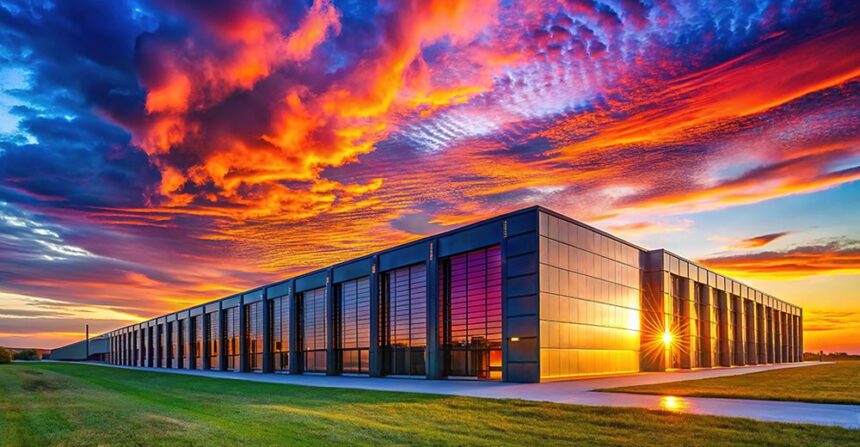
The future of massive-scale data centers to accommodate the demands of artificial intelligence appears to lie in inland America.
New data released Monday by the Synergy Research Group indicates that the focus of U.S. hyperscale developments has shifted substantially away from coastal regions toward the center of the country, with Texas and Midwestern states being the main beneficiaries.
According to the research and market intelligence company, at the end of 2025, Texas and the Midwest accounted for 33% of operational U.S. hyperscale data center capacity. The firm’s pipeline shows inland regions will account for 53% of new capacity coming online over the next few years.
Synergy acknowledged that Northern Virginia has, and will continue to have, the largest concentration of data centers, but it pointed out that as AI has supercharged investment in infrastructure, the geographic focus has shifted inland, seeking areas where power is more readily available.
Power Advantage Drives Texas Growth
By a wide margin, Texas is the most prominent state in the pipeline, it noted. In the Midwest, Wisconsin, Indiana, Michigan, and Missouri will all grow rapidly in importance, as they have attracted multiple major projects from Amazon, Google, Meta, Microsoft, OpenAI, and CoreWeave.
“Texas stands out due to its energy market structure,” explained Sandeep Prakash, senior product manager for AI infrastructure and data center planning at Microsoft.
“It has strong renewable and solar power buildout and relatively faster permit and approval processes,” he told TechNewsWorld. “All of which makes it easier to scale power-intensive AI infrastructure.”
Synergy’s research jibes with the AI “Superpower Index” released by TRG Datacenters on Sunday. That index, based on an analysis of computing power and AI-sector innovations by state, ranked Texas at the top with 17 data center clusters, a power capacity of 9.17 million kilowatts, and an overall score of 79.40.
Indeed, inland states dominated the index, with Tennessee (75.59), Wisconsin (63.56), Louisiana (58.12), Ohio (56.91), Indiana (53.80), Georgia (53.25), and North Dakota (52.57) all capturing top-10 spots in the tally.
As infrastructure constraints intensify and market dynamics continue to shift, hyperscale providers are increasingly reallocating capital toward central U.S. regions, with Texas emerging as the primary focal point, Synergy’s Chief Analyst John Dinsdale said in a statement.
“A new wave of gigawatt-scale campuses is taking shape in non-traditional locations such as Abilene, Mount Pleasant, South Bend, El Paso, Boone County, and Kansas City,” he added. “While established hubs will remain strategically important, the center of gravity for new hyperscale investment is clearly moving elsewhere.”
Thirst for Power
Gordon Bell, principal for strategy and execution at EY-Parthenon, in Boston, the global strategy consulting arm of Ernst & Young, agreed that in places where the industry has been growing rapidly for the past decade-plus, access to power is the primary infrastructure constraint to data center development.
“To get power at the scale customers are currently seeking — hundreds of megawatts — it often requires the construction of dedicated substations,” he told TechNewsWorld. “This means potentially new transmission infrastructure, and various rounds of studies and approvals to get the site energized.”
“In many established markets, the time required to get to energization through local utility now extends beyond — sometimes well beyond — 2030,” he said. “As a result, developers and customers are considering new locations for data centers where power is more readily available.”
“Data center developers are chasing megawatts, and the megawatts are inland,” declared Mark McNees, director of social and sustainable enterprises at the Jim Moran College of Entrepreneurship at Florida State University.

While Texas and the Midwest accounted for 33% of operational U.S. hyperscale capacity at the end of 2025, in the next few years, they’ll represent 53%. “That shift is almost entirely driven by where power can be secured fastest,” he told TechNewsWorld.
The interconnection queue for transmission and distribution is one of the biggest constraints on new data centers, concurred Whitaker Irvin Jr., CEO of Q Hydrogen, developer of sustainable hydrogen energy technologies in Park City, Utah.
“In a lot of places, you’re talking five to seven years plus to get any additional power to these data centers,” he told TechNewsWorld. “It was first going after whatever was available in the most friendly states, and now that is starting to reach its limit, too.”
Community Pushback
Local resistance is also contributing to the shift inland, asserted Jackson Gaskins, director and a communications advisor to hyperscalers at Hot Paper Lantern, a marketing and communications agency in New York City.
“The shift inland is being driven first by community pushback, due to skyrocketing consumer energy bills, and then by the political and regulatory pressure that follows,” he told TechNewsWorld.
“Once concerns around energy use, water, and land start gaining traction locally, it doesn’t take long for that to turn into hearings, delays, or new restrictions,” he explained. “At that point, it’s less about land availability or power access and more about where a project can realistically get approved.”
Water is a huge issue, contended Q Hydrogen’s Irvin. “We’ve already seen a large data center canceled because the community was getting angry about water resources,” he said.
“If more people understood that AI is not free,” he continued. “I think people would be a little more mindful about when to use these tools.”
Community pushback often takes the form of state and local laws and regulations that seek to limit data center development, added EY-Parthenon’s Bell. “Emerging data center locations, which have not experienced the same level of data center development, can be more open to expansion and growth,” he explained.
The data center industry can face other challenges in established markets. “Recently, utilities have put in place, or are considering, various mechanisms specific to the data center industry that increase cost and upfront investment for developers,” Bell said. “These mechanisms can include data center-specific tariffs, upfront deposits, and long-term energy use commitments to avoid speculative applications for power and to manage costs across their rate base.”
Risk of Data Center Overbuild
Market dynamics such as cheaper land, faster permitting, and state governments in inland states competing aggressively to attract data centers are contributing to the hyperscaler location shift, but the real market driver is cost, as maintained by Florida State’s McNees.
“Electricity prices vary dramatically by region,” he explained. “Texas operates its own competitive wholesale market through ERCOT, which historically offered lower prices than the regulated utilities in coastal states. For a facility drawing hundreds of megawatts, even a small price differential per kilowatt-hour translates to tens of millions of dollars annually. The economic gravity is pulling investment toward the cheapest available power.”
However, as the AI landscape changes, so may the migration patterns of the hyperscalers. “As the data center industry shifts from training models to actually serving those models to end users, proximity to existing cloud infrastructure and population centers will swing back to becoming increasingly important,” predicted EY-Parthenon’s Bell.
Even if industry shifts don’t affect location strategies, the dizzying pace of technology might do so. “I personally think this is just a stupid waste of money because the reality is we’re already seeing better algorithms, better approaches that use less computing and make more efficient usage of resources,” observed Jonathan Schaeffer, CEO and founder of Synsira, a software company in Canada that develops AI-powered tools.
“People are building these massive facilities, yet as the technology gets better, the dependence on using those resources is going to drop, and we’re going to have these big data centers that are going to be underutilized,” he continued.
“With advances in AI algorithms, computer chip technology, edge computing, hybrid AI models, and local processing technologies, the need for these data centers will decrease,” he reasoned. “Perhaps in the not-so-distant future we will have ‘data center ghost towns’ dotting the landscape.”
Read the full article here