

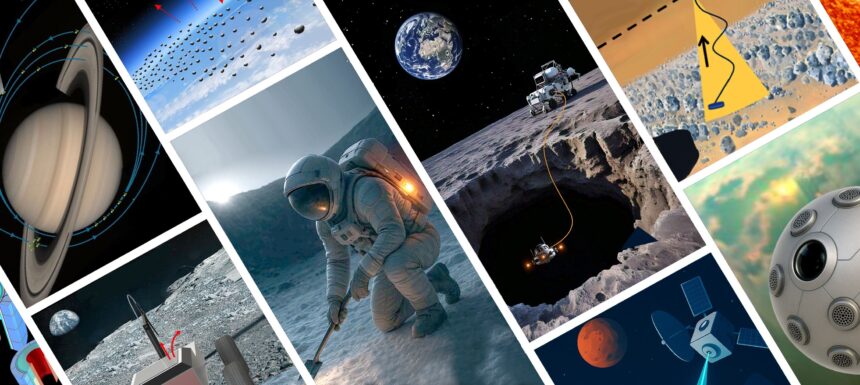
NASA says it’s funding a new batch of far-out research projects, including a study evaluating how radioactive heaters can keep astronauts warm while they work on the moon.
The heating project was proposed by Zeno Power Systems, a nuclear battery company with operations in Seattle, California and Washington, D.C. It’s one of 18 projects selected for nine-month, $225,000 Phase I grants by the NASA Innovative Advanced Concepts program. For decades, NIAC grants have helped researchers test concepts with potential space applications.
Zeno’s research project is led by A.C. Charania, the company’s senior vice president of space business development. Charania previously spent two years as NASA’s chief technologist and five years in management roles at Jeff Bezos’ Blue Origin space venture.
The project comes with an acronym taken from J.R.R. Tolkien’s tales of Middle-earth: EARENDIL, which stands for Extended Astronaut Radioisotope-EVA in Nighttime and Deep-Space Icy Landscapes. In “The Silmarillion,” Eärendil is a half-Elven mariner who voyaged to the Undying Lands. As described in Zeno’s proposal, EARENDIL technology would warm space voyagers while they work outside during the frigid lunar night, amid temperatures that can plunge as low as 410 degrees below zero Fahrenheit (-246 degrees Celsius).
Zeno is already developing a new class of compact nuclear devices powered by the heat of radioactive decay. One type of device would convert that heat into electricity, but the device proposed for EARENDIL would function strictly as a heater rather than a battery.
The NIAC proposal says these heaters would address “a critical barrier to sustained human operations on the lunar surface: the extreme cold of permanently shadowed regions (PSRs) and the two-week lunar night.” NASA’s grant will help Zeno assess the feasibility of integrating compact heaters into the spacesuits that astronauts wear during extravehicular activity, or EVA.
Americium-241, a radioisotope produced as a byproduct in nuclear reactors, would serve as fuel. Zeno is already working on americium-powered generators alongside Blue Origin and other partners in a NASA-backed initiative called Project Harmonia.
Zeno says its EARENDIL study will address key unknowns surrounding heating requirements, radiation dose rates, human factors and spacesuit compatibility. If the results from the Phase I study are encouraging, NASA could award follow-up grants to support further development.
“By extending the operational range and duration of EVAs into PSRs and nighttime environments, EARENDIL enhances crew safety during habitat power failures, reduces reliance on heavy battery systems, and unlocks new opportunities for science and resource utilization in previously inaccessible regions,” Zeno’s proposal says. “This capability is critical for the Artemis program’s long-term objectives at the lunar south pole and directly supports NASA’s broader ambitions for sustainable exploration architectures on the moon and Mars.”
Here’s a rundown of the 17 other proposals funded by NASA’s latest round of Phase 1 NIAC grants:
- Actively Steerable Femtosat Constellations for In-situ Exploration of Saturn’s Rings, Atmosphere, and Magnetosphere, proposed by Michael Rubenstein, Northwestern University.
- Coilable Stacked Solar Sails for Very High Delta-V Missions, proposed by Artur Davoyan, University of California at Los Angeles.
- Combinatory Architecture offering Neomobility, on-Venus Adaptability, and Survivability (CANVAS), proposed by David Bugby, NASA Jet Propulsion Laboratory.
- Dimming the Sun (DimSun) Using Controllable Dust Cloud to Reduce Solar Insolation, proposed by Saptarshi Bandyopadhyay, JPL.
- ECLIPSE – Efficient Variable Conductivity Lunar Insulator for Passive Surveyor Environmental Control, proposed by Austin Phoenix, Virginia Polytechnic Institute & State University.
- Interworld Slingshot Resource Surveys, proposed by Pablo Sobron Sanchez, SETI Institute.
- Mapping Alien Continents: Achieving Optical VLBI for Exoplanet Imaging, proposed by Paul Stankus, Brookhaven Science Associates, Upton, N.Y.
- OBLIVION: Observing Black hole LIght Via Intensity cOrrelatioN, proposed by Jeff Nosanov, Orbital Velocity, Decatur, Ga.
- Photophoretic Tracers for Near-Space Remote Sensing at 30-100 km Altitudes, proposed by Benjamin Schafer, UCLA.
- Plasmon-Enhanced Radioisotope Thermophotovoltaic (PRTPV) Power Generation for Interstellar Missions, proposed by Keunhan Park, University of Utah.
- Power-over-Fiber to Enable a Lunar Underground eXplorer (LUX), proposed by Gilly Elor, Stone Aerospace, Del Valle, Texas.
- PRAXIS: Planetary Rings Autonomous EXploration with In-situ Sampling, proposed by Marco Quadrelli, JPL.
- Precision Astrometry Using Optically Independent Spacecraft for Gravitational Wave Detection, Paul Stankus, Brookhaven Science Associates.
- PS21: Transforming Submillimeter Space Interferometry with Photonic Technologies, proposed by Anish Damodaran, University of Central Florida.
- Quantum Wind Lidar Applications for Planetary and Earth Science Missions, proposed by Zhaoyan Liu, NASA Ames Research Center.
- Robotically Assembled Electromagnetic Metamaterials for Long-Range Space Situational Awareness, proposed by David Smith, Duke University.
- Solid-state Propulsion for Autonomous Reconnaissance of Karst (SPARK), proposed by Daniel Drew, University of Hawaii.
Read the full article here