
A running joke in the agricultural field is the average age of a U.S. farmer is 58 today, but that will tick up by one next year. The trouble is, it’s not so funny when the people who grow our food are aging out with no one to replace them.
An Oregon startup aims to address that with an environmentally sustainable, scalable farming solution.
“We’re trying to create the future job for local farmers, where essentially you franchise a robotic farm, you have almost no employees, and you can provide organic produce to your community,” said David Ashton, CEO and co-founder of Canopii.
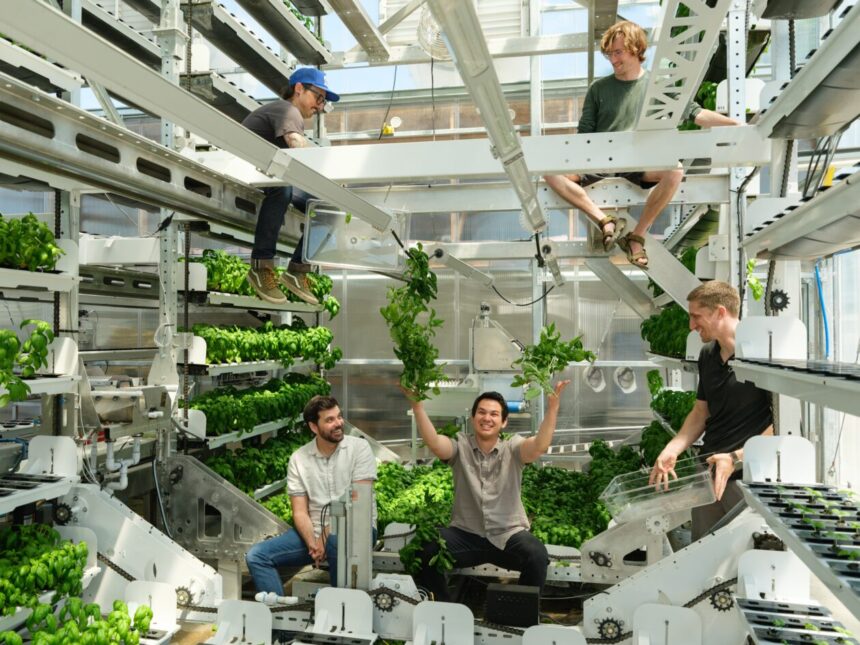
The company has built a greenhouse system with a footprint smaller than a tennis court that requires little power or water and can be installed in urban settings to produce 40,000 pounds of greens per year — enough to supply roughly 20,000 people.
Canopii plans to kick off a WeFunder campaign this week to raise $1.5 million to build a commercial greenhouse in Portland and demonstrate its franchise model. The startup launched in 2021 and has received $3.6 million in funding, primarily through grants from the National Science Foundation and the U.S. Department of Agriculture, along with investments from Elevate Capital, Onami and Vertue Labs.
The team designed an automated conveyor system that takes specialty lettuces, herbs, Asian broccoli and other greens from seed to boxed produce. A robotic arm inserts seeds into soil pucks the size of mini cupcakes; once seedlings develop leaves, the system transplants them into larger containers and, at harvest, clips and deposits the greens into bins.
The company is pursuing a grant to develop AI-powered plant monitoring to further reduce labor, with conveyors routing trays to stationary cameras rather than outfitting the entire facility.
Ashton’s inspiration traces back to his time at California Polytechnic State University, situated in a rural stretch between San Francisco and Los Angeles. In the early-to-mid 2010s, California was enduring a record drought.
As part of his agricultural engineering program, “we traveled to all the different farms, and everyone was talking about water,” he said. Ashton was struck by the water demands of high-volume outdoor farms and the impacts of shipping produce over long distances.
He set out to build the smallest, most efficient greenhouse possible. The result is Canopii’s structure: 2,500 square feet and 30 feet tall, capable of producing in one-twentieth of an acre what would require 3 to 4 acres in a typical field.
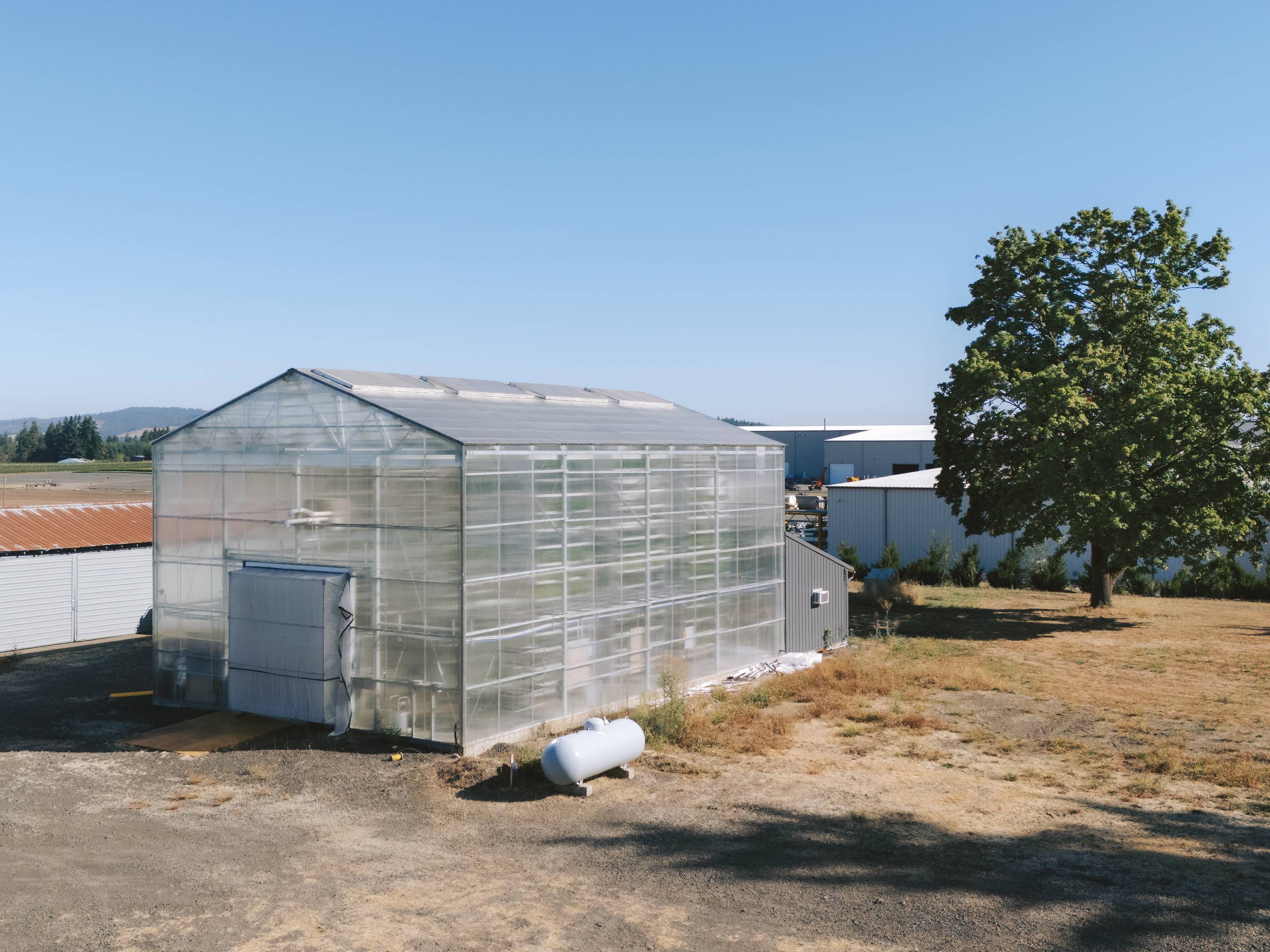
The six-person Canopii team currently has a prototype greenhouse operating in Hubbard, Ore., supplying greens to customers including Ōkta Farm and Kitchen, a nearby high-end restaurant.
The indoor farming sector has struggled in recent years. Well-funded ventures including Plenty, AppHarvest, Bowery Farming and Kalera have gone bankrupt, though others such as Oishii and Gotham Greens continue to operate. Ashton noted that most of those failures involved large-scale operations.
A Wyoming-based startup called Vertical Harvest is also building smaller urban greenhouses, differentiated by its use of soil-free hydroponic technology. Other Pacific Northwest players in the space include IUNU and Koidra.
Canopii is pursuing a franchise model in which it oversees the greenhouse installation, trains the owner and provides ongoing service and support, while the franchisee funds and runs the site. Each unit costs approximately $600,000. Target customers for the produce include independent grocery stores and restaurants, and the company has a letter of intent with the Confederated Tribes of the Umatilla Indian Reservation for an installation.
The startup partners with GK Machine, which helped build its robotics and is opening a facility capable of producing the systems at scale, and two construction companies for building installation.
For Ashton, the deeper appeal is about reconnecting communities with where their food comes from.
“It can be in a downtown, it can be a school yard, it can be at a restaurant, or at a supermarket — people can actually see it and understand where their food is actually coming from,” he said. “Local becomes less of just a brand, but actually an experience.”
Read the full article here