
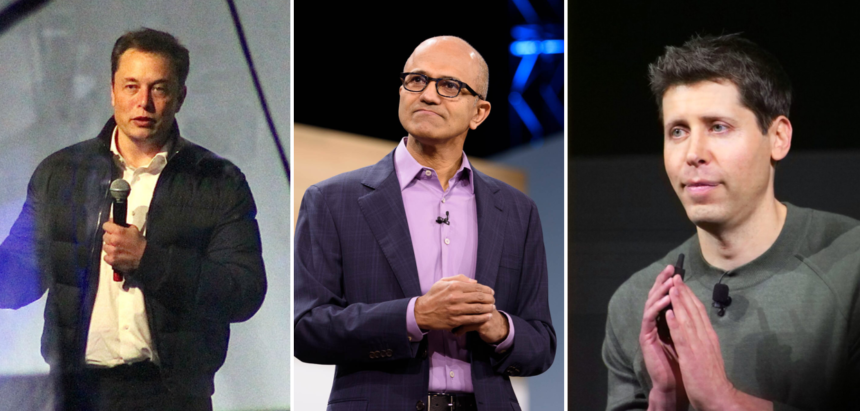
We are watching a courtroom drama in Oakland made for motion pictures. Elon Musk versus Sam Altman, a dramatic firing and reinstatement, the CEO of Microsoft testifying about who was “the adult in the room.” The spectacle is keeping our eyes on the courtroom. Yet the reckoning, when it comes, will have to come from Washington, D.C.
The Silicon Valley soap opera is obscuring a question that matters far more than who said what during a chaotic weekend in November 2023. It is a question that should concern every nonprofit, and every taxpayer. As the founding CEO of the Allen Institute for AI — a nonprofit research lab launched in 2014, a year before OpenAI, and still a nonprofit today — I want to ask it plainly: can a charity, funded by tax-deductible donations, be converted into a corporation?
If your answer is yes, then American charity law is a tax-advantaged staging ground for whichever venture later proves lucrative, and the word “nonprofit” means whatever the founders decide it means once the asset gets valuable enough. If your answer is no, then someone should stop this. California Attorney General Rob Bonta and Delaware Attorney General Kathy Jennings chose not to.
Nonprofit status is not an umbrella you fold once the sun comes out. It’s a lasting commitment.
That precedent — that charitable assets can be migrated into private-equity-style structures as long as some equity stake flows back to the nonprofit — will shape the next decade of nonprofit-to-for-profit conversions in technology. It was accepted without judicial review, and that is why we are now watching Elon Musk litigate the question. The defense is making the trial about him. The precedent OpenAI is setting is the real issue.
This argument has been made forcefully by UCLA legal scholars, Public Citizen, Nobel laureates, fifty California foundations, and former OpenAI employees for two years, in letters, briefs, and petitions to both AGs. What’s missing is enforcement.
The defenders of the conversion will tell you that OpenAI’s nonprofit board still controls the new for-profit public benefit corporation, that the foundation now holds a 26 percent stake worth roughly $130 billion, that the AGs extracted real concessions, and that the alternative — blocking the conversion — would have destroyed value and accomplished nothing. Every one of these arguments has some merit. The first three are even partially true.
But hold on. We already ran the experiment. The result is in.
The November 2023 firing of Sam Altman was the empirical test of whether nonprofit governance was real. The board exercised its single most important power — removing the CEO — and was forced into reversal within five days by employees and investors who held the equity. Microsoft’s CEO testified on Monday that he had to step in as “the adult in the room.” The board’s authority evaporated the moment it tried to use it.
Public Citizen put it plainly in its September 2025 letter to the two AGs: the nonprofit has become “little more than a rubber stamp of the for-profit.”
That is the test case Sacramento and Wilmington had in front of them, and the one they did not pursue. On October 28, Bonta issued a settlement statement blessing the recapitalization on the representation that nonprofit control is preserved. Kathy Jennings in Delaware released a Statement of No Objection the same day, tracking California almost word for word. So when the settlement tells you nonprofit control is preserved, ask which version — the version on paper, or the version that actually held when tested.
The deeper question is why the case settled at all. Both offices had standing, resources, and jurisdiction. The reasons they didn’t use them are political — two state AGs, each with a single charity bureau, weighing a fight against the most valuable private company in history, its lead investor, and a White House that has made AI dominance an explicit industrial policy.
Judge Yvonne Gonzalez Rogers could still order an unwinding of the recapitalization, the removal of Altman and Brockman, damages funneled back to the charity. Any of those would matter. But the case turns on Musk’s particular claims and Musk’s particular standing, and even a sweeping ruling in his favor would not bind the next state attorney general weighing the next conversion. The precedent problem outlives the verdict.
The solution is a federal case. The state AGs have spoken; the path forward runs through Washington, where the IRS, the tax-writing committees in both chambers, and the federal antitrust agencies each have a potential role to play. A federal case can establish that the next AI lab considering this maneuver will face consequences.
The precedent matters far beyond AI. It matters for every nonprofit, and for every founder who took the harder road because they believed the rules meant something. We need public officials with the courage to enforce the laws that protect the nonprofit system. Sacramento and Wilmington failed. Washington has not yet tried.
Disclosure: The author serves as a retained expert for the plaintiffs in The New York Times v. OpenAI and Microsoft copyright litigation. The opinions expressed are his alone.
Read the full article here