
Amazon’s OpenAI investment and cloud partnership made big headlines Friday, but the mechanics of the deal — including how the money flows, what triggers the payments, and what happens if things go sideways — are buried in SEC filings that tell a more complicated story.
Here’s how it works, what the filings say, and what they’re still keeping under wraps.
The money: Amazon is investing up to $50 billion in OpenAI, in two stages.
- $15 billion in OpenAI Series C Preferred Stock, due March 31.
- A $35 billion commitment that comes later, with the timing dependent on a series of triggers. (The filing puts the exact figure at $34,999,999,447.98. The share price didn’t divide evenly into $35 billion, leaving it $552.02 short. Every penny counts!)
It’s part of a larger funding round: OpenAI raised $110 billion total at a $730 billion pre-money valuation, with SoftBank and Nvidia each contributing $30 billion alongside Amazon’s $50 billion. OpenAI said additional financial investors are expected to join as the round progresses.
Microsoft, OpenAI’s largest existing investor, has not yet participated in the round. CNBC reported that Microsoft still has an option to join. Microsoft and OpenAI put out a joint statement saying their partnership remains unchanged. (More on that below.)
Microsoft did, however, invest $5 billion in Anthropic last year, so with the latest deals, both Seattle-area tech giants now have their own stakes in the makers of Claude and ChatGPT.
The triggers: Amazon can buy its remaining shares whenever it wants, at its discretion, according to the filings. But two events can force its hand, requiring the additional investment.
- A “Mandatory Funding Event” that requires Amazon to buy all remaining shares within five business days. The filing doesn’t disclose the milestone. The definition is redacted.
- An initial public offering by OpenAI. If OpenAI notifies Amazon after filing for an IPO confidentially with the SEC, Amazon must buy every remaining share. It gets four weeks from the notice or five business days after the public S-1, whichever is later.
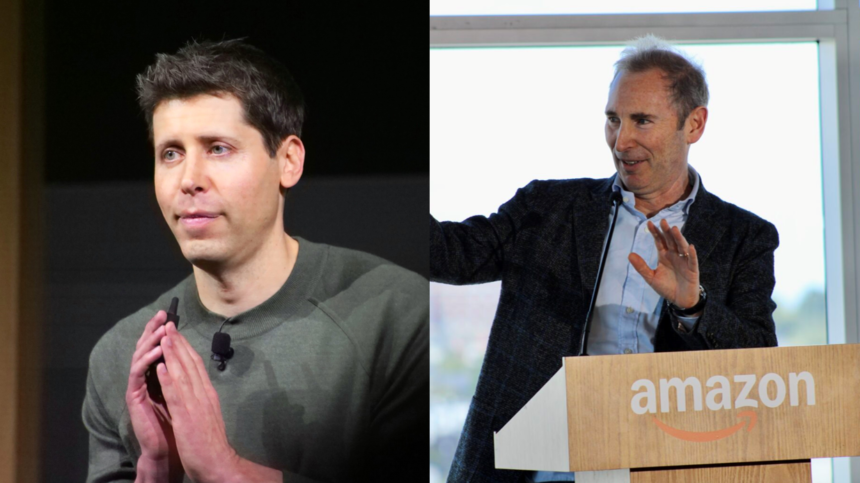
OpenAI CEO Sam Altman, talking about the deal in a joint appearance with Amazon CEO Andy Jassy on CNBC on Friday, said OpenAI is “open to going public at the right time.”
The form of the investment could also change. If Amazon buys its remaining shares before an IPO, it gets Series C Preferred Stock. If the purchase happens after OpenAI goes public, the filing says Amazon receives common stock instead.
The expiration date: The equity commitment expires Dec. 31, 2028. If the triggers haven’t happened and Amazon hasn’t invested the full amount by then, the obligation ends.
If either side fails to meet its obligations under the equity agreement, monetary damages are capped at the unfunded commitment amount. Each company has the right to seek a court order forcing the other to follow through. Both sides waived their right to a jury trial.
The underlying cloud deal: The equity is only part of the arrangement. On the same day, Amazon and OpenAI signed a Joint Collaboration Agreement (JCA) and a cloud services deal, both of which are referenced but not included in the public filings. OpenAI already had a $38 billion multi-year agreement with AWS. This expands it by $100 billion over eight years.
The cloud services agreement includes a commitment by OpenAI to consume 2 gigawatts of Trainium capacity through AWS. Gigawatts measure power draw, and serve as a proxy for the scale of computing involved. For reference, a large nuclear power plant produces about 1 gigawatt.
Trainium is Amazon’s custom AI chip, designed as a lower-cost alternative to Nvidia’s GPUs. Anthropic is already training its next version of Claude on Trainium, according to Jassy, making OpenAI the second major AI lab to commit to the chip.
Amazon and OpenAI are also co-building a Stateful Runtime Environment, powered by OpenAI models, that will run in Amazon Bedrock, AWS’s AI model platform. This runtime environment will let AI agents maintain context, remember prior work, and act across multiple systems over time. OpenAI says it will launch in the next few months.
The filing doesn’t mention Amazon Alexa specifically, but the press release says OpenAI will develop “customized models available to power Amazon’s customer-facing applications,” supplementing Amazon’s own Nova family of AI models.
The equity investment and cloud partnership deals are contractually linked. If the Joint Collaboration Agreement terminates, the additional $35 billion equity commitment dies with it. But because the JCA isn’t public, we don’t know how it could be terminated.
OpenAI and Amazon have been talking for years: The filing references a mutual nondisclosure agreement dated May 23, 2023. That’s nearly three years before Friday’s announcement, and four months before Amazon’s first $4 billion investment in Anthropic.
One reason they probably didn’t do a deal sooner: Microsoft had a right of first refusal to be OpenAI’s compute provider, and OpenAI couldn’t jointly develop products with third parties.
Those restrictions were loosened in October 2025, when Microsoft and OpenAI announced a restructured partnership agreement that included new provisions allowing OpenAI to jointly develop products with third parties and removing Microsoft’s right of first refusal on compute.
In exchange, OpenAI committed to purchase an additional $250 billion in Azure services.
In their joint interview Friday, Jassy told CNBC that he and Altman had been talking “for a while” and that the OpenAI partnership was already in Amazon’s projections when the company announced plans for $200 billion in capital spending this year.
What’s hidden: The filing is heavily redacted. Key deal terms left out include: the milestone that could require Amazon to invest the remaining $35 billion on five business days’ notice; events that could terminate the $35 billion investment obligation; what constitutes a material breach of the deal; and the conditions to be satisfied before Amazon buys additional shares.
The Verge and others have speculated that the redacted milestones may be tied to OpenAI achieving artificial general intelligence, or AGI, a loosely defined threshold at which AI systems can match or exceed human-level reasoning across a wide range of tasks.
An AGI clause exists in Microsoft’s OpenAI deal. But Altman signaled that’s not the case here. “We’re not doing new deals that stop when AGI gets reached,” he told CNBC.
What about Microsoft? OpenAI and Microsoft put out a joint statement of their own on Friday, coinciding with OpenAI’s funding news, saying that Microsoft Azure remains the exclusive cloud provider for stateless OpenAI application programming interfaces.
Stateless refers to a useful but basic building block, where an application sends a prompt, gets a response, and the connection ends. That’s in contrast with stateful APIs, more sophisticated connections that maintain context and memory across multiple interactions.
Microsoft also keeps its exclusive license to OpenAI’s intellectual property, which powers Copilot, Bing, and the Azure OpenAI Service. Under the existing partnership, Microsoft receives a share of OpenAI’s revenue. That arrangement is unchanged, and it includes revenue from OpenAI’s partnerships with other cloud providers.
The joint Microsoft-OpenAI statement said, “Collaborations like the partnership between OpenAI and Amazon were always contemplated under our agreements and Microsoft is excited to see what they build together.”
OpenAI’s own products, including Frontier, still run on Azure. Frontier is OpenAI’s enterprise platform for building, deploying, and managing teams of AI agents.
AWS becomes the exclusive third-party cloud distributor for Frontier, meaning enterprises that want to access it through a cloud provider other than OpenAI go through Amazon. But the product itself remains hosted on Microsoft’s infrastructure.
Bottom line: The era of exclusive AI relationships is over. Microsoft keeps the core API business, the intellectual property license, and the revenue share. Amazon gets the Stateful Runtime Environment, the Trainium workloads, and third-party Frontier distribution.
Both companies are investing in Anthropic. OpenAI is getting investment from everyone. The biggest players in AI are no longer just picking partners, they’re playing all sides.
Read the full article here