

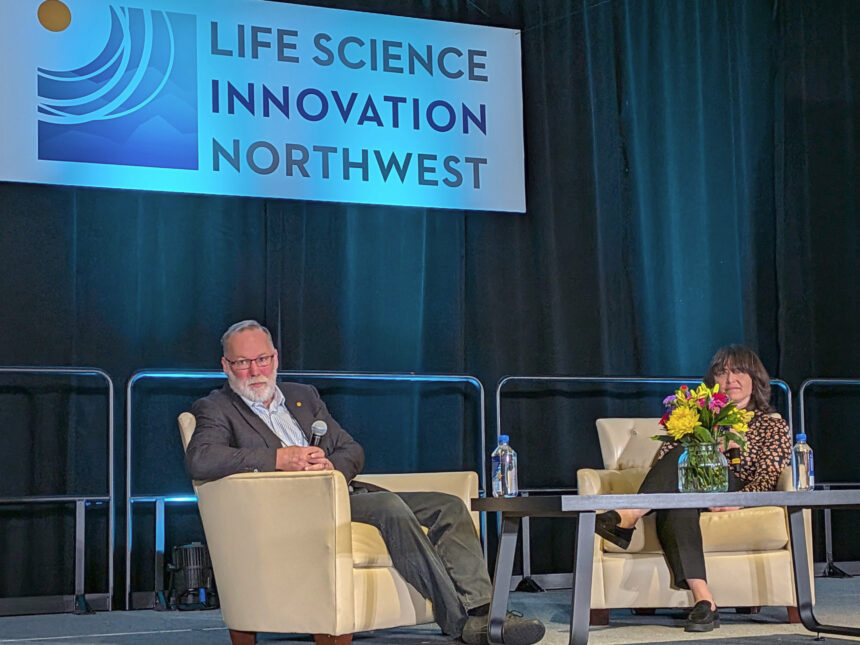
The biotech industry is increasingly shaped by computer-designed drugs and investor pressure to move fast and show commercial traction. Nobel laureate Fred Ramsdell took a different path — one built on cell-based therapies, philanthropic funding and patient investing.
That path began at Darwin Molecular, a biotech startup in Bothell, Wash., that launched in 1992 with backing from Bill Gates and Paul Allen. The Microsoft co-founders weren’t chasing quick returns, Ramsdell said, and that freedom attracted dedicated researchers.
“People bought into that because you’re trying to do something that would make a difference,” he said. “It wasn’t a one-drug company. It wasn’t hyper-focused on something very specific. It was trying to figure out how we can affect change in patients.”
That mission-drive culture proved fertile ground. Ramsdell’s work at Darwin ultimately led to a Nobel Prize in Physiology or Medicine, awarded in October and shared with former Darwin colleague Mary Brunkow and Shimon Sakaguchi of Osaka University in Japan. The trio was recognized for foundational work in regulatory T cells, or Tregs — dubbed the “immune system’s security guards.”
The discovery of Tregs changed therapeutics by showing that the immune system has a built-in braking mechanism that can be enhanced to treat autoimmune disease, transplant rejection and graft-versus-host disease, or blocked to improve cancer immunotherapy.
Ramsdell recounted his journey at Life Science Washington’s annual conference in Seattle on Tuesday, tracing the unlikely origins of the discovery back to the Cold War.
The Darwin team studied a line of mice descended from post-Manhattan Project research into the effects of radiation on living organisms. In 1949, the program produced a mouse from a naturally occurring, non-radiation-induced mutation, later named “scurfy.”
A fraction of the male mice were riddled with illness and lived for only a few weeks. “They had every autoimmune disease in one animal,” Ramsdell said — diabetes, Crohn’s disease, psoriasis, myocarditis and more.
That suffering pointed to something important. The scurfy mice carried a mutation the Darwin scientists identified and named Foxp3 — a gene essential to keeping the immune system from attacking the body’s own healthy cells. The mouse gene has a human counterpart, FOXP3.
“We recognized the potential of these cells,” Ramsdell said. Introducing healthy Tregs into people with autoimmune disease could treat the condition — but the scientific tools to make that a reality didn’t yet exist.
Darwin was acquired in 1996 by London-based Chiroscience Group, which merged with the British company Celltech. When the company shut down its Washington state R&D operations in 2004, Ramsdell and Brunkow moved on.
Ramsdell eventually landed at the Parker Institute for Cancer Immunotherapy, which he helped launch in 2016. The nonprofit research institute presented another unique opportunity. Founded with a $250 million grant from tech entrepreneur Sean Parker, it operates as a collaborative network across seven major U.S. cancer centers, applying immunotherapy to cancer in ways that siloed institutions couldn’t.
The secret ingredient, Ramsdell said, was trust — built deliberately through Parker Institute retreats that included scientists and their families.
“The ability to build trust and collaboration, true collaboration, and combine [research] that wouldn’t otherwise be combined, was incredibly appealing to me,” he said.
Today, Ramsdell serves as a scientific advisor for the Parker Institute and for Sonoma Biotherapeutics, a Seattle- and South San Francisco-based startup he co-founded that is focused on Treg cells. The company has a partnership with Regeneron to co-develop cell therapies for Crohn’s disease, ulcerative colitis and other conditions — a direct line from the scurfy mice of the 1940s to the clinic.
Even in advisory roles, Ramsdell keeps returning to big-picture biological questions. He’s currently intrigued by people who carry genetic predispositions for diseases that never materialize — and what that might reveal about the hidden coding in their DNA that hold illness at bay.
Looking at this phenomenon across populations, scientists can explore these genetic factors, he said, “and that will open up a lot of your doors.”
Read the full article here