

Step 3: Find the right union affiliation or go it alone
“Running a campaign against major employers requires the resources and expertise of the larger labor movement, even if workers publicly present as independent,” says Kate Bronfenbrenner, director of labor education research and senior lecturer emeritus at Cornell University’s School of Industrial and Labor Relations.
Options include the Communications Workers of America (CWA), Service Employees International Union (SEIU), and the Office and Professional Employees International Union (OPEIU), among others. Another resource, the Tech Workers Coalition (TWC), provides training on organizing tactics, AI-in-workplace issues, and contract negotiation, and can match workers to the right unions for their needs.
The Alphabet Workers Union decided early on to affiliate with CWA. “They gave us a bunch of support early on in our campaign with no strings attached,” McAvinney says.
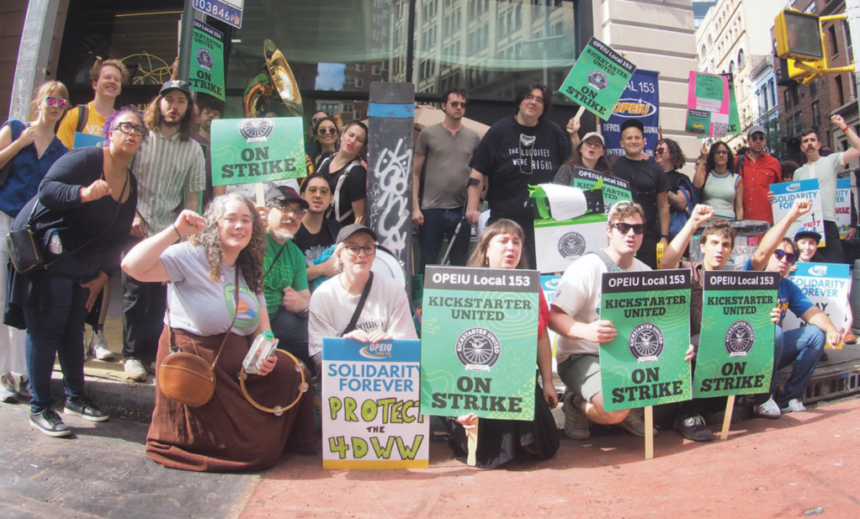
Kickstarter is organized through OPEIU, Thompson says. “They’ll usually have resources and staff that can help you through the next steps: collecting signatures in support of a union, bringing that to management, holding a vote — the more formalized things that interact with US labor law. They’ll also help with organizing along the way,” he says.
For workers at institutions where a union already exists, there may be a faster path. Organizers at UCLA did what’s called a “unit modification,” aligning with UPTE. By organizing under UPTE, the workers didn’t have to negotiate a new contract from scratch — they joined an already-negotiated contract covering existing UPTE tech members, which put them in “a much stronger position” than starting fresh, Belasco says.
Step 4: Choose your union model: majority vs. pre-majority or minority
Assess what’s practical for your organizing effort. In a majority union, more than 50% of all workers in a defined bargaining unit must vote to join the union through an NLRB-supervised election in the private sector, or a Public Employment Relations Board (PERB)-supervised election for public sector workers.
The NLRB must certify the union, which then operates under its legal protections. This means, for example, that the employer must bargain, negotiated contracts are enforceable, violations must go to the NLRB or arbitration, and workers can’t be dismissed without just cause.
A pre-majority or minority union is a minority labor organization operating without NLRB protections or collective bargaining agreements. “Pre-majority means that workers are able to demonstrate majority support — through signed cards, petitions, a walkout, or everyone wearing solidarity T-shirts — without going through a formal election,” Bronfenbrenner says.
Kate Bronfenbrenner from the School of Industrial and Labor Relations, Cornell University
ILR School/Cornell University
The Alphabet Workers Union-CWA (AWU-CWA) formed as a pre-majority union because achieving majority status across a globally distributed workforce of over 100,000 was not a realistic near-term goal. “An underground model where you try to reach 70% support across a workforce of over 100,000 people isn’t realistic,” McAvinney says.
A pre-majority union can still make a difference, he says. For example, the Alphabet Workers Union-CWA convinced management to offer voluntary exit packages — buyouts — prior to announcing layoffs.
For smaller organizations, a majority union may be the more practical option — it’s more attainable, McAvinney says. “I don’t think [the pre-majority union model] is the correct thing to do in all situations. I certainly would not recommend it to a 200-person shop.”
Kickstarter, which had fewer than 100 employees, was able to form a majority union, with 55% voting to organize.
Ultimately, says McAvinney, “there’s no inflection point where you go from being able to win nothing to winning everything, even with a contract and a supermajority. But the more people you have who are willing and able to fight for what they want, the more you’ll be able to get.”
Step 5: Who should — and should not — be in your union?
Belasco’s situation at UCLA illustrates a broader strategic choice that every organizing campaign must make. He had been in a union position in educational technology when he was told his role would be reclassified as a non-union position.
“I was given a choice: apply to the new non-union position to continue doing the work I’d trained for, or stay in my union position doing service desk work I wasn’t used to,” he says. “Essentially, it was a choice between job security and career progression.”
Belasco joined a “wall-to-wall” union, which represents a broad range of university professional and technical employees across the UC system rather than a single job category, such as engineers or tech professionals.
Kickstarter United is another example of a wall-to-wall union. “It’s not just the engineers who are unionized, but also customer support, designers — everyone,” Thompson says.
Wall-to-wall unions are more powerful, but they’re also more difficult to achieve. Under US labor law, “professionals have to vote separately on whether they want to be combined with other workers,” says Bronfenbrenner. “You can never have a wall-to-wall unit without giving professionals the chance to decide whether they want to be separate.”
The law’s “professional employees” category includes roles like software engineers and developers but not necessarily others. For example, customer support specialists and QA analysts would fall into the “non-professional workers” category.
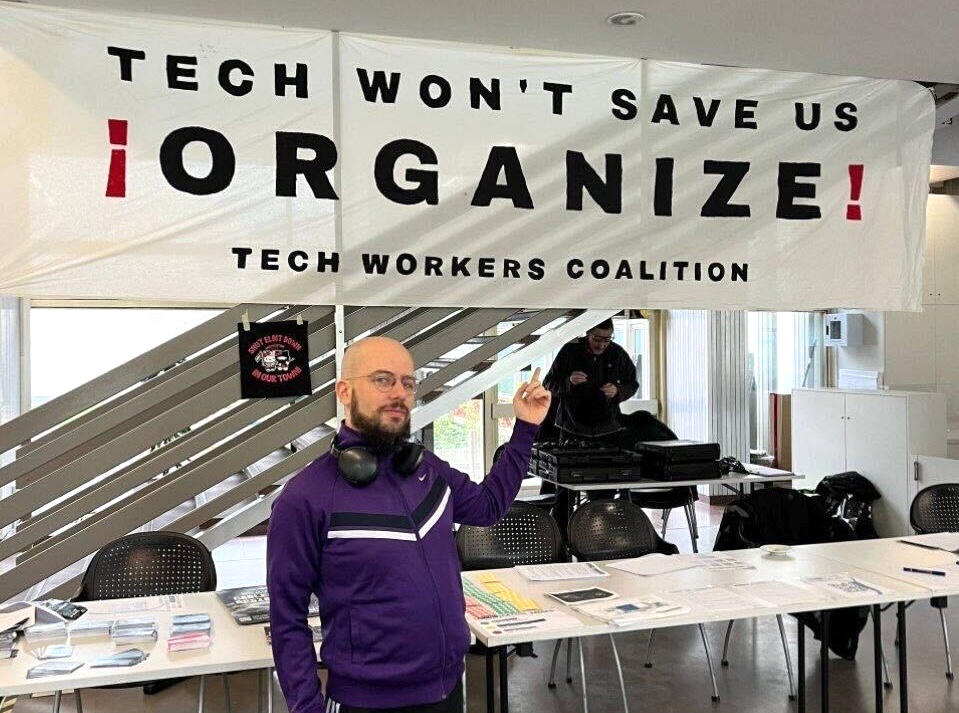
“For decades, the pattern was either to organize everybody except the engineers, or manage to organize the engineers and fail to bring in everybody else — neither of which builds real worker power,” says Simone Robutti, an organizer with Tech Workers Coalition Global, an international branch of TWC based in Berlin.
Simone Robutti from Tech Workers Coalition Global
TWC
Step 6: You won the vote. Get ready for what comes next
Winning a union vote means having a seat at the table, says Thompson. “Once the workers have come together and agreed they want that seat, you bring that to management, and they have a chance to voluntarily recognize a union,” he says.
But in most cases employers contest the results, which must be certified by the NLRB or PERB. That process, in which the employer uses various tactics to challenge the legitimacy of the outcome, can take weeks or months.
Unfortunately, the legal framework that is supposed to protect workers during this process has been significantly weakened in the last few years. In a potentially more ominous development, SpaceX, Amazon, Trader Joe’s, Starbucks, and the University of Southern California have in separate legal actions challenged the constitutionality of the NLRB, arguing that the agency’s structure violates the separation of powers. The Fifth Circuit Court of Appeals upheld injunctions against the NLRB in SpaceX’s case in August 2025 — a serious challenge to the agency’s authority.
In the meantime, some companies may disregard negotiated contracts, which can lead to lengthy legal appeals or extended arbitration.
“The NLRB can still force an election, but it can’t force a contract, and companies are saying they simply won’t comply,” Bronfenbrenner says. This is where the expertise and resources of affiliation with a major union can help, she adds.
As a result, contract negotiations can take far longer than workers might expect. At Kickstarter, for example, two years and four months elapsed from the time of the union vote to the first contract, and that was at a 59-person company with a relatively cooperative employer. At larger companies with more aggressive legal teams, the timeline will be longer.
Forming a union is hard work, Robutti says. “It’s not a service you pay for and they protect you. It doesn’t happen spontaneously, and it doesn’t happen magically. It’s the choice to take responsibility for improving your workplace.”
Read the full article here