

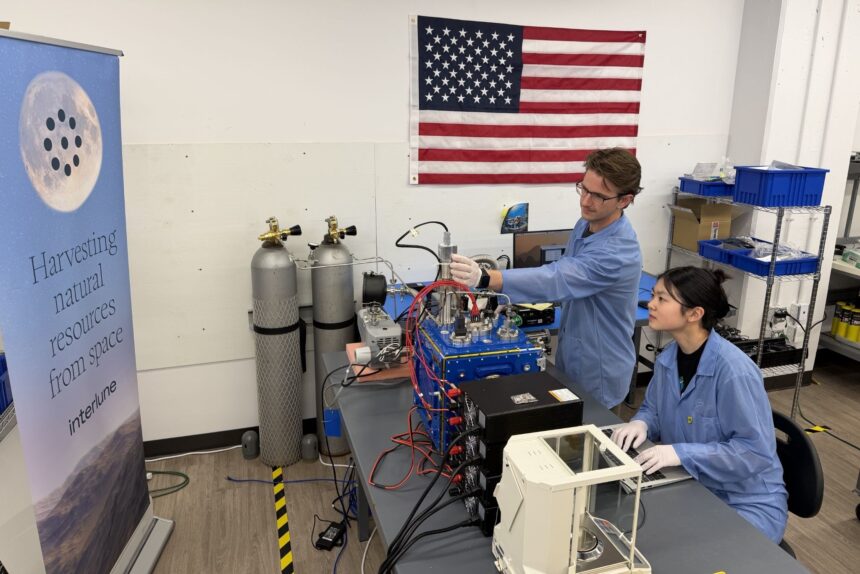
NASA has awarded a $6.9 million contract to Seattle-based Interlune for the development of a system that can extract gases such as helium-3 and hydrogen from lunar soil and rocks.
The system will be developed and tested on Earth under the terms of an 18-month Small Business Innovation Research Phase III grant, and then launched to the moon on a commercial robotic lander in 2028. Interlune says the project meshes with its plan to extract and market lunar helium-3 for applications on Earth ranging from quantum computing and medical imaging to neutron detection and commercial nuclear fusion.
“We’re gathering data and advancing technologies that serve multiple purposes across industry and government,” Rob Meyerson, co-founder and CEO of Interlune, said today in a news release. “NASA’s continued investment in space technology enables technology development projects like this one to ensure America’s leadership in building the lunar economy.”
Interlune’s payload will include a robotic arm and scoop to gather up moon dirt (technically known as regolith), a particle-sorting device, hardware for heating up lunar material and harvesting the gases that are given off, a multispectral camera capable of determining helium-3 concentrations, and a mass spectrometer that can analyze the gases.
“For the first time ever, we will measure volatile gases by heating lunar regolith while on the moon, dramatically advancing the scientific community’s understanding of its properties,” Interlune chief scientist Elizabeth Frank said. “The data we collect will also tell us how much power is needed to extract resources like helium-3.”
The project builds on Interlune’s previous efforts to build payload prototypes and test them on parabolic airplane flights that simulate lunar gravity. The company plans to send a camera to the moon on California-based Astrolab’s FLIP rover as soon as this summer for a demonstration mission known as Crescent Moon. In March, Astrolab announced that it would work with Interlune to integrate resource extraction hardware onto future lunar rovers.
The NASA-supported mission, called Prospect Moon, would generate data detailing the concentrations of volatile materials that have been deposited on the moon’s surface by the solar wind. Follow-up missions could focus on extracting hydrogen for rocket fuel and other lunar power applications, alongside helium-3 that could be sent back to Earth.
Interlune says it already has nearly $500 million in binding purchase orders for helium-3, from quantum computing companies and from the U.S. Department of Energy and the Department of the Air Force. For initial deliveries, Interlune plans to harvest helium-3 from natural gas supplies on Earth while full-scale lunar infrastructure is developed.
Helium-3 is the first resource targeted by Interlune, but the company plans to widen its focus over time to extract other potentially valuable materials from lunar regolith, including industrial metals, rare earth materials and water.
Interlune was founded in 2020 and reported raising $18 million in seed capital in 2024. This January, Interlune announced an additional $5 million investment offering aimed at advancing key technical milestones.
Read the full article here