
Microsoft has based much of its AI business on models from OpenAI, before expanding more recently to Anthropic. On Tuesday, the company showed how it plans to rely less on both.
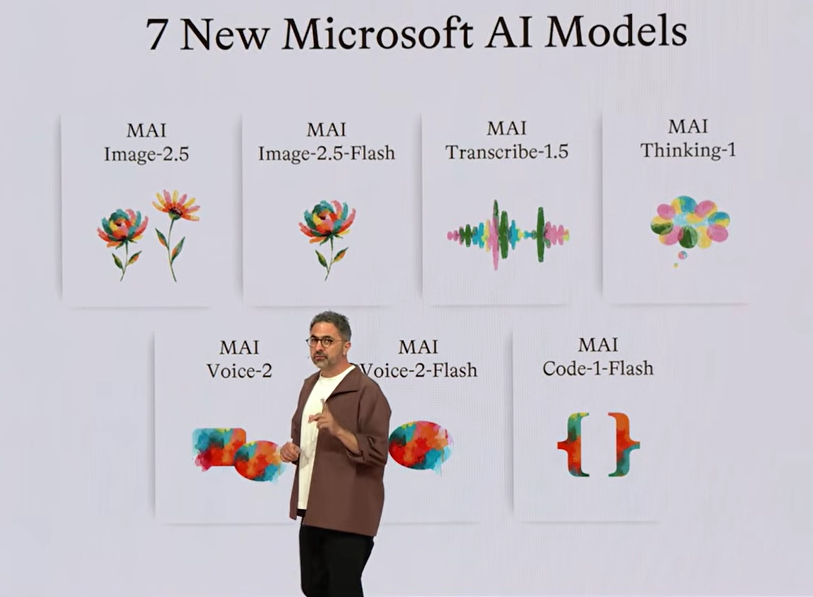
At the Build developer conference, the Microsoft AI Superintelligence Team unveiled a family of seven models built from scratch. It’s part of an ongoing effort by the company to build credible in-house alternatives to models from partners and rivals with competing allegiances.
“This is all about long term self-sufficiency for Microsoft and our partners. It’s about models you can trust,” wrote Mustafa Suleyman, CEO of Microsoft AI, in a post announcing the models.
Microsoft is OpenAI’s largest backer, having invested a cumulative total of $13 billion in the ChatGPT maker over multiple funding rounds. The company last year announced an investment of up to $5 billion in Anthropic, and later integrated its technology into a Copilot Cowork AI assistant.
However, Anthropic is also backed by Microsoft rivals Google and Amazon, and OpenAI is increasingly cozy with Amazon — showing the need for Microsoft to control its own AI destiny.
The flagship of the seven newly announced MAI models is MAI-Thinking-1, a reasoning model that Microsoft says draws even with Anthropic’s Claude Sonnet 4.6 in blind human testing, and matches the more capable Claude Opus 4.6 on a widely used coding benchmark.
Suleyman stressed that MAI-Thinking-1 was trained from the ground up with no distillation from other companies’ models, looking to appeal to enterprises that care about clean data lineage.
It’s available in private preview on Microsoft Foundry, where the company also hosts the latest models from OpenAI and Anthropic, including the recently released Claude Opus 4.8.
Microsoft AI also released MAI-Code-1-Flash, a 5-billion-parameter coding model now rolling out in Visual Studio Code and GitHub Copilot, and MAI-Image-2.5, which Microsoft says ranks second on a leading image-editing leaderboard, ahead of Google’s Nano Banana Pro.
The full set of models spans image, voice, transcription, coding and reasoning.
Read the full article here