
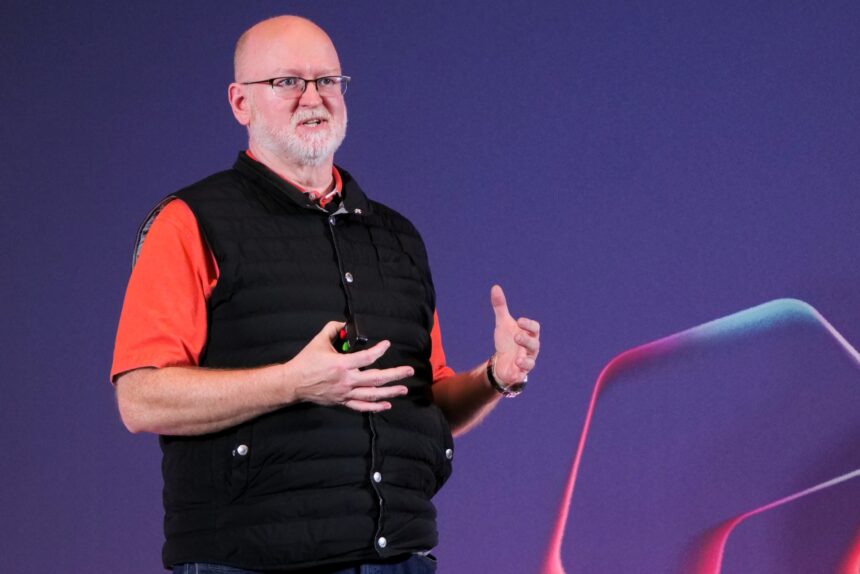
Microsoft CTO Kevin Scott took the stand Wednesday and, for the first time, publicly addressed the internal email that Elon Musk’s lawyers have cited to support allegations that Microsoft knew OpenAI was abandoning its nonprofit mission before investing billions in the company.
That email, sent by Scott on March 7, 2018, read in part, “I wonder if the big OpenAI donors are aware of these plans? Ideologically, I can’t imagine that they funded an open effort to concentrate ML [machine learning] talent so that they could then go build a closed, for-profit thing on its back.”
Musk alleges in the suit that Sam Altman and OpenAI secured his donations to found a nonprofit AI lab and then, with Microsoft’s help, converted it into a for-profit venture that enriched its leaders.
On the stand Wednesday, Scott said he was asking whether OpenAI even had standing to pursue the commercial plans it was pitching to Microsoft, not raising bigger questions about its mission. He explained that both companies were behind Google in AI, that OpenAI had recently left Azure for Google, and that he was worried the conversations would be “a big distraction.”
Scott said the OpenAI donor he had in mind was not Musk but rather his friend Reid Hoffman, the LinkedIn co-founder, who sat on both the Microsoft and OpenAI boards.
But later that year, Scott testified, over dinner with Altman and retired Microsoft exec Craig Mundie at Flea Street Cafe in Menlo Park, he learned a key detail: Hoffman, the donor he had wondered about, was actually investing in OpenAI’s new for-profit entity and joining its board.
Also at the dinner, Scott said he learned that OpenAI was raising a $500 million round, that Altman was leaving Y Combinator to lead the company full time, and that OpenAI had created a new “capped profit” corporate structure as part of the new funding round. Scott called that structure “surprising and interesting” — something he said he had never seen before.
The path to a deal: But Microsoft was still far from committing. Scott testified that the company had “a substantial amount of diligence we needed to do,” including technical, financial, legal, and governance.
By June 2019, the stakes were becoming more clear. In a confidential memo at the time, filed as an exhibit in the case, Scott and Microsoft CFO Amy Hood formally asked Microsoft’s board to approve a $1 billion investment in OpenAI. Scott warned that Google had used its proprietary AI training infrastructure to pull ahead, and that Microsoft was “scrambling to replicate” the results.
Without OpenAI, Scott wrote in an appendix to the memo, Microsoft faced “gaps in experience and talent” that would make building its own program “time-consuming and risky.”
A key part of the strategic case was that Microsoft needed what Scott called a “frontier AI workload” on Azure — a customer pushing the platform at a scale that would reveal what infrastructure needed to be built. Google had that advantage; Microsoft did not.
The board approved the investment. Microsoft announced the deal in July 2019, the first investment in a multi-year partnership that would see Microsoft commit a total of $13 billion to OpenAI.
Within six months of that first deal, the companies had built their first AI supercomputer together, and OpenAI used the computing horsepower to train what would become known as GPT-3.
On the stand Wednesday, Scott called the partnership a success. “I’m very proud of our infrastructure capabilities,” he said, adding that he was proud overall of what Microsoft enabled OpenAI to do.
Pushback from Musk’s team: One of Musk’s lawyers challenged elements of Scott’s account in a brief but pointed cross-examination.
For example, Scott had testified that he did not have any understanding when writing the March 2018 email of whether OpenAI was releasing its technology as open source. Musk’s lawyer showed Scott an email he had received earlier, in which Microsoft chief scientist Eric Horvitz wrote OpenAI had “been sharing their work openly, per their basic tenet.” Scott confirmed he received it.
Musk’s lawyer also pressed the Scott on whether Microsoft had conducted legal due diligence specifically for compliance with nonprofit law. Scott said he didn’t know, adding that the legal work was handled by others on Microsoft’s team.
New financial details: Also on the stand Wednesday, Microsoft corporate development leader Michael Wetter addressed the scale of Microsoft’s commitment to OpenAI. He testified that Microsoft’s total spending related to OpenAI — including its $13 billion in investment commitments, Azure infrastructure, and hosting costs — is “upwards of $100 billion” as of this fiscal year end in June.
Wetter testified that Microsoft had generated approximately $9.5 billion in direct revenue from the partnership through March 2025. Separately, The Information reported this week that Microsoft’s total OpenAI-related revenue (including Azure server rentals, Copilot sales, and revenue-sharing payments) exceeded $30 billion between 2023 and 2025.
Under their deal announced last fall, Microsoft received a stake of roughly 27% in OpenAI, with a commitment by OpenAI to spend $250 billion on Microsoft’s Azure cloud services.
On cross-examination by a lawyer for Musk, Wetter acknowledged that Microsoft, having contributed 98% of the capital in OpenAI’s for-profit entity at one point in time, held effective approval rights over major corporate transactions. This is a level of influence Musk’s lawyers have argued amounted to control.
Wetter said Microsoft has never rejected an approval request.
Under the latest renegotiation of their deal, announced as the trial began, OpenAI gained the ability to serve its products on any cloud platform, ending its exclusive commitment to Azure. Amazon Web Services quickly moved to offer OpenAI’s models on its own platform.
Microsoft’s license to OpenAI’s technology was extended through 2032 but became non-exclusive, and the companies removed a clause that could have cut Microsoft off from future models if OpenAI declared it had achieved artificial general intelligence.
Musk’s legal case: Lawyers for the SpaceX and Tesla founder have argued that Microsoft’s approval rights gave it effective control over OpenAI’s transformation from nonprofit to for-profit, and that the company proceeded despite its own CTO flagging the potential problem in 2018.
Microsoft has maintained that it relied on OpenAI’s contractual assurances that the partnership would not violate any third-party rights. Wetter testified that Microsoft found “no conditions related to Elon Musk” in its normal process of due diligence.
Microsoft is named as a defendant in the case on allegations of aiding and abetting what Musk asserts was a breach of charitable trust by Altman and OpenAI in the for-profit conversion.
What’s next in the suit: Testimony in the case ended around 1 p.m. today in federal court in Oakland. Closing arguments are set for Thursday, with jury deliberations expected to begin on Monday.
The jury will determine whether OpenAI breached its charitable trust and whether Altman and others were unjustly enriched. If the jury finds for Musk, the judge will determine the amount of financial damages.
Musk is seeking up to $134 billion across all defendants, though U.S. District Judge Yvonne Gonzalez Rogers has questioned the methodology behind those financial calculations. Musk, the world’s richest person, has said he would donate the proceeds to charity.
GeekWire reported on today’s proceedings via the court’s audio livestream.
Read the full article here