
NASA’s most powerful rocket is due to send four astronauts on a round-the-moon journey as early as this week, and although the launch team has to make sure everything goes right in Florida, the mission’s success will also depend on hardware that was built in the Seattle area.
During a visit to two of the contractors for NASA’s Artemis moon program on Monday, U.S. Sen. Maria Cantwell said that when it comes to spaceflight, it’s important to get the little things right.
“A lot of people think, ‘Oh, well, we know how to build big rockets,’ right?” the Washington state Democrat said at Karman Space & Defense’s manufacturing facility in Mukilteo, Wash. “But do we know how to separate payloads and return them, and do all of that? That’s what we’re doing here in Puget Sound. … I think that’s the untold story that people don’t understand.”
NASA’s big story will focus on the first humans to go from the Earth to the moon since the Apollo 17 mission in 1972. Artemis 2’s crew won’t land on the lunar surface during what’s expected to be a 10-day mission. But because their figure-8 route takes them 4,700 miles beyond the moon’s far side, they’ll set a new distance record for human travel beyond Earth.
The first opportunity for liftoff from NASA’s Kennedy Space Center in Florida is scheduled for 6:24 p.m. ET (3:24 p.m. PT) on Wednesday, with backup dates available through April 6. NASA plans to provide live video coverage of the countdown and launch via YouTube, starting at 12:50 p.m. ET (9:50 a.m. PT) on launch day.
This will be the second launch for NASA’s Space Launch System rocket, which sent an uncrewed Orion space capsule around the moon for the Artemis 1 test mission in 2022. The Artemis 2 crew — including NASA astronauts Reid Wiseman, Christina Koch, Victor Glover and Canadian astronaut Jeremy Hansen — will be the first people to ride an Orion into space.
If all goes according to plan, Artemis 2 will clear the way for NASA to test the lunar landers built by Elon Musk’s SpaceX and Jeff Bezos’ Blue Origin space ventures in 2027, then for Artemis 3 to put astronauts on the surface of the moon in 2028. And that’s just the start. “Ultimately, Artemis is about returning to the moon and building a permanent moon base that can then be used for accelerating our travel to Mars,” Cantwell said.
In order for the Artemis program’s big story to unfold, thousands of smaller but no less important stories will have to play out successfully. NASA says 2,700 commercial suppliers in 47 states have contributed to the Artemis program. More than three dozen of those suppliers, ranging from Blue Origin to SuperGraphics, have a presence in Washington state.
One of the best-known of those Washington state suppliers is L3Harris, which is headquartered in California but operates a facility in Redmond that has built thrusters for nearly every NASA space program. (The facility was operated by Aerojet Rocketdyne until L3Harris acquired that company in 2023. Now L3Harris is in the midst of yet another corporate transition.)
During her visit to the Redmond facility, Cantwell said L3Harris and other space companies exemplify the “engineering mindshare” that’s one of the strengths of the Pacific Northwest’s tech industry. “That is why people have called us the Silicon Valley of space,” she said.
L3Harris’ Redmond team manufactures thrusters for Orion’s European-built service module, Orion’s crew module and the Space Launch System’s upper stage. It’s also been given a leading role in the development of the main engine for future Orion spacecraft.
John Schneider, vice president of operations for L3Harris, acknowledged that most of the rocket engines built to send astronauts to the moon come from other places. “But if you want to come back, you need a Redmond thruster to bring you back and get you back to Earth safely,” he said.
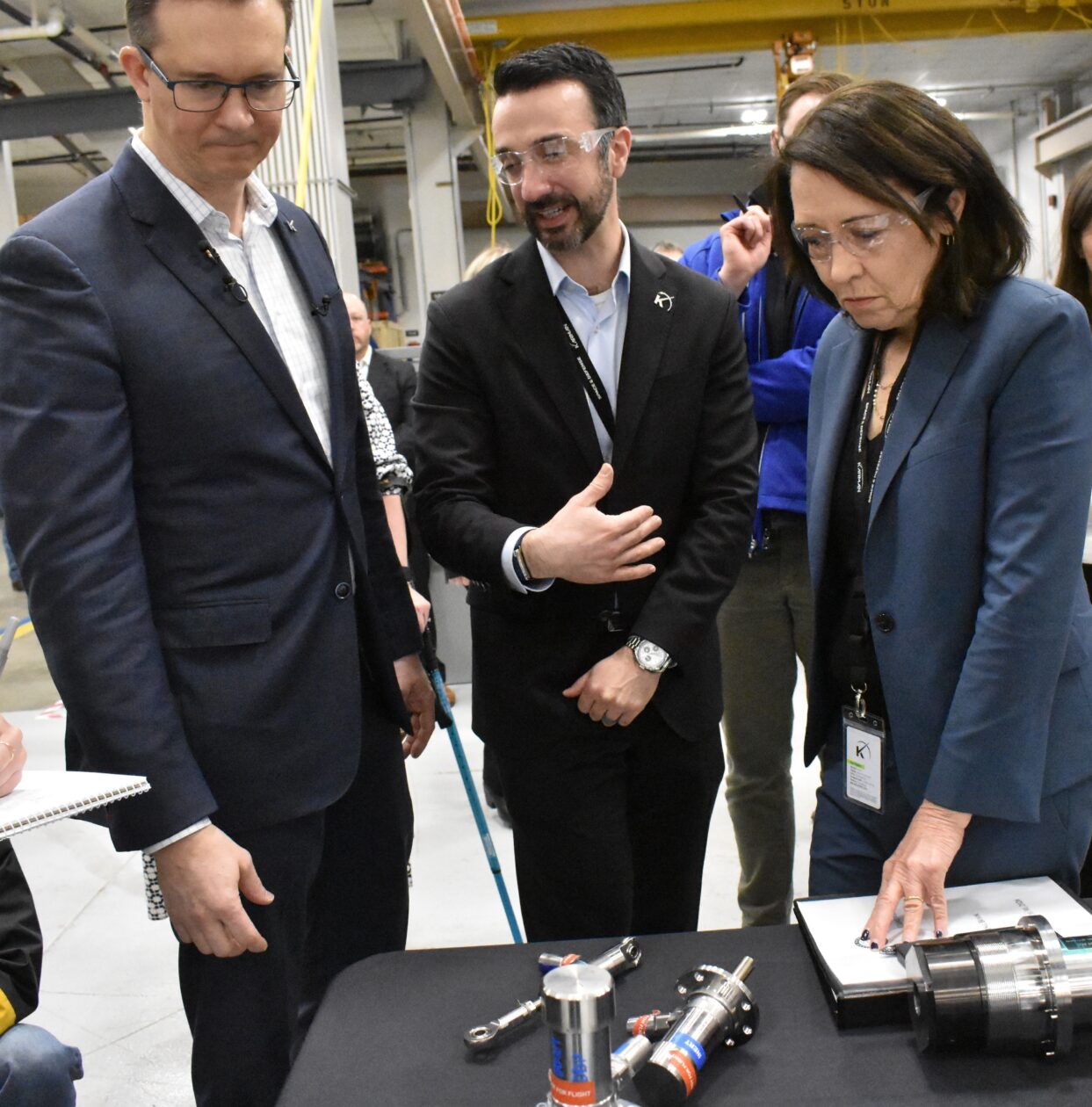
You also need the hardware built by Karman Space & Defense. Like L3Harris, Karman is based in California but operates a facility in the Seattle area. The team in Mukilteo makes mechanisms that ensure the safe deployment of Orion’s parachutes, and mechanisms that are designed to open a side hatch on the Orion spacecraft if the astronauts need to make an emergency exit.
Jonathan Beaudoin, chief operating officer at Karman Space & Defense, says he hopes we’ll never have to see the hatch release system activated for an actual emergency. “But if we do, it had better work,” he added.
Artemis 2 is currently focusing the space spotlight on the teams supporting the Space Launch System and the Orion spacecraft, but Washington state’s space companies are also involved in other aspects of the Artemis program. Blue Origin, for example, is getting its Blue Moon lander ready for missions to the moon and working on a system capable of turning moon dirt into solar cells and electrical wire.
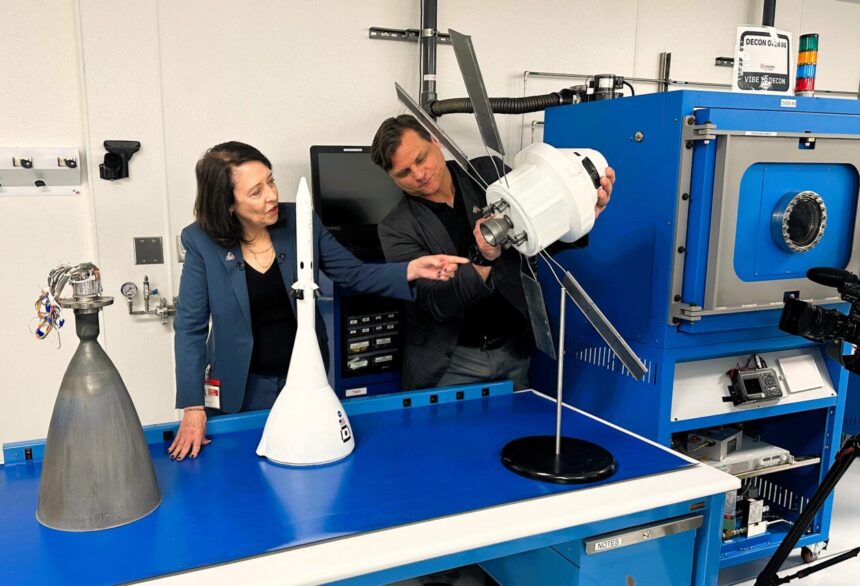
During today’s tour, Cantwell got a sneak peek at a robotic lander that Karman is assembling for a NASA-supported mission to the lunar surface. The senator said she also heard about innovations that aren’t yet ready for public disclosure. Those innovations could bubble up to the surface as NASA pursues its plan to create a permanent moon base — a plan endorsed in a bipartisan authorization bill that Cantwell and her colleagues on the Senate Commerce Committee approved unanimously this month.
“This is about cutting-edge technology. These guys out here aren’t waiting for somebody to describe to them what comes next. They’re out here solving a problem and then saying to NASA, ‘We’ve got a solution.’ And that’s really fantastic,” Cantwell said.
“Obviously, some of this they don’t want to show for intellectual property protection reasons,” she added. “But we’re just really, really proud that our region is so far ahead, thinking through the problems that we’re going to incur and what the possible solutions should be.”
Read the full article here