
Foldable smartphones have been the next big thing for several years, and that is exactly the problem. The category has generated plenty of hype, engineering swagger, and “future of mobile” headlines. What it has not achieved is broad mainstream adoption.
Even after multiple product cycles from Samsung, Motorola, Google, OnePlus, and others, foldables remain a small slice of the overall smartphone market, estimated at only about 3% of total smartphone sales. That makes foldables less of a mass market today and more of a beachhead waiting for the right catalyst.
Can Apple Be the Foldable Catalyst?
The obvious question is whether Apple can become that catalyst. SmartTech Research recently conducted primary research to better understand consumer interest in foldable smartphones, with a particular focus on the potential impact of Apple’s rumored entry into the category.
The survey was conducted in May 2026 and drew 531 completed responses at the top of the survey funnel, with 291 qualified respondents answering the deeper, foldable-smartphone questions. This represents a statistically meaningful sample for directional market insight, especially because respondents came from diverse geographic regions across the United States rather than being concentrated in coastal tech hubs or among more sophisticated early adopters.
The sample included respondents from the South Atlantic, Pacific, Middle Atlantic, East North Central, Mountain, West South Central, New England, East South Central, and West North Central regions.
Geographic diversity matters because foldable interest needs to be measured beyond the usual gadget crowd. The category does not need more validation from people who read spec sheets for fun. It needs validation from everyday smartphone buyers who care about price, durability, battery life, screen size, convenience, and whether the device makes their lives easier.
Consumers Show Strong Interest in Foldables
On that front, the survey results are surprisingly encouraging.
The first major takeaway is that consumers are more receptive to foldables than the category’s current market share would suggest. Among respondents who answered the foldable consideration question, 30.9% said they are very open to considering a foldable smartphone for their next phone purchase, while another 27.5% said they are somewhat open. That means 58.4% showed at least some openness to the category. Only 5.3% said they are not open at all.
That is not a niche response. It is latent demand that the market has not converted yet. Despite some contrary feedback from industry analysts, consumers are not rejecting foldables as weird, gimmicky, or irrelevant. They are saying, in effect, “Show me why this matters.” That is exactly where Apple tends to be dangerous.
Apple rarely enters a category first. Instead, it moves when it believes it can redefine usability, design language, ecosystem value, and consumer trust. The iPod was not the first MP3 player. The iPhone was not the first smartphone. The Apple Watch was not the first smartwatch. AirPods were not the first wireless earbuds.
Apple’s playbook is not about inventing the category. It is about making the category feel inevitable. The primary research suggests Apple could do that with foldables, but only if it gets the product and pricing right.
Apple’s Trust Advantage
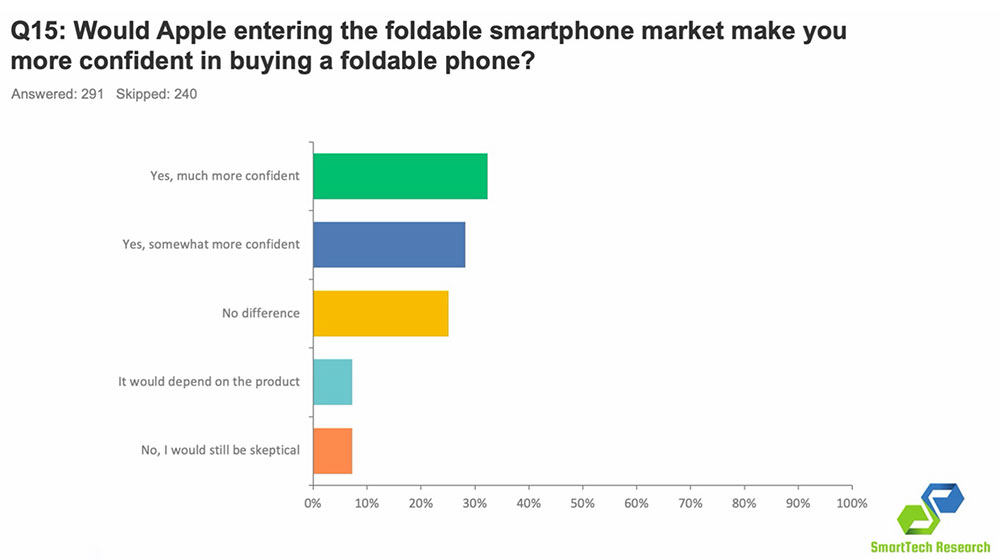
The most compelling data point is the Apple confidence effect. When respondents were asked whether Apple entering the foldable smartphone market would make them more confident in buying a foldable phone, 32.3% said yes, much more confident, and 28.2% said yes, somewhat more confident. Combined, 60.5% said Apple’s entry would increase their confidence in buying a foldable.
That is a big deal because Apple’s brand still acts as a trust accelerator. The company has trained consumers to believe that when Apple enters a category, it has probably solved enough of the friction points to make the product worth considering.
For foldables, that trust could be especially powerful because the category still carries baggage. Consumers worry about high prices, durability, screen creases, repair costs, battery life, and device thickness.
These are not imaginary concerns. They are the core reasons foldables have not broken out of the premium niche. In the survey, high price was the top concern, cited by 24.1% of respondents. Durability concerns came next at 22.0%. Another 16.5% said they were Apple users who want to stay in the Apple ecosystem because Apple currently has no foldable available.
Permission to Jump In
That last number may be the quietest but most important result in the entire study. Some consumers are not avoiding foldables because they dislike the form factor. Rather, they are staying on the sidelines because, for lack of a better word, Apple has not given them permission to enter the category.
That is vintage Apple. The ecosystem does not merely retain users. It slows their experimentation outside the Apple universe. For many iPhone owners, switching to a Samsung Galaxy Z Fold, Google Pixel Fold, Motorola Razr, or OnePlus Open is not just a hardware decision. It means leaving iMessage, FaceTime, AirDrop, Apple Watch, iCloud, Apple Photos, Apple Pay, and the general comfort of a system that works predictably across devices.
That ecosystem lock-in gives Apple a built-in audience for a foldable iPhone. The survey reinforces this point. When asked which statement best describes their attitude toward Apple and foldable smartphones, 32.6% said they are waiting for Apple before seriously considering one. Another 20.3% said they prefer Apple but would not automatically buy a foldable iPhone.
That is both good news and a warning. Nearly one-third of respondents are essentially sitting on the sidelines waiting for Apple, a powerful demand signal. The cautionary side of the equation is just as important because Apple cannot simply slap a hinge on an iPhone, charge a luxury price, and expect the market to genuflect.
Bigger Screen Without the Bulk
The product story becomes critical here. Consumers appear to understand the functional value of foldables when the benefits are clear. When respondents were asked how appealing the idea of a foldable is compared with a classic candy-bar smartphone, 29.2% said much more appealing, and 29.9% said somewhat more appealing. That means 59.1% found the foldable concept more appealing than a traditional smartphone after seeing the images and prompts.
Those results are strong because consumers were not just responding to novelty. Instead, they identified practical use cases. The most frequently cited benefit was a larger screen for video, browsing, and reading, selected by 39.9% of respondents. Better multitasking came next at 19.6%, followed by a more tablet-like experience in a pocketable device at 15.8%.
That tells us something important about where Apple should focus the message. Apple should not overcomplicate the pitch. This is not about some abstract “future of mobile computing.” Consumers respond to the idea that a foldable gives them a bigger screen when they want it and a pocketable phone when they do not. That is the whole ballgame.
Entertainment, Multitasking Drive Interest
The strongest usage scenarios also point in that direction. Entertainment was selected by 50.5% of respondents, followed by multitasking between apps at 47.4% and reading news, books, or documents at 39.2%. Work productivity and email came in at 19.9%, while travel landed at 10.3%.
This is not a narrow enterprise device, a gaming niche, or a tool reserved for content creators. The mainstream hook is entertainment, reading, multitasking, and convenience.
That matters because Apple already has the ecosystem assets to make those use cases sing. Apple TV, Apple News, Apple Books, Safari, Notes, Mail, FaceTime, iCloud, Photos, and iPadOS-style multitasking all become more interesting on a foldable canvas. A foldable iPhone could be the missing link between the iPhone and the iPad mini.

The survey tested that idea directly. When respondents were asked how convincing they found the argument that a foldable smartphone can replace both a phone and a small tablet, 25.4% said it was very convincing and 30.2% said it was somewhat convincing. That means 55.6% found the phone-plus-small-tablet argument convincing at some level.
That is a legitimate market opening. It does not mean everyone will ditch their iPad. It does mean Apple could position a foldable iPhone as a premium convergence device for users who want one device that feels like two.
Pricing Remains the Biggest Challenge
Here is where the story gets tricky: pricing could be Apple’s biggest hurdle.
The survey shows clear interest but also price sensitivity. When respondents were asked what they expected to pay for their next smartphone, 30.6% said $500 or less, and 40.1% said $599 to $999. Only 24.2% expected to pay $1,000 to $1,499, and just 5.1% expected to pay $1,500 or above.
That is the harsh reality. Most consumers are not walking into a carrier store, Apple Store, or other retail outlet expecting to pay $1,800 or more for a phone.
The pricing question around foldables makes the challenge even more evident. If a foldable smartphone clearly delivered benefits over a traditional smartphone, 38.1% said the highest price they would consider paying is under $1,500. Another 18.2% said $1,500 to $1,799. Only 9.3% said $1,800 to $1,999, while 11.0% said $2,000 to $2,199. Just 2.8% said $2,800 or more.
Translation: Apple has pricing power, but it does not have unlimited pricing power. A foldable iPhone priced near $1,999 could generate excitement, but it could also quickly narrow the addressable audience. At $2,500 or more, Apple risks turning a potentially category-expanding device into a lavish tech trophy. That would be a mistake.
Additionally, lingering high energy prices into the latter part of the year, particularly for gasoline, could pose an additional challenge for Apple. A foldable smartphone may be perceived as, and probably will be, a luxury purchase, which could affect its market positioning.
What Consumers Are Saying
The 142 open-ended comments provided by respondents add a sharper, more human edge to the data: consumers are intrigued by foldables, but they are not ready to suspend disbelief. Several respondents came back to the same gut-level concerns: the crease, the seam, screen durability, repair costs, bulk, weight, and whether a foldable phone can survive three or four years of real-world use.
At the same time, respondents also identified meaningful advantages. People see real value in multitasking, a tablet-sized screen that still fits in a pocket, easier reading, mobile entertainment, and even practical workflows like toggling between apps for security codes.
The vibe is not “foldables are dead.” It is closer to “convince me this thing will not crack, cost a fortune to fix, or feel like a brick.” That is exactly why Apple’s potential entry matters. If Apple can make the foldable feel durable, elegant, useful, and ecosystem-native, it has a shot at turning cautious curiosity into real demand.
Consumers Want Proof Before Buying
Carrier subsidies, trade-in offers, installment plans, and aggressive upgrade programs will matter. When asked what they would most likely do if Apple released a foldable iPhone, only 20.6% said they would buy it as soon as it was available. Another 21.0% said they would wait for reviews, 12.7% would wait for a lower-priced version, and 15.5% would consider it only with carrier discounts or trade-in offers.
That is not hesitation. It is rational consumer behavior. People are interested, but they will want proof that:
- Reviewers bless the device
- The crease is tolerable
- The hinge holds up in real life
- Battery life is adequate
- Apple has made foldable software feel natural rather than forced
This is why Apple’s execution burden is so high. For Samsung, foldables can be a showcase of innovation and a premium Android differentiator. For Apple, a foldable iPhone would carry higher expectations. It cannot feel experimental, fragile, or like a compromise disguised as innovation.
It has to feel like an iPhone. That means polished hardware, a near-invisible learning curve, strong app continuity, optimized multitasking, credible battery life, and a design that does not make consumers feel like they are carrying a science project in their pocket.
Consumer Awareness Already Exists
The research also shows that consumers are not completely new to the category. Before taking the survey, 24.1% said they were extremely familiar with foldable smartphones, 23.7% were very familiar, and 34% were somewhat familiar. Only 4.5% said they were not at all familiar.
Those findings are encouraging because Apple would not have to educate the market from ground zero. The category already has awareness. What it lacks is broad-based confidence and a killer ecosystem-driven reason to buy. Apple can supply both, but that still does not guarantee this is a victory lap.
The current foldable market is small for a reason. Consumers have been trained by years of slab phones to value thinness, durability, battery life, and simplicity. A foldable adds complexity, and complexity needs to earn its keep.
That is why the “larger screen in your pocket” message is so important. If Apple frames the device as just a premium iPhone that folds, the value proposition may feel thin. If it’s framed as the most personal iPhone ever built, that unfolds into a mini tablet, entertainment screen, reading device, productivity tool, and travel companion, the story gets much stronger.
The Opportunity Is Real — Execution Matters
The survey results are good news for Apple, but they are not a blank check. The findings suggest Apple’s ecosystem can lure many non-foldable smartphone users into the category while also showing that a meaningful number of consumers are waiting for Apple specifically before taking foldables seriously. That is the best possible starting point for a company that excels at turning latent demand into premium product momentum.
Still, pricing will be a major hurdle. Apple can overcome that if the device feels indispensable rather than merely interesting. The company will need to make its foldable phone feel less like a luxury surcharge and more like a smarter replacement cycle. It must convince consumers that they are not paying extra for a hinge but for a new usage model.
That is the difference between curiosity and conversion. It is also worth noting that these are top-level findings. My colleague Brett Faulk recently created a SmartTechCheck EduSeries episode that takes a deeper dive into this data and elaborates on the results from different segments of the research.
That in-depth analysis is important because the real story will likely vary by income, current device platform, Apple loyalty, tablet ownership, upgrade timing, age, and price tolerance.
Bottom Line
Even at the top level, the signal is clear. Foldables have more mainstream appeal than their market share implies, and Apple has a credible opportunity to expand the category. The company’s ecosystem provides a meaningful advantage, but pricing remains a very real constraint. Consumers are not asking for novelty — they are asking for a reason to care.
If Apple enters the foldable market with a polished product, well-defined use cases, and a pricing strategy that does not insult reality, it could do what Apple has done before: take a category that looks niche and make it feel normal.
Rumors abound about what Apple might introduce in the September timeframe, and the world may learn more about what the company might announce at its upcoming Worldwide Developers Conference (WWDC), though that event generally doesn’t reveal new hardware.
Nonetheless, we might get a glimpse of how Apple intends to retool its mobile device operating systems and/or enable its developer ecosystem with tools to begin optimizing apps for foldable devices, enabling interesting new usage models not possible with a traditional candy bar smartphone form factor.
Read the full article here