
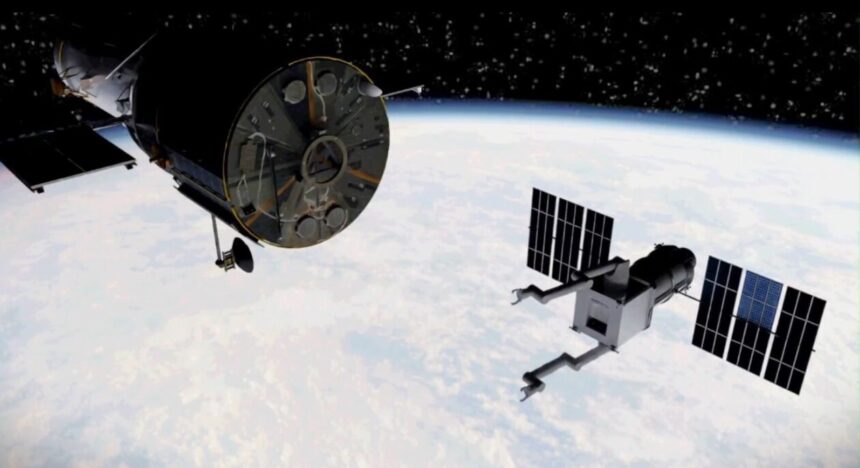
A space startup founded by veterans of Jeff Bezos’ Blue Origin space venture is recruiting partners in its quest to build robotic arms powered by artificial intelligence.
Founded in late 2024, Puyallup, Wash.-based Orbital Robotics is still in its infancy — but it has already raised about $110,000 in funding from friends and family. Orbital Robotics CEO Aaron Borger told GeekWire that the company is working with a stealthy space venture on an orbital rendezvous project for the U.S. Space Force, with a series of demonstration missions scheduled in the next year and a half.
And that’s just the start: Borger and his teammates are trying to get traction for a plan that could give NASA’s aging Hubble Space Telescope a much-needed boost.
“We worked to get to the right people to talk to, both on the servicing side and on the mission side, and we’re in conversations now on how we could work together on a collaborative mission,” said Doug Kohl, Orbital Robotics’ chief operating officer.
Borger and Kohl both worked at Blue Origin until 2024, and then went on to create Orbital Robotics with fellow co-founders Riley Mark and Sohil Pokharna. Their advisers include Chris Sembroski, an engineer who went into orbit in 2021 for a privately funded philanthropic space mission known as Inspiration4 and later spent two and a half years at Blue Origin.

Orbital Robotics aims to focus on a key challenge looming for the next stage of the new space age: how to build spacecraft that can interact with other orbiting objects safely.
That’s not as easy as it may sound, especially when you’re trying to manipulate objects in space while obeying Newton’s Third Law of Motion. When a robotic arm on a free-flying spacecraft moves around, the spacecraft itself reacts with an equal and opposite motion. The arm has to compensate for those movements as it reaches out to grab its target.
“That is exactly one of the hardest parts about putting robotic arms on spacecraft,” Borger said. “When you move the arm, your spacecraft is going to move as well.”
To address the challenge, Orbital Robotics is developing a suite of AI-based software tools designed to track targets in space, plan out orbital maneuvers and interact with other spacecraft. It’s also laying the groundwork for robotic arms and spacecraft that make use of its technology. “A lot of NASA engineers will say you can’t use AI because you can’t really predict what it’s going to do, but with our method, we can,” Borger said.
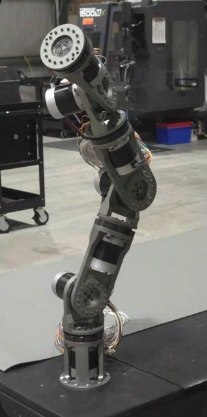
Earlier in their careers, Borger and Mark were involved in efforts to put small AI-controlled robotic arms through suborbital testing. Now Orbital Robotics has built a larger prototype arm with seven degrees of freedom. For the next few months, the company will be putting that hardware through its paces in its lab.
“Those smaller arms were designed to catch, like, a ball or a cube. We had a small 3D-printed wrench that we were focused on,” Borger said. “This one is more focused on how you dock with space debris, for example.”
The ability to inspect or link up with objects in space has obvious implications for national security in space, which is why the Pentagon is so interested in the technology. Borger declined to discuss that side of Orbital Robotics’ business plan, but he noted that there are commercial applications as well.
“Now that there’s the ability to put so much mass up there, it’s come to the point where, OK, you have all this stuff up there. How do you actually continue to use it, rather than just letting it come down or die up there?” he said. “If you want to refuel something, if you want to repair something, the first step is, how do you capture it? That’s what we’re really focused on right now. … Then we can start focusing on using our robotic arms to manipulate things, start refilling it, repairing it, all sorts of stuff.”
Orbital Robotics recently tested its tracking software using video footage that was captured during an earlier suborbital test mission. Now the team is collaborating with a stealth partner on a series of space missions. The first mission would test Orbital Robotics’ flight software. Later missions would test the company’s robotic arm and demonstrate its ability to capture a spacecraft in orbit. Borger said it would be premature to disclose the partner’s identity, but he mentioned a 2026-2027 time frame for the missions.
There’s a growing interest in orbital rendezvous, proximity operations and capture, or RPOC for short — and Orbital Robotics isn’t the only space company targeting that market. Starfish Space and Portal Space Systems are among other Seattle-area ventures on the RPOC frontier.
Borger said he prefers to think of such companies as potential partners rather than rivals.
“I think they could use our arms,” he said. “They could use some of our software.” The company has already announced partnerships with Redmond, Wash.-based Starcloud and Texas-based Space Ocean.
Orbital Robotics is also recruiting partners for an effort to save the 35-year-old Hubble Space Telescope from a fiery, mission-ending descent. Kohl said he and his collaborators are working on a white paper about the project that would be reviewed by NASA experts as well as astronauts who participated in previous Hubble servicing missions.
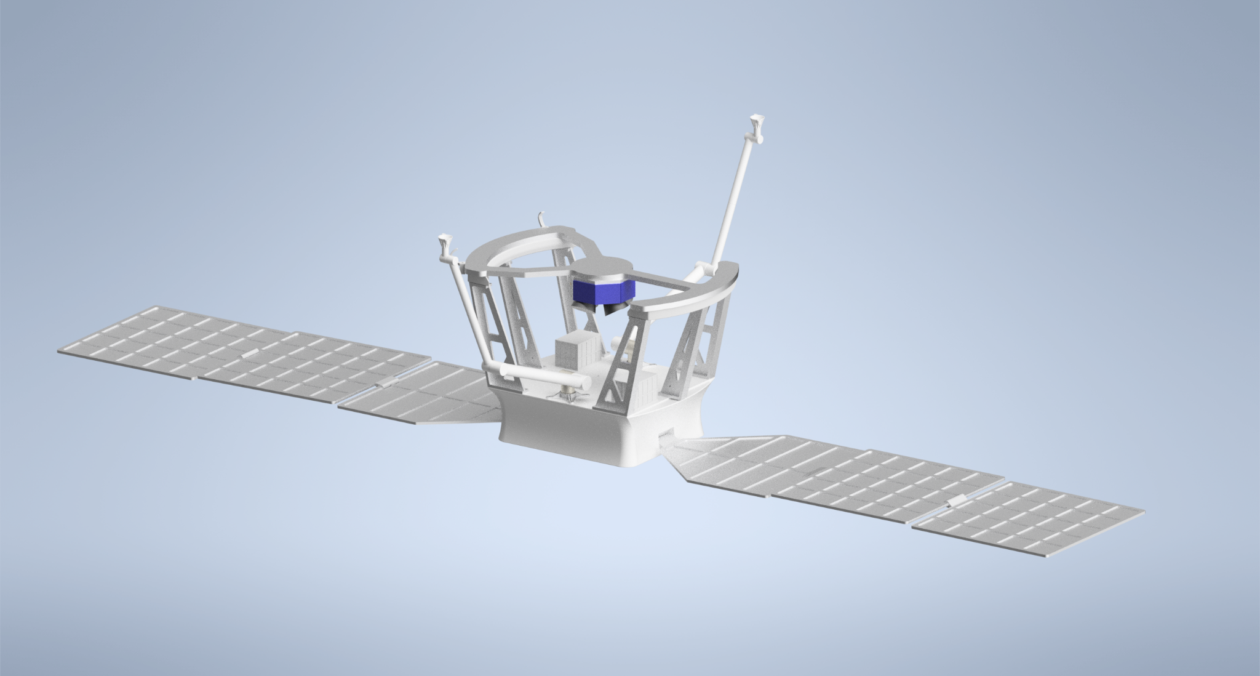
The plan calls for building a robotic spacecraft that could attach itself to the telescope, install a star tracker package on its exterior, boost Hubble to a more stable orbit, and then undock.
Several years ago, tech billionaire Jared Isaacman was trying to get NASA interested in a crewed Hubble reboost mission. In 2024, the space agency decided not to take him up on his proposal — but now that Isaacman is NASA’s administrator, Kohl is hoping that the public-private consortium he’s trying to assemble, known as the “Save the Hubble Space Telescope Alliance,” will get a warmer reception.
“Jared is as interested in Hubble as we are, and so we’re hoping to take an unsolicited proposal to him with the white paper on helping to recover Hubble,” he said.
The clock is ticking: Last week, a team of scientists reported that Hubble could fall to its doom in as little as three or four years, due to increased atmospheric drag caused by heightened solar activity. “Even though it would come in around 2030, we actually need to save it before that,” Borger said. “The longer you wait, the more difficult it is.”
Meanwhile, the clock is ticking for Orbital Robotics as well. Borger acknowledged that it’s going to take more funding to fuel the venture’s grand ambitions. “We’re OK with where we’re at on funding for now, and then we’ll go for a much larger round in a couple of months,” he said.
Read the full article here