
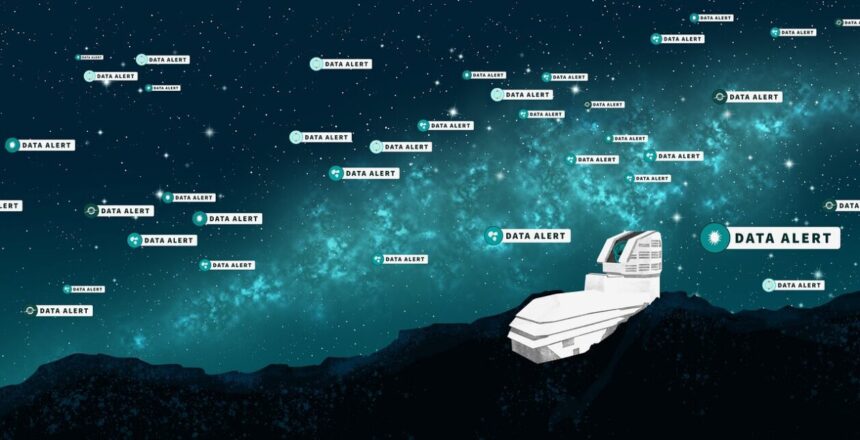
An astronomical alert system developed at the University of Washington started off with a bang this week, sending out 800,000 notifications about moving asteroids, exploding stars and other celestial changes detected by the Vera C. Rubin Observatory in Chile.
Tuesday night’s surge was just the first wave of alerts. Eventually, the Alert Production Pipeline is expected to produce up to 7 million alerts per night. Astronomers around the globe will use the system to sift through the torrent of data, zeroing in on events ranging from newly detected asteroids to supernovas, variable stars and active galactic nuclei.
“Rubin’s alert system was designed to allow anyone to identify interesting astronomical events with enough notice to rapidly obtain time-critical follow-up observations,” Eric Bellm, a UW astronomer who leads the Alert Production Pipeline Group for the Rubin Observatory, said today in a news release. “Rubin will survey the sky at an unprecedented scale and allow us to find the most rare and unusual objects in the universe. We can’t wait to see the exciting science that comes from these data.”
The $800 million observatory, jointly funded by the National Science Foundation and the U.S. Department of Energy’s Office of Science, had its grand opening last June. It is now ramping up to begin its 10-year Legacy Survey of Space and Time. Each night, the facility’s Simonyi Survey Telescope — named after the family of Seattle-area software billionaire Charles Simonyi, who provided $20 million in seed funding — will scan a swath of the Southern Hemisphere sky, generating up to 20 terabytes of data nightly.
Processing trillions of bytes of raw data is no easy task. For the past decade, the University of Washington’s Institute for Data Intensive Research in Astrophysics and Cosmology, also known as the DIRAC Institute, has been working with other teams across the country to figure out how to manage the observatory’s astronomical riches.
“Enabling real-time discovery on such a massive data stream has required years of technical innovation in image processing algorithms, databases and data orchestration,” Bellm said. “We’re thrilled to continue the UW’s legacy of excellence in data-driven science.”
Rubin’s data processing system is designed to compare pixels in new imagery with previous pictures of the same patch of sky. Each change in the image — for example, a shift in the location of a moving asteroid, or a change in the brightness of a supernova — triggers an alert within two minutes of image capture.
“The scale and speed of the alerts are unprecedented,” said Hsin-Fang Chiang, who is leading operations for data processing at the SLAC National Accelerator Laboratory’s U.S. Data Facility. “After generating hundreds of thousands of test alerts in the last few months, we are now able to say, within minutes, with each image, ‘here is everything’ and ‘go.’ ”
Software agents known as brokers use machine learning algorithms to filter the alerts for research teams and observatories. The official brokers for Rubin data include ALeRCE, AMPEL, ANTARES, Babamul, Fink, Lasair, Pitt-Google, SNAPS, and POI Broker. Using these tools, astronomers can set hyper-specific criteria — for example, to show alerts for events that are brighter than 21st magnitude, that have been detected less than six days ago, and that are also associated with two previous detections.
Thanks to the alert system, other observatories will be able to follow up on Rubin’s data and confirm astronomical discoveries. And through collaborations with citizen-science initiatives like Zooniverse, anyone with access to a computer will be able to join in as well.
Read the full article here