
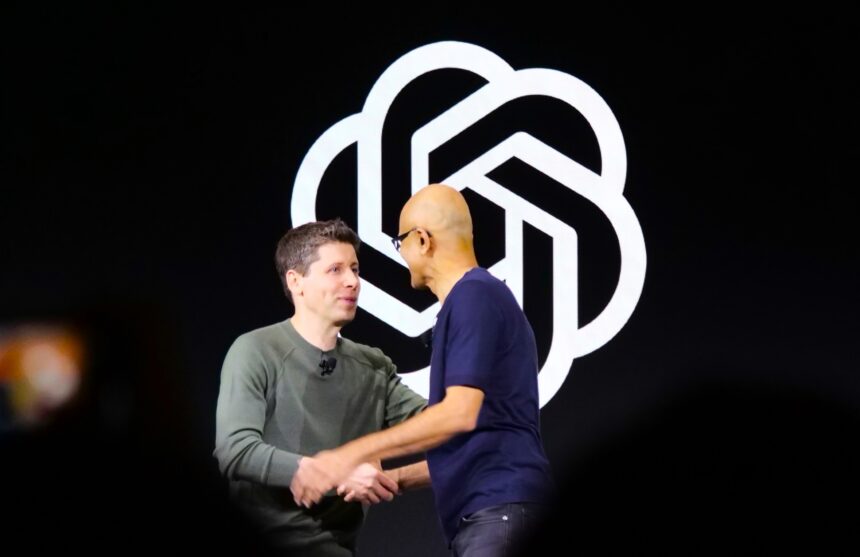
Satya Nadella drew a historical parallel to Microsoft’s early PC partnership with IBM as the tech giant prepared to invest $10 billion more in OpenAI in April 2022 — writing in an internal email that he didn’t want Microsoft to become IBM while OpenAI became the next Microsoft.
That email, presented as evidence by Elon Musk’s lead trial attorney Steven Molo, was one of the new details to emerge from the Microsoft CEO’s turn on the stand Monday morning in Musk’s lawsuit against Sam Altman, OpenAI and Microsoft in federal court in Oakland.
Nadella described the decision to invest in OpenAI as a “one-way door,” saying Microsoft couldn’t build two supercomputers — one for itself and one for OpenAI — and had to accept the opportunity cost of diverting scarce computing resources away from its own AI teams.
“We were outsourcing essentially a lot of the core IP development and taking a massive dependency on OpenAI,” Nadella testified, explaining that he wanted to ensure Microsoft had access to the intellectual property generated by the partnership, and continued to build its own knowledge and capabilities at the same time.
Board considerations unredacted: The testimony also provided new information from messages among Microsoft execs and Altman in the days following his brief ouster as OpenAI CEO in 2023. The names of potential candidates from that thread were previously redacted in public court records.
From Nadella’s testimony Monday, it emerged that two potential OpenAI board candidates for whom he voiced his disapproval were Diane Greene, the former Google Cloud CEO, and Bing Gordon, the veteran gaming exec and Kleiner Perkins partner previously on Amazon’s board. Nadella said he objected to both as potential candidates because of their ties to companies that compete directly with Microsoft in AI.
He said the discussions were initiated by Altman and other OpenAI insiders seeking his input, and that the board could have ignored his suggestions. One candidate he suggested, former Gates Foundation CEO Sue Desmond-Hellman, was later appointed to the board.
Musk argues that Microsoft’s efforts to protect its interests in the OpenAI partnership came at the expense of the OpenAI nonprofit’s original mission to develop AI for the benefit of humanity. His lawsuit alleges that Microsoft aided and abetted a breach of the charitable trust that governed OpenAI’s founding, misusing his original investment, estimated at $38 million to $44 million.
Enabling a massive nonprofit: Nadella offered a different view on the stand, describing a collaboration built on mutual benefit in which Microsoft took on enormous risk to support a fledgling AI lab that no one else was willing to fund. He said the partnership had created “one of the largest nonprofits in the world,” enabling products like ChatGPT and Copilot that put AI tools in the hands of millions of people.
Under cross-examination, however, Nadella acknowledged that he was not aware of any full-time employees at the OpenAI nonprofit before March 2026, or of any grants, research, or open-sourced technology it had produced.
Microsoft’s lead attorney, Russell Cohen, also sought to undermine Musk’s standing in the case. He walked Nadella through three major milestones in the Microsoft-OpenAI partnership — the 2019 announcement, a 2020 exclusive license to GPT-3, and the 2023 $10 billion investment — and asked each time whether Musk had reached out to object.
Each time, Nadella said no. He and Musk have each other’s phone numbers, he added.
Microsoft estimates the OpenAI return: Musk’s attorney, on cross-examination, sought to show the benefits Microsoft has received from the partnership. He walked Nadella through a January 2023 memo from Microsoft President Brad Smith to the company’s board, projecting a $92 billion return on Microsoft’s cumulative $13 billion investment in OpenAI.
According to the testimony, a footnote in the memo showed a 20% annual increase kicking in starting in 2025, which could roughly double the return within four years.
Under the restructured deal announced last year, the caps on Microsoft’s returns were removed entirely. Microsoft and OpenAI also recently amended the partnership to make Microsoft’s IP license non-exclusive and open all OpenAI products to any cloud provider.
Nadella confirmed the figures but noted that the investment carried real risk, saying the return could just as easily have been zero.
The trial, before U.S. District Judge Yvonne Gonzalez Rogers, is expected to continue through May 21, with OpenAI CEO Sam Altman also expected to take the stand this week.
GeekWire reported on today’s proceedings via the court’s audio livestream.
Read the full article here