

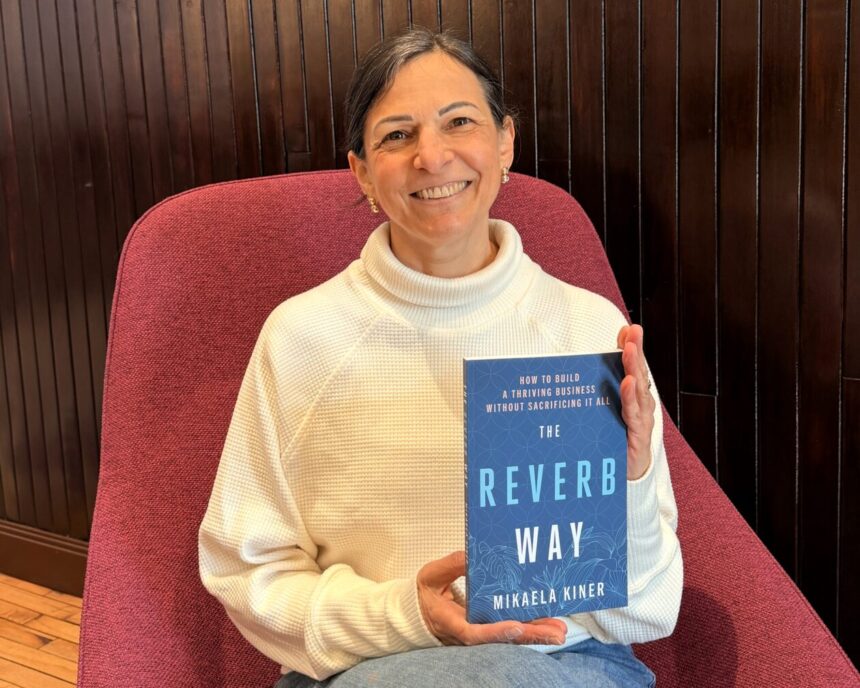
The dreamy part of Mikaela Kiner‘s life is easy to picture. She has spent her recent winters working from a small Costa Rica beach town, taking surfing lessons before dawn, sunset walks in the sand, and Zoom calls with real palm trees swaying in the background.
But “The Reverb Way,” her new book about building and running the Seattle-based HR consulting firm of the same name, is not the postcard version of the story.
Kiner describes what happened when new business dropped to half its usual volume, as tech layoffs, a rocky economy, and the rapid rise of AI hit Reverb’s client base. She battled insomnia so severe she couldn’t get through a workday without napping. Her daughter, watching her scramble through a client crisis, told her she’d never seen her this stressed.
The book is a candid account of the ups and downs, detailing what Kiner has learned in a decade of reorienting her work to support the life and the company she wanted to create.
“I didn’t want to give the impression that owning a business is easy,” Kiner said in a recent conversation about the book on the porch of a Seattle coffee shop. “You can still be tired, you can still be overworked, you can still be drained, and you can still struggle.”
At the same time, she wanted to convey the fun and joy that comes from the freedom of doing your own thing. Kiner spent 15 years in HR leadership at companies including Microsoft, Amazon, and Starbucks, often working 60 to 80 hours a week, before starting Reverb in 2015.
“I made a choice to try and do something different,” she said. “And I’m so happy I did. Really, really happy. The key words there being made a choice.”
“The Reverb Way” is her second book, following “Female Firebrands” in 2020.
The new book is part memoir and part leadership guide. It draws on Kiner’s corporate career and her decade running Reverb to offer insights on everything from hiring and delegation to performance management and company values, and the daily mechanics of productivity and protecting your time.
Practical takeaways
Here are some of the insights from the book that resonated with me:
Park your ideas. Instead of chasing every good idea the moment it came up, Kiner started logging them in a “Future Goals spreadsheet” and reviewing the list during quarterly business reviews. Some items got done as part of other initiatives. Others became irrelevant. But the team stopped getting pulled in a dozen directions at once.
Use your freedom. Reverb takes Fridays off from Memorial Day through Labor Day, with one person on call to check email a few times in case clients need help.
When Kiner offered to go further and adopt a formal four-day work week, the team turned her down. They already had the flexibility they needed. One employee had been going to a rock climbing gym at 3 p.m. every day, and Kiner never knew, because the work was getting done.
Don’t apologize for your schedule. Kiner writes about watching male executives cancel meetings for their kids’ soccer games without explanation or apology, and realizing she’d been justifying every time she was unavailable. Her rule now: no meetings before 9 or after 5, and no explanation necessary.
Build your own community. After being rejected from a business accelerator — possibly, she suspects, because she’d listed family time as a personal value — Kiner created her own informal group of women CEOs called WISE. They meet quarterly, share business insights, and support each other. Some are direct competitors. Friendship comes first.
Celebrate more than you think you need to. Kiner describes herself as a recovering perfectionist who used to hesitate to praise someone doing one thing well if they were struggling in another area.
For leaders who struggle with this, she suggests a simple tracking method: write down your team members’ names and add a checkmark each time you recognize them. Her point: everyone needs to hear they’re on the right track, probably more often than you think.
In that spirit, while the book is about Kiner’s experience, it also puts a big focus on the team that makes Reverb work, including co-owner and COO Sarah Wilkins, whom Kiner describes as the person who kept the company running during the worst stretches.
What’s happening now
As candid as the book is about the downturn, things have shifted since Kiner finished writing. In the weeks before our recent conversation, she said, new deal volume had jumped 50%, across tech, nonprofits, and small businesses. Reverb is hiring consultants again.
“I literally can’t explain it,” she said, noting that the turnaround has been happening despite inflation, gas prices, and geopolitical turmoil such as the war in Iran.
AI is a frequent backdrop and topic of conversation in their work. Kiner writes in the book, for example, about teams at some companies being told to double productivity with AI but getting little support.
In our conversation, she described a split: companies using AI as a way to demand more, and those actually bringing people along, showing them how to save time.
She’s not worried about AI replacing the human side of her work. One of her advisors uses a term she likes: “connective labor,” referring to empathy, conflict resolution, and the work of helping people and teams get unstuck. That part, she said, isn’t going away.
“I think there’s room for all of us,” she said. “Us and the agents, too.”
“The Reverb Way” is available in paperback and e-book versions.
Editor’s Note: GeekWire is a Reverb client.
Read the full article here