
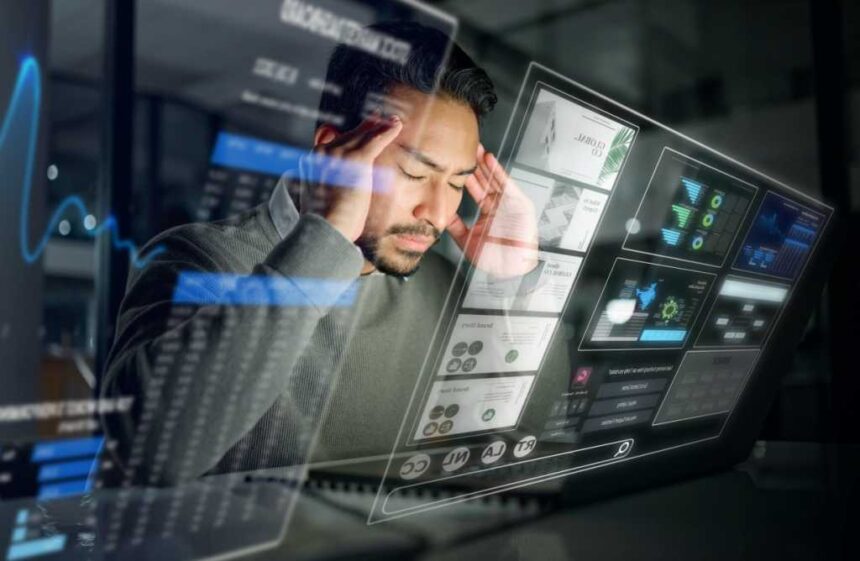
Workers are facing a conundrum: They worry about the potential for their displacement by AI even as it dramatically speeds up their own productivity.
According to a new survey from Anthropic, workers in roles most likely to be taken over by AI (developers or IT workers, for instance) recognize their precarious position. Yet, perhaps naturally, they readily adopt the tools that could take their jobs, and see first-hand how well they work.
This measurement is fundamentally different from the way others are gauging AI job displacement, noted Thomas Randall, research director at Info-Tech Research Group.
While macro reports, such as those from Goldman Sachs, the International Monetary Fund (IMF), or the World Economic Forum (WEF), are asking what share of existing job tasks AI could theoretically perform in the future, “Anthropic is measuring qualitative experiences of workers in the present,” he pointed out. This “tells us how people are navigating this landscape in real time.”
The paradox of AI in the workforce
Anthropic’s survey of 81,000 Claude users gauged peoples’ “visions and fears” around advances in AI, and weighed these findings against the company’s own measurement of jobs most vulnerable to AI displacement. This was based on Claude usage data; jobs are identified as more exposed when associated tasks are significantly performed on the platform, in work-related contexts, and take up a larger share of a role.
Some occupations at risk include computer programmers, data entry keyers, market researchers, software quality assurance analysts and testers, information security analysts, and computer user support specialists.
Overall, one-fifth of respondents expressed concern about displacement, noting that their job, or at least aspects of it, is being taken over by automation. Those in jobs identified as most exposed readily recognized that fact, voicing worry three times as often as those in less at-risk positions. One software engineer remarked: “like anyone who has a white collar job these days, I’m 100% concerned, pretty much 24/7 concerned, about losing my job eventually to AI.”
Early-career respondents were also more nervous than others.
At the same time, those in the highest-paid occupations reported the largest productivity gains when using AI. This is most notably in terms of their ability to perform new tasks, which was cited by 48% of users. In addition, 40% of workers said the technology helped speed up their work, and a little more than 10% said it improved the quality of their work.
In general, enterprise usage of AI is “actually quite consistent,” said Sanchit Vir Gogia, chief analyst at Greyhound Research. Teams are using the technology “where information is abundant and time is limited,” such as in drafting documents and code, summarizing content, responding to customer queries, navigating internal systems.
Is AI actually creating more work?
Still, not everyone thinks AI makes their jobs easier or faster. In some cases, people felt it made their work harder; for instance, project managers are assigning tickets for issues that are much more difficult to solve, Anthropic noted.
Gogia agreed that, even when tasks become easier, scope and responsibilities expand, and roles can absorb adjacent tasks. This results in a “redistribution of effort,” rather than a reduction of effort.
“Faster generation means higher expectations on quality,” he said. More output feeds into decision pipelines that are already constrained. “In some cases, the system becomes heavier, not lighter.”
Delayed impact on enterprises
The market is rewarding those who can integrate AI into complex workflows to do more, faster, and often with better outcomes, Gogia noted. However, the most exposed tasks, including documentation, basic coding, routine analysis, and structured support work, often “sit at the base of the experience ladder.”
These very tasks traditionally have given entry-level workers a way in, and the automation of them reduces the urgency for companies to hire them. “What you begin to lose is not the job,” said Gogia. “It is the path into the job.”
This can have a delayed impact; enterprises may not realize until years later that they do not have enough mid-level experts because they didn’t bring enough people in at lower levels. As AI plays a greater role in the workplace, there must be a “conscious effort” to rethink how people enter and grow, Gogia said. “New pathways need to be created, and they need to be deliberate.”
How enterprise leaders should adjust
As is often the case, sentiment moves faster than structural change, Gogia pointed out. Workers feel the shift almost immediately, but organizations take longer to adjust hiring, redesign roles, and rethink workforce structures.
“This is why expectations can become misaligned,” he noted. The reality is that most enterprises have introduced AI into existing ways of working without fundamentally changing them. Acceleration occurs in unchanged systems that still carry the same dependencies, approval chains, and coordination challenges.
Ultimately, Gogia advised, leaders must approach the shift with “intentional design.” This requires clarity, he emphasized; people need to understand how their work is expected to change. What will be enhanced? What will reduce? Where should they focus their development?
Baselines are moving: Roles may begin to look “oversized” as what used to be considered a full day’s work begins to look like half a day’s work, or what used to be considered efficient begins to look average. “AI is changing how work is done, but more importantly, it is changing what work expects from people,” said Gogia.
As well, Info-Tech’s Randall pointed out that workers who experience AI expanding what they can do by performing tasks previously outside their competence appear to relate to AI more positively than those who experience it as doing their existing job faster. So, he advised, “tech leaders should design AI deployment around capability extensions.”
Along with goal setting, managers must have support, Gogia emphasized. They set expectations and interpret strategy, and when they’re not properly equipped, “even the best tools will fall short,” he said. Measurement must also evolve; enterprises need to look at quality, sustainability, and capability development over time.
“What we are witnessing right now is not a sudden disruption,” said Gogia. “It is a gradual shift that is becoming impossible to ignore.”
Read the full article here