
[Note: Armon Dadgar, a UW computer science alum, was co-founder and CTO of HashiCorp, a cloud infrastructure automation company that was founded in 2013, went public on the NASDAQ in 2021, and sold to IBM in 2025. In his role, he spoke with thousands of companies adopting cloud across a wide range of industries, giving him a unique perspective on technology adoption.]
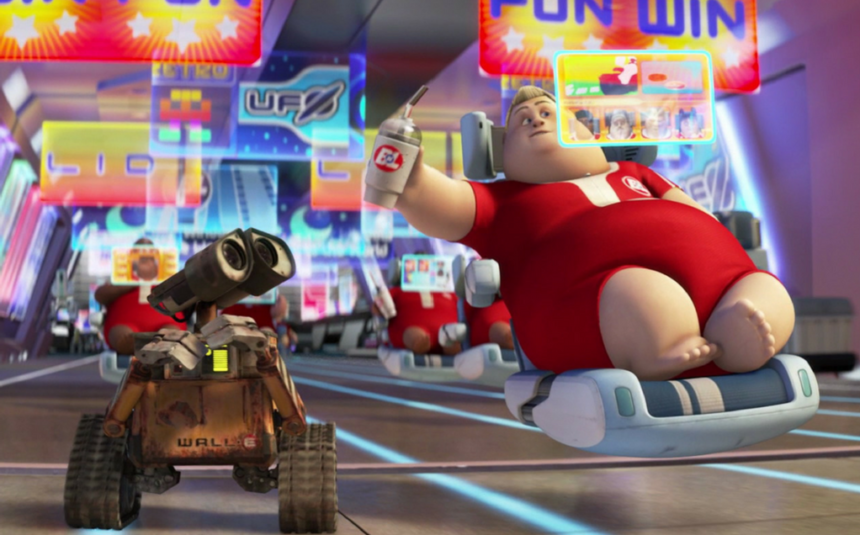
Pixar released WALL-E in June 2008, almost two weeks before Apple launched the App Store. The film follows WALL-E, a robot left behind to clean up Earth after it becomes an ecological wasteland no longer suitable for life, stranding humanity out in space. The remaining human population is entirely moribund in hoverchairs and completely immersed in a digital reality.
For many years, I’ve jokingly called it a historical documentary from the future and with each passing year we seem to get closer to its dark prophecy. Today, we live in a “WALL-E economy” with apps and services that cater to convenience and human vice, but with an increasing toll to our mental, physical, and emotional wellbeing, as well as our environment. The growing capabilities and prevalence of AI risks accelerating those trends, and moving us further towards the WALL-E dystopia.
The faustian bargain of WALL-E is that we willingly trade comfort for everything, including our free will. We live a bovine existence, where we are endlessly fed content, told what to wear, what to buy, what to think, and how to vote, and in exchange we are kept safe and warm in the proverbial womb. We get our dopamine, but we never ask at what cost.
Far from being hypothetical, we can see many of these same tradeoffs in the most popular services today. The average American spends around 2.5 hours per day on social media, and for Gen Z it’s even worse, at a stunning 5 hours daily. It feels costless to scroll through memes and share posts with friends, but these services have stolen time from physical activity, connecting with friends, engaging in hobbies, and other activities that foster connection and meaning. We have a crisis of teenage mental health, a loneliness epidemic, rising political extremism, and a “friendship recession.” While correlation is not causation, it’s reasonably safe to admit it’s the phones.
Outside of social media, we have many services of convenience, such as DoorDash, Uber Eats, and Instacart, which are primarily used for food delivery. While you might think they are “luxury services,” data shows that usage is broad across income levels, and in fact disproportionately used by those who can least afford it, even trapping users with “Buy Now, Pay Later” services. The immediate convenience is undeniable, but so is the financial burden to users, damage to restaurant culture as they are forced to adapt to delivery services, and the growing unhappiness that comes with solo dining.
The WALL-E economy often pairs delivering convenience with packaging vice under a shiny application layer. Sports betting services like DraftKings, prediction markets like Kalshi, and retail options trading on Robinhood are prime examples. They are all gambling packaged up and made presentable. Chesterton’s fence reminds us that if we’ve discouraged gambling for millennia, there might be a good reason for it. Unsurprisingly, making these services available 24/7 and putting them in our pockets has led to a rise in addiction, bankruptcy, and suicide.
If the smartphone enabled the WALL-E economy, AI is going to supercharge it. AI is accelerating the ability to collect and analyze data, to highly personalize, and to target algorithmically with precision, with the intent to influence user behavior. This threatens to make the WALL-E economy both smarter and more harmful.
Targeting people who are already lonely and alienated, virtual dating services are one of the most pernicious use cases for AI. Users are willing to believe they’ve found meaningful connection with an AI while getting used to the “frictionless” interaction of chatbots makes the nuanced and ambiguous world of real people that much harder to navigate. It’s clear the cure is worse than the disease, as this only increases social isolation, leading to depression and suicide.
AI will also enable more sophisticated applications of surveillance capitalism and dark patterns that aim to manipulate user behavior. AI-driven customer profiles will determine if you are a price sensitive shopper and use that to inflate prices or apply surge pricing. Betting apps can detect when a frequent gambler hasn’t placed bets recently and give them free credits to lure them back along with a 24/7 AI-bookie that can discuss and encourage bets.
The AI-slop future of social media is clear as Zuckerberg is walking back from the metaverse and pivoting to AI. Social media platforms historically needed users to actually create content, which they could promote based on user interests. The need for content producers vanishes if content can be AI generated, perfectly tailored and personalized, endlessly. This future might increase user engagement, but would likely exacerbate the problems of isolation and alienation that we already face.
We can wax nostalgic for a simpler time, but there is no path back to before smartphones, social media, or AI. We can’t wish it away, and there are staggering amounts of capital being deployed to extend AI to every corner of the economy. While Silicon Valley might argue for “technology inevitability” and the notion that technological progress is inevitable and good, this ignores the fact that people still have agency. Most technology is inseparable from a set of social and political questions, and unfettered use is not inevitable. The recent order banning Anthropic’s Fable and Mythos model is a prime example.
In the movie, WALL-E is given the sisyphean task of cleaning up a ruined Earth. Despite his programming, he imagines a better world and rejects the inevitability of his destiny to fight for something better. Today as we consider the AI-supercharged version of the WALL-E economy, it’s not surprising that most people aren’t enthused. We are suffering from a failure of imagination for what a better future could look like instead.
The rise of “friction-maxxing” as a new trend that rejects convenience as an end to itself is a start. It’s part of the growing recognition that humans need to derive meaning from our lives and work. The growing discourse around the perils of convenience, along with individual behavior changes, help to shift the Overton window. Changing hearts and minds is a crucial step towards new regulations, which are needed to solve the social challenges more broadly. This is a slow process, but we can look to cigarettes as a good historical analogy.
Cigarette companies had a clear incentive to market and sell aggressively, and made a best effort to hide the health impacts of their products, similar to the companies powering the WALL-E economy. Eventually, it became clear that cigarettes pose a major health risk, both to the direct users and the second-hand bystanders, which prompted social changes in how they were viewed and ultimately political changes in how they are regulated. As a result, there has been a dramatic reduction in their usage today.
For the modern WALL-E economy there is no perfect, singular regulation. It requires a democratic process to balance mitigating the harms as we better understand them, with individual rights and autonomy. For digital platforms, countries like Australia and the UK are leading the way in banning the use of social media for children and teenagers, in recognition of the harm they cause. Utah is taking action against “prediction marketplaces” in recognition of them being effectively online gambling. This type of regulatory change is important to solve societal problems but takes time, especially with highly concentrated interests lobbying against a disorganized public.
Beyond just waiting for improved regulation, we can reclaim our individual agency by living with more intentionality. In my personal life, I’ve looked for opportunities to host more regularly, whether a small dinner or a large party to create and foster connections. I’ve worked to reduce the “information noise” by disabling most notifications, limiting time on social media, and spending more time reading on my Kindle distraction free. I consciously avoid eliminating all daily friction to provide a healthy level of resistance. None of these are huge changes, nor will they solve the broader problems, but they help to reshape our environment to avoid depending on willpower alone.
Changing our personal behaviors can help to insulate us from the WALL-E economy, but that isn’t enough. Taxing the profits of AI companies to provide UBI to fund “bread and circuses” couldn’t be more WALL-Esque. We should look to the techno-optimism of the Jetsons, where technology empowered humanity, and build towards a future we are excited about, rather than one we merely accept as inevitable. WALL-E is incredibly dark for a children’s movie, but the struggle of the character ultimately gives hope to a more optimistic future, and brings to mind the old boy scout motto: try to leave this world a little better than you found it.
Special thanks to Josh Kalla, Behzod Sirjani, and Kevin Fishner for their feedback on this post.
Read the full article here