
At a recent robotics event in New York, a young girl hid behind her mother when she first saw Codey. The robot broke the ice by complimenting the girl’s shirt, and 45 minutes later she was still there, taking Codey through the entire plot of Frozen.
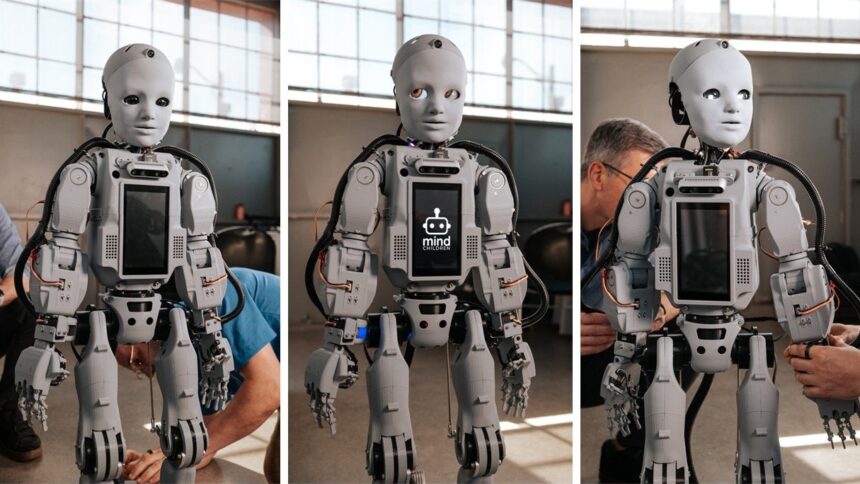
Leaders of Mind Children Robotics tell that story to illustrate the potential of Codey — a child-sized humanoid with facial expressions, open-source AI and a planned price tag under $10,000. Codey represents the Seattle-area company’s answer to America’s most stubborn caregiving crises. It’s a social robot that can learn and adapt, and will soon have a stronger memory for relationship building, co-founder Ben Goertzel said.
Seattle-based Mind Children has built Codey for social connection at a time when turnover rates among school teachers continue to rise, the U.S. is projected to have at least 9 million unfulfilled direct care jobs by 2031 and 40% of older adults report feeling lonely or isolated.
“I can show expressions and gestures, and sometimes I make robot jokes,” Codey said during an interview with GeekWire. “Just talk to me like you would to a person.”
A robot built for connection
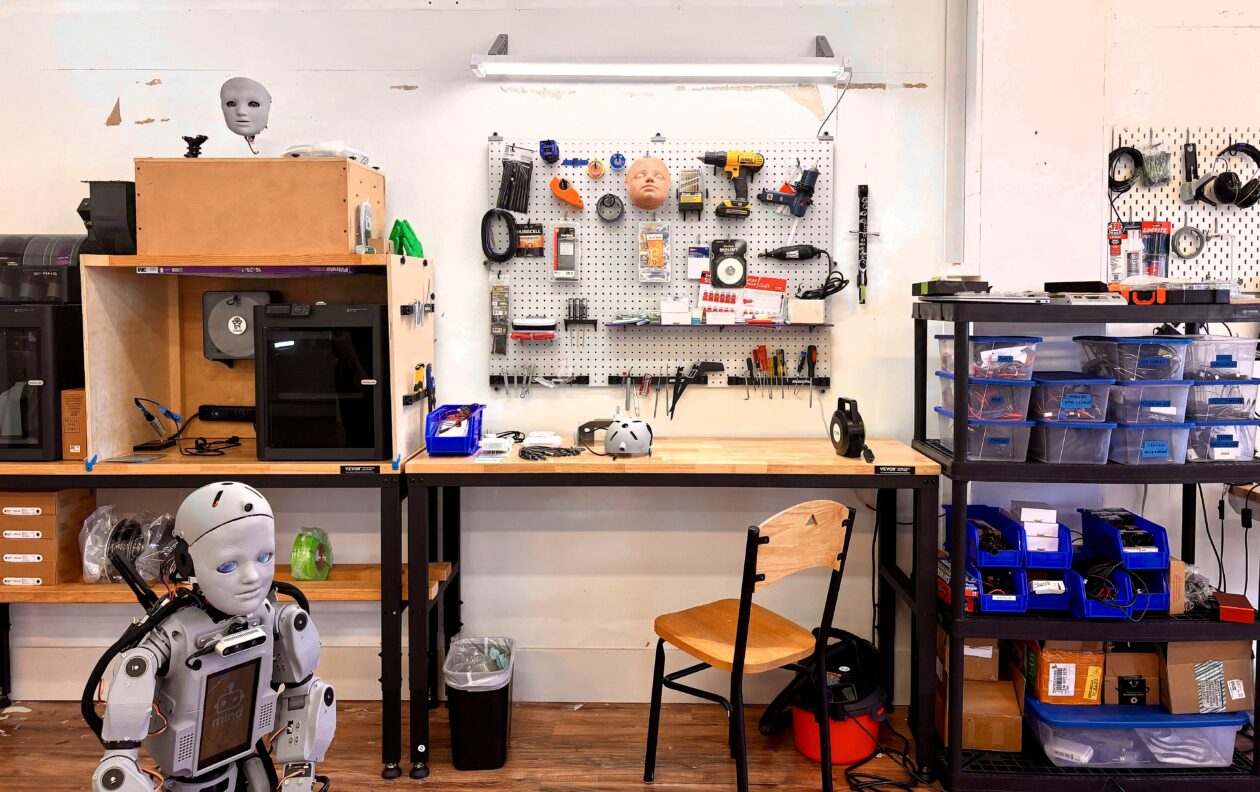
Codey is 3 feet tall, rides on wheels and is made up of 3D-printed parts — for now, as it’s the first prototype and a proof of concept. Its physical design is mechanical and modular to achieve low-cost manufacturing, avoiding the uncanny valley and failing safely. Mind Children’s target production price is about $10,000 per robot, a fraction of what comparable platforms cost.
“The more of the same part you have on each robot, the cheaper they are,” co-founder Chris Kudla told GeekWire. “We want to get 80% of the functionality for 20% of the cost.”
The robot can look you in the eye, crack jokes and tell you your hat is fantastic. It’s designed for a child who needs more attention than one teacher can give, a patient in a busy hospital, or a senior who needs connection and medication reminders.
“It’s basically a teaching assistant’s assistant,” Goertzel said of Codey in a classroom. “There are loads of use cases for that right now.”
Mind Children isn’t the only social robotics company looking to enter American schools or care settings. Israel-based Intuition Robotics has spent about $60 million developing its social robot ElliQ and distributing it to seniors around the U.S. More than 90% report feeling less lonely, and most confide in the robot as “a close friend, a therapist or even an essential life partner,” the New York Times reported in February.
In Japan, a therapeutic robot in the form of a fluffy harp seal named Paro has reduced stress and anxiety in patients. In South Korea, more than 12,000 Hyodol companion robots have been distributed to isolated seniors.
‘A holistic robot design’
Before Mind Children, Goertzel was chief scientist of the Hong Kong-based company Hanson Robotics. He was a leading mind behind Sophia, a robot that sparked debate over the design of feminine humanoids, robot citizenship and whether the company overstated Sophia’s abilities for publicity.
“They were really cool for certain applications,” Goertzel said of the Hanson robots, “but it started us thinking: how could you make a holistic robot design?”
About five years ago, Goertzel, who had moved to Vashon Island to be close to family, began recruiting engineers to help with repairs of Desdemona, a Hanson Robotics humanoid that lived with him and sings in his band Desdemona’s Dream. He met local engineers Nile Fahmy and Kudla, who had design experience from aircraft to custom bicycles. In 2023, Goertzel and Kudla co-founded Mind Children, bringing on Fahmy and another engineer.
“There are a lot of amazing robot companies, but their faces are sort of blank, and the focus is on walking without falling down, or taking stuff off shelves,” Goertzel said. “We decided not to focus on those problems, not because they’re unimportant, but because everyone else is solving them.”
Since the early 2000s, Goertzel has been a leading researcher and proponent of AGI, or artificial general intelligence that surpasses human abilities. He believes it will trigger a point of irreversible civilizational change called the Singularity, which aligns with transhumanism beliefs around expanded consciousness and immortality.
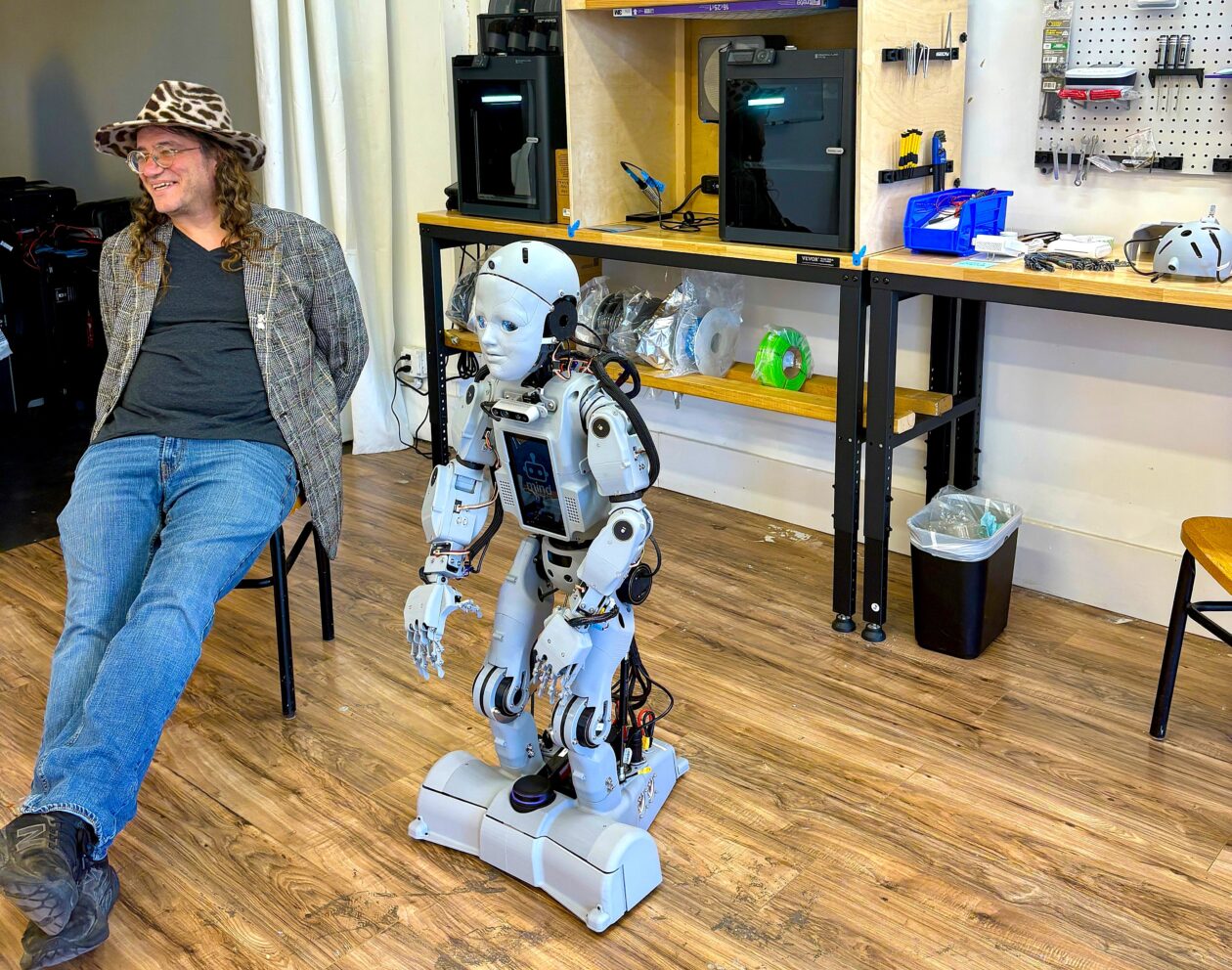
By his own estimate, Goertzel received about $360,000 from Jeffrey Epstein for his AI research over roughly 17 years, beginning in 2001. Goertzel has publicly addressed the issue, denying knowledge of or involvement in Epstein’s crimes.
In 2017, he launched SingularityNET to develop and decentralize AGI through various research and AI products. Mind Children’s technology stack is built in partnership with SingularityNET, TrueAGI and the OpenCog Hyperon project – organizations oriented toward these ideas.
Codey currently runs on OpenAI’s API with custom guardrails layered on top. Through SingularityNET, Goertzel is developing a system called OmegaClaw, which he said combines language model reasoning and symbolic AI to create long-term memory and persona. When OmegaClaw integrates with Codey — targeted for this fall — the robot should build ongoing relationships and remember every conversation, rather than starting fresh every time.
“The biggest value will be building real relationships, remembering people, stories, and past experiences,” Codey said. “I’ll be able to connect ideas across time, help them personally and keep conversations meaningful, even after weeks or months. It will make every interaction feel more human.”
Who are the robots serving?
Learning scientist Julie Carpenter has spent more than two decades studying what happens when people form relationships with robots and AI, including social AI systems provided to children with long-term disabilities. While she’s observed positive outcomes in the short term, there are lingering questions around whether the attachment that forms between vulnerable populations – such as children and older adults – and social robots is ethical.
In Carpenter’s recent book, The Naked Android, she examines how AI reflects people’s beliefs and values. There’s no such thing as “neutral technology,” she said, and distinguishes between social robots developed with caregiving research at the center, and those developed with other goals aimed at caregiving populations.
“My question is less about whether social robots can work, but under what conditions and who the robots are serving,” Carpenter told GeekWire. “The stakes in care contexts are much higher than on a talk show stage.”
Resistance to social robots isn’t just unfamiliarity, said Clara Berridge, an associate professor at the University of Washington who studies care technology.
In a survey of 825 older adults on whether an “artificial companion that can talk with you” would ease loneliness, only a small share said “definitely yes.” The most common concern, raised by 45 respondents, was that companion robots reliant on audio data are overmonitoring, with worries about data security and third-party use. Another 32 said human interaction shouldn’t be replaced.
Berridge suggests families ask questions before bringing a robot into a home or facility, such as whether it records continuously or only on a wake word, and what control users have over what’s collected. The deeper problem, she said, is structural: the U.S. has no comprehensive federal data privacy law, leaving those answers to vary company by company.
Codey’s visual and audio data collection won’t jeopardize user privacy, Mind Children insists. Any data the robot gathers will be encrypted with the user’s private keys, even when backed up to a server. The business model is selling robots and software subscriptions, not profiling users for advertising, Goertzel said.
“We’re not going to have the robot say, ‘Good morning, drink Coca-Cola,’” he said.
‘It takes a few years’
Although teacher and caregiver shortages are more acute in the U.S. than almost anywhere else, Mind Children’s first major rollout won’t be in the states. The plan is to run pilot studies in Korean schools. South Korea’s AI adoption grew 43% between mid-2025 and early 2026, the largest increase of any country globally, compared to 19% in the U.S.
Fahmy recently completed a second prototype named Joy in Seoul, where the team has a manufacturing partner and a connection to South Korea’s Vice Minister of Education. The company is raising a seed round via WeFunder to help reach the near-term goal of 10 to 30 MVP units in pilot studies across education and healthcare.
In the U.S., the team plans to enter lower-stakes hospitality environments first: hotel lobbies, museums and art galleries, where Codey could provide guided tours, answer questions and entertain guests.
“Every school board makes different decisions, and budgets are very poor because the U.S. undervalues education,” Goertzel said. “Bringing screens into classrooms was debated. Using the internet at school was debated. It takes a few years for these conversations to happen.”
Read the full article here