
Need to know
What is it? A mash-up of match-three, autobattler and visual novel
Release date April 23, 2026
Expect to pay TBC
Developer AP Thomson
Publisher Fellow Traveller
Reviewed on RTX 3060 (laptop), Ryzen 5 5600H, 16GB RAM
Steam Deck Verified
Link Steam
As far as I can tell Titanium Court is the first prestige match-three game ever made. It’s also a roguelite, kind of a deckbuilder, a tower defense autobattler, and a lo-fi visual novel. Occasionally there are goofball electric folk performances, and its meditations on the byzantine hidden meanings of road signs are right up my alley. But in total, is Titanium Court any good? Absolutely—despite one of its central hooks, match-three tile sliding, proving an obstacle for me.
Due to a sudden mysterious shattering of her world, our nameless protagonist is whisked away to an alternate universe where two nondescript factions are locked in a forever war. Almost by accident she becomes queen of the Titanium court, a “royal faerie court” whose inhabitants speak “mostly in riddles and nonsense”. They’re a weird bunch, not least because the purpose of their lives—taking the fight to the opposing red court—is not undergirded by any of the halfway-compelling motives you’d normally expect of daily bloodshed. The war is, as far as I can tell, totally meaningless.
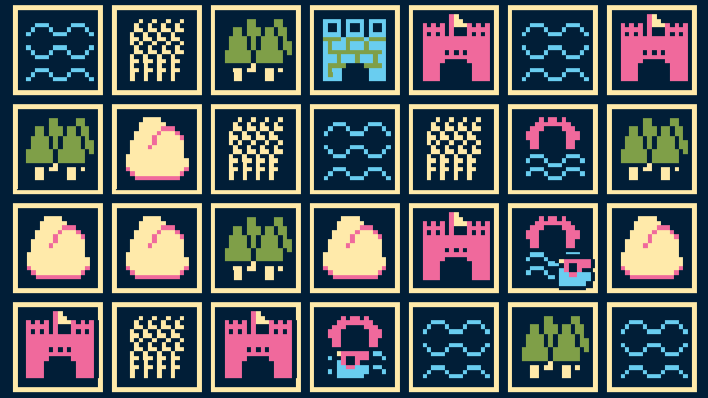
Yet they fight every single day. In the morning, at High Tide, I’m allowed to shape the battleground. This is where Titanium Court’s match-three component comes into play: If I match three trees together they’ll disappear, leaving me with wood. The same applies for water and rocks, which are also important resources. Crucially, I can also eliminate enemy blocks during this phase, so there’s always a tension between whether I should gather resources for the fight, or destroy as many of my foes as possible. Hopefully I can do both.
Article continues below
During this phase various random complications can appear. A giant jar, for example, will prove so compelling to my faery soldiers that they’ll focus on opening it rather than defending the court. Giant shoes can sell me real estate. Sometimes a goat will demand a toll; if I pay the toll it helps me but If I don’t, the fierceness of its wrath usually guarantees death. If my map is strewn with enemy catapults, I need to either eliminate as many as possible or make sure my court is secured behind rock tiles ahead of the oncoming battle. If it’s full of warships, I should try to landlock my court by eliminating rivers.
Since my “plans” are made in the randomised match-three format, I can work in the direction of goals and strategies but, crucially, pulling them off is never guaranteed. Shops can sell me various buffs and boons to help in the looming battle, but the items available are also subject to randomisation. Since most have fairly specific use cases, it’s usually a risk to blow my hard-earned money on items instead of hoarding it in the hope for, say, a health-replenishing hospital later on. Experimentation is encouraged—I can undo moves within the bounds of a single high tide / low tide sequence—but it often feels too risky on a macro level.
Once the shape of the battlefield is set I move into Low Tide where, based on the resources I’ve gathered, I can send out soldiers, resource-gatherers, and various other offensive and defensive aides—presented, of course, as cards—to help in the ensuing autobattle. If I’ve chosen wisely and my court is not destroyed, I move up a notch in the overworld grid towards one of several final bosses. If I haven’t the day is over and it’s back to square one, though not all is lost: every death pours a tad more wine into my Comfort glass. Every time it fills I get a new point to spend on various buffs and advantages at the beginning of a run.
Court in-between
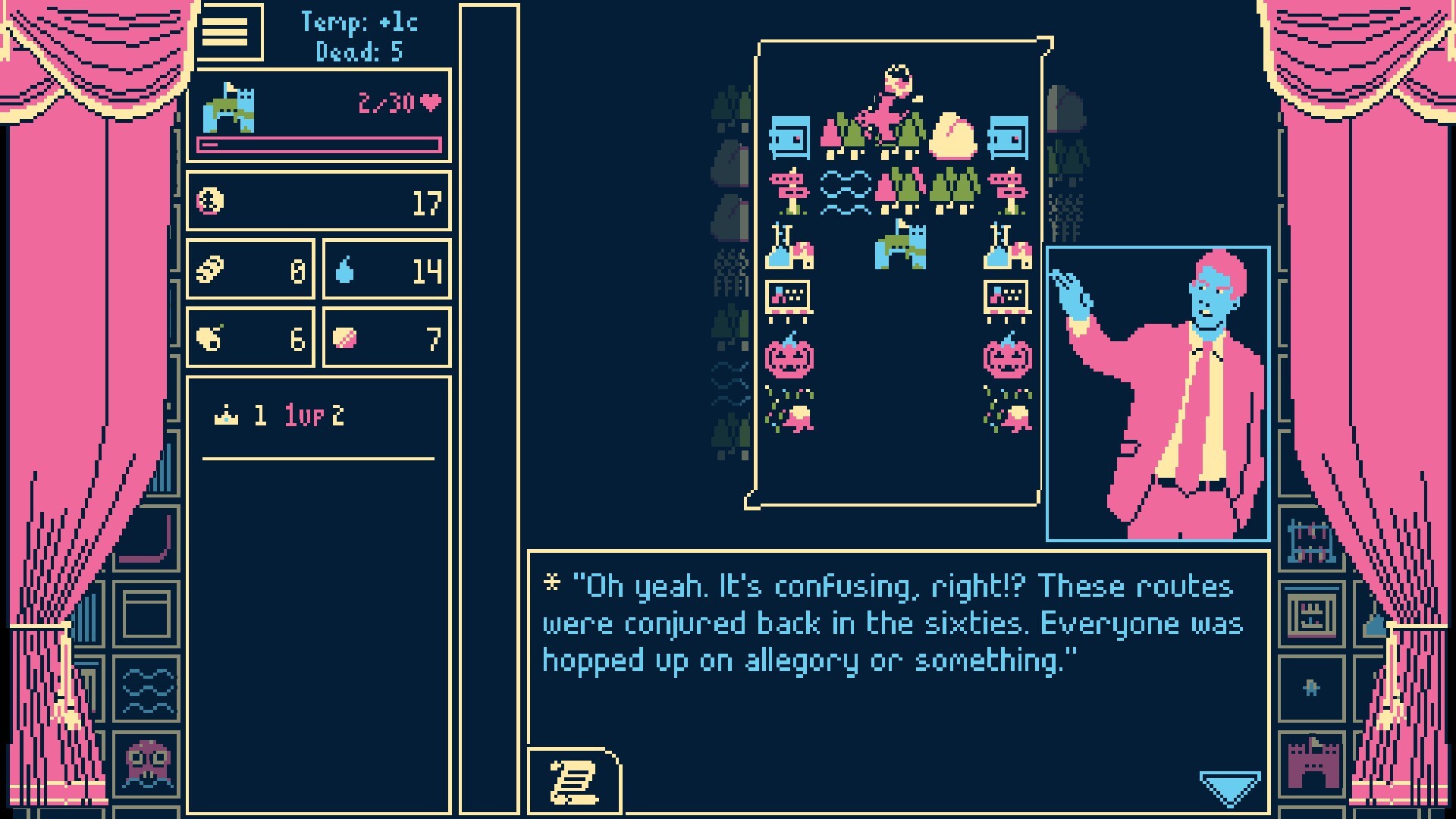
The combination of randomisation with an inherently imprecise gameplay system like match three is what ultimately bugged me.
It’s a conceptually smart commingling of genres, but Titanium Court’s writing and presentation is what helps elevate it above a clever but sometimes tedious roguelite. The writing is abundant and, for the most part, gloriously funny. A bridge is described “as a door defined by its presence rather than its absence”. The protagonist has misplaced their keys and their locks. The faery court keeps encountering road signs but, of course, has no knowledge of cars: what can a brash octagonal red sign with STOP printed on it mean without that context? Something quietly disturbing and charmingly stupid, of course.
It’s also tonally askew in a way that’s delightfully, endlessly surprising. When my faeries fell castles the screen is festooned with victorious baseball pixel art or a cat aloofly knocking a cup from a bench. The music sounds like something released direct to cassette by a drain-dwelling loon, and I mean that in the most admiring sense possible. It’s gently dreamlike, but also features the best one-note charred guitar wig out I’ve heard in a game. There’s even an item that swaps out a boss battle with a musical performance by creator AP Thomson, a performance so amusingly prolonged that it feels designed to punish you for conflict avoidance.
There’s a lot I love and admire about this gorgeous and distinctive artefact, which is as tangential and—yes, sometimes as self-indulgent—as all good weirdo art. Wandering the court between battles, and interacting with its landmarks and characters is never boring if you have an appetite for eccentricity.
But none of this can paper over the fact that, at least 40 percent of the time, you’re matching three. And Titanium Court taught me, among other things, that I kinda hate matching three. No matter how much strategic complexity is added via curiously interacting blocks, I’m still tasked with interacting with everything via this dull fundamental.
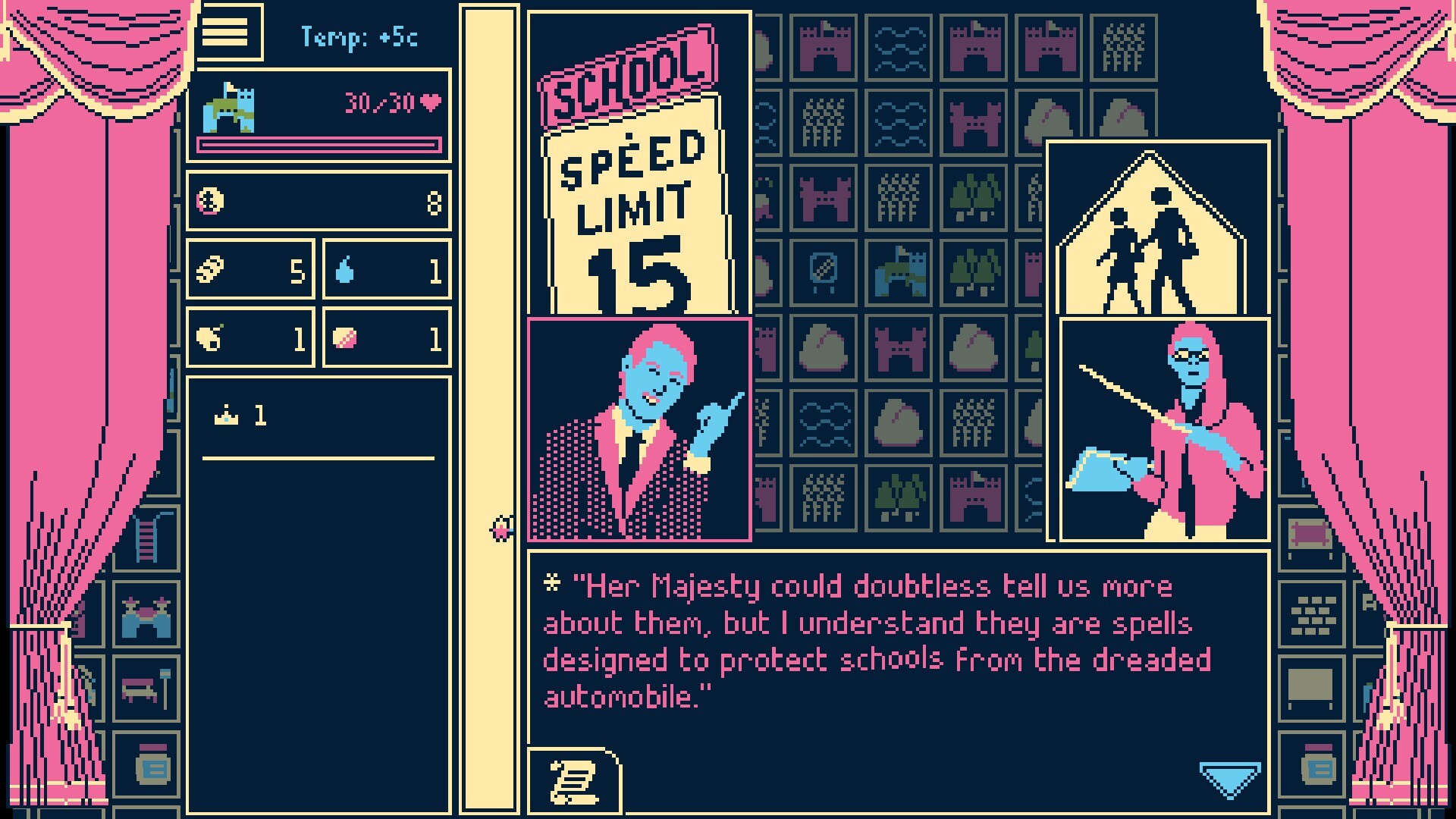
There’s a strange friction between the simple precision of match-three and the tense imprecision of, well, everything else
The combination of randomisation with an inherently imprecise gameplay system like match three is what ultimately bugged me. Titanium Court lets me choose between three randomised battle fields at the beginning of every fight; one might have a lot of trees but no water, for example, while hosting lots of knights and wormholes. Another might have no trees but a lot of rocks, and warships. But there’s no guarantee any will offer much hope. There are times when I’m down on resources, low on health, and my best option is a map full of, I don’t know, archer faeries and wormholes, right before a boss battle, where I think: can I have that 40 minutes back please?
I don’t think Titanium Court wastes my time—I’ve chosen to play it—but I was too often annoyed that my best-laid plans, my canny strategising, was flippantly undermined by a randomness the gameplay systems are too cumbersome to counteract. Too often I knew how to solve a problem but the problem could not be match-three’d away, and there’s a harsh limit to how much forward-planning can be done to accommodate for unfavourable RNG. So maybe this is secretly just a card game? (If so, that’s me bamboozled: I don’t like them either.)
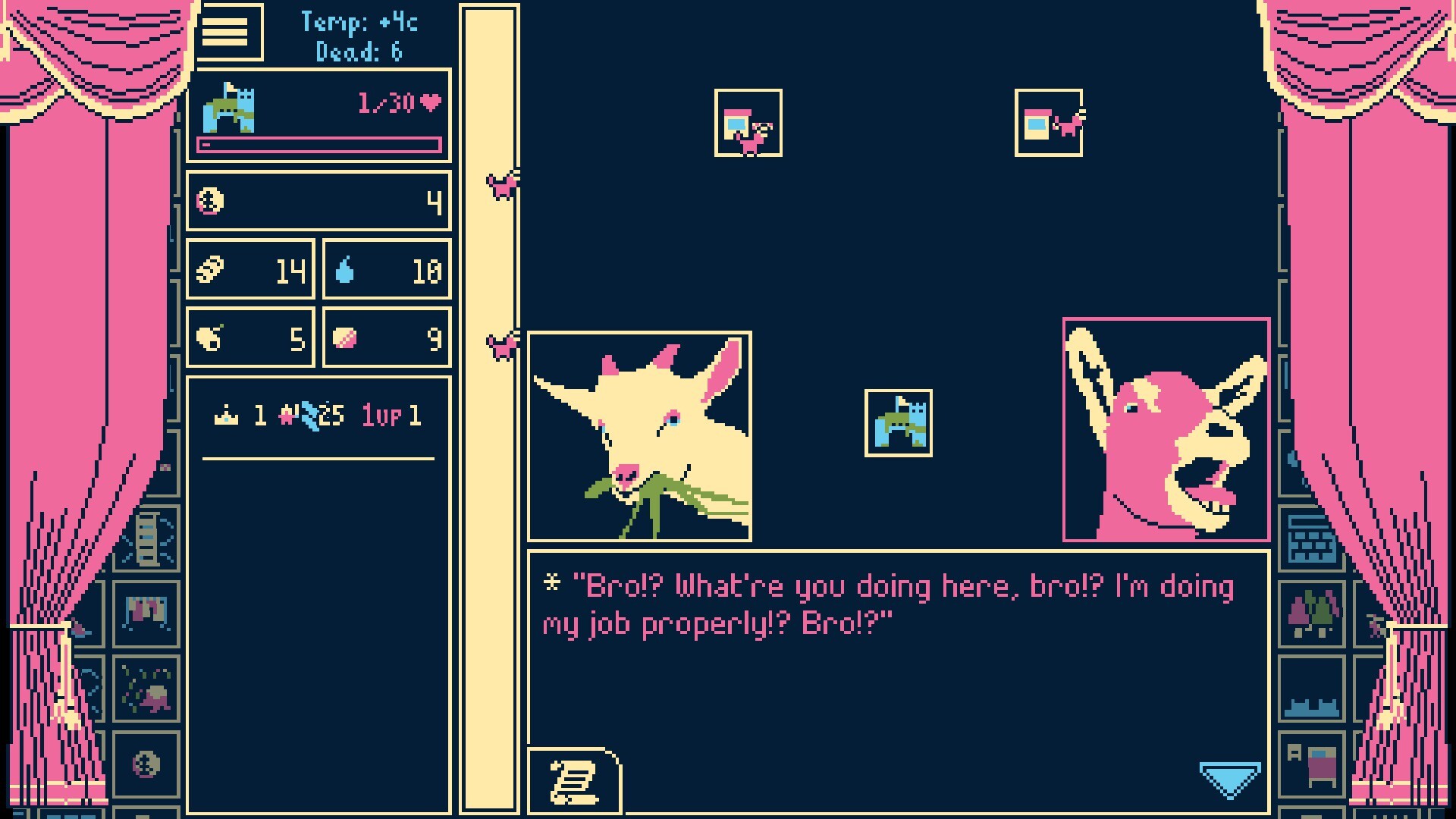
Certainly, there’s a strange friction between the simple precision of match-three and the tense imprecision of, well, everything else. Every time I match three tiles it’s a hit of dopamine that eventually feels ill-gained once I learn how capricious and unmalleable the battlefield can be despite my inputs. The appeal of match-three in Bejewelled, or Candy Crush, is the simple tactile pleasure of—wait for it—matching three, but there’s also the dazzling visual rewards and the pursuit of high scores. Wedded to a game demanding much more strategic thinking, it often just feels annoying.
And yet, I admire what Titanium Court achieves, and I want more games that are brazenly intellectual and funny like this. I adored it 60 percent of the time, and I daresay a lot of people will be fine or else smitten with the match-three stuff. It’s testament to the brilliance of everything else that I feel like I’d recommend Titanium Court despite not loving one of its star attractions. It’s the kind of thing that can only be made by one person when no one is around to vet or shout down its manifold weirdnesses. I can’t help but love it for that.
Read the full article here