
How can the U.S. bond market, where the world’s smartest money lives, reconcile $36 trillion in national debt with less than 2.5% expected annual inflation over the next decade? The answer may consist of two letters: A and I.
Four forces are pushing inflation up:
- The debt keeps growing as a fraction of GDP and neither political party has a credible plan to contain it.
- The AI buildout is consuming gigawatts, transformers, and copper faster than the grid can supply them.
- The Iran war has sent oil prices to a four-year high and pushed April inflation to 3.8%.
- And we have a president who announces tariffs at breakfast and rescinds them by lunch.
Any one of these should put inflation back on the front burner. Taken together they are alarming.
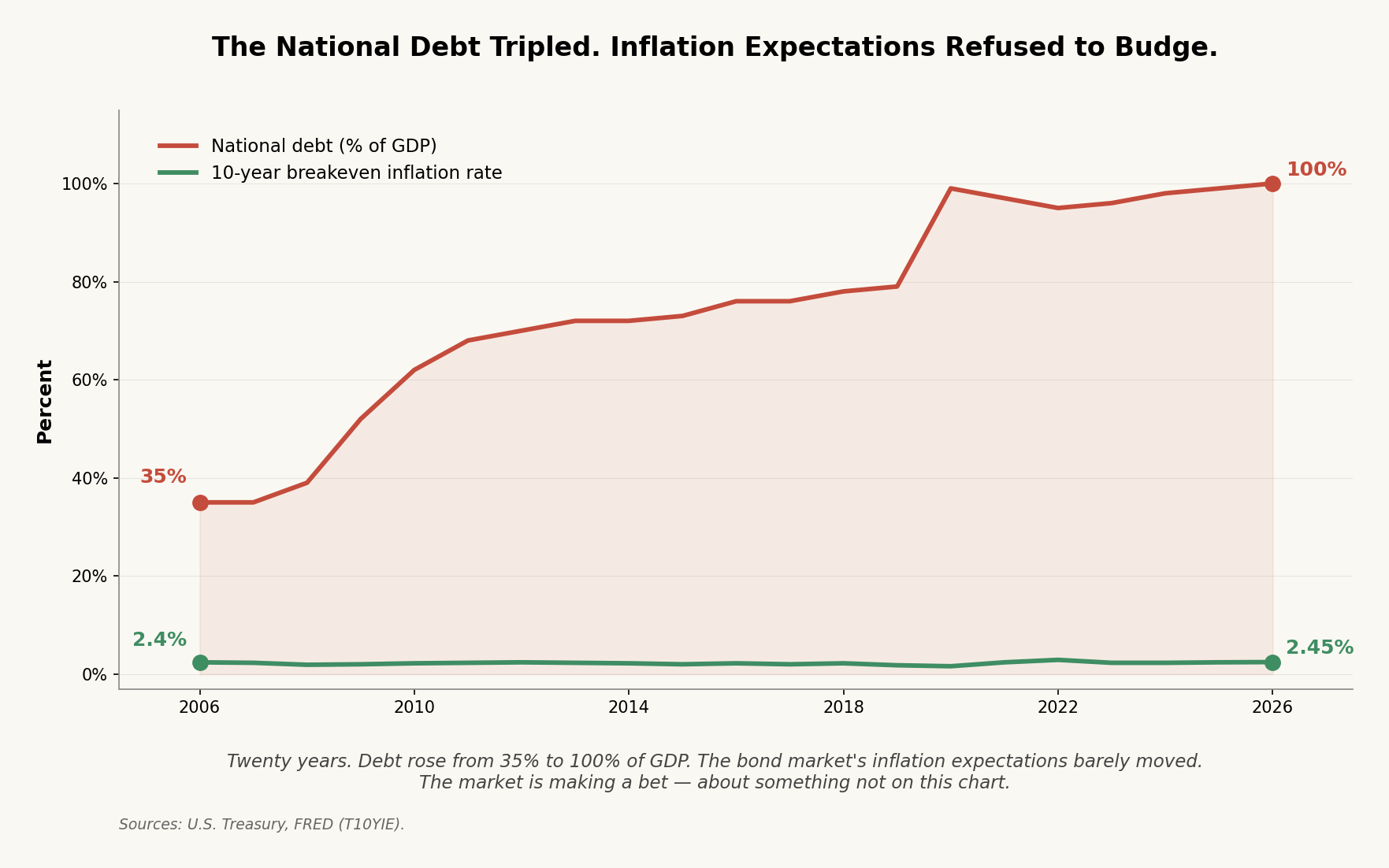
Look at the chart. The red line is the national debt. It tripled. From 35% of the size of the economy to 100% in 20 years. The green line is what the bond market expects inflation to be. It went from 2.4% to 2.45%. Not a typo. A mere 20 basis points over 20 years.
The bond market has been telling the same inflation story since George W. Bush’s second term. Through three presidents, two financial crises, a pandemic, and the highest inflation in 40 years.
For most of those 20 years, four forces did the anti-inflationary work. The Federal Reserve earned its credibility crushing inflation in the 1980s and defended it every time since. Globalization sent cheap goods from China and cheap labor from everywhere, and that quietly held down prices. The country was aging, which dampens demand. And foreign central banks bought our debt no matter what, putting a floor under the bond market.
Here’s the problem: every one of those four forces is weaker now than it was a decade ago.
The Fed is under more political pressure than at any point since Nixon leaned on Arthur Burns in the early 1970s. Kevin Warsh was recently sworn in as Fed chair after the most divisive Senate vote in the institution’s history.
Globalization is going the other way. Tariffs are up, companies are bringing production home, and the U.S. and China are pulling apart economically. The old direction held prices down. The new direction pushes them up.
Aging is happening more slowly here than abroad, and restricted immigration is tightening the labor market further. Meanwhile, foreign demand for our debt is fading as China and the Gulf states quietly diversify away from dollars.
Four pillars, all cracking at the same time. Enough that you’d expect bond traders to notice. Enough that they should be demanding more inflation compensation than they used to.
Yet they aren’t. The green line hasn’t moved. The bond market is still pricing in about 2.45% inflation over the next 10 years. Roughly the average of the last 30 years. The professionals are barely flinching. Is the market missing something? Or, perhaps, the market is betting on AI.
Not on Sam Altman, not on Nvidia’s next earnings report, not on whether ChatGPT can write your kid’s college essay, but on productivity. On the idea that AI will deliver more output from the same labor, lower costs across the economy. A shift big enough to absorb the fiscal mess and keep prices anchored. That’s the bet baked into the green line. Whether you’ve thought about it that way or not, you’re either riding it or fading it.
Is the AI bet a good one?
The case for the market being right is straightforward. AI substitutes compute for labor in exactly the white-collar service sectors that have been driving inflation: customer support, basic coding, radiology, drug discovery, the entire knowledge-worker middle. Each of those becomes cheaper and faster.
Do the arithmetic: one extra point of annual productivity growth over a decade gives you an economy that’s roughly 10% larger. The debt stabilizes as a share of GDP without austerity. And here’s the kicker: this is the only story big enough to plausibly replace all four of those pillars all at once. If AI works, the anchor holds. If it doesn’t, nothing else is big enough.
The case for the bet going wrong is also strong. The productivity payoff is the back half of the trade. The front half, what we’re living through right now, as I wrote recently in the column about AI capital spending, is inflationary as hell. Data centers eating gigawatts, three-year waits for transformers, electricians making six figures, power prices climbing in every region hosting compute. The bill comes first. The payoff comes later. Maybe.
Productivity gains take longer than anyone expects. The personal computer was on every desk by 1990. The productivity gains didn’t show up in the data until 1995. In 1987, the economist Robert Solow joked that you could see computers everywhere except in the productivity statistics. The same is true of AI today. It’s in every newsroom, every earnings call, and almost nowhere in the productivity data. So far.
Stanford economist Erik Brynjolfsson argued in the Financial Times in February that the fog may finally be lifting. The 2025 jobs numbers were revised down by 403,000 while Q4 GDP grew 3.7%: output up, labor flat, which is the definition of productivity gain. His estimate: 2.7% in 2025, nearly double the prior decade’s 1.4% trend. If he’s right, the harvest phase has started.
AI doesn’t settle the inflation question. It widens the range of plausible outcomes. If AI works, the productivity gains absorb the debt and inflation stays anchored. If it doesn’t, the other pressures take over. A weakening Fed. Reversing trade. Bigger deficits. All pushing prices up simultaneously.
The bond market has made its choice. It isn’t betting on the Fed. It’s betting on the GPUs. The professionals are betting that AI will save us from the debt.
So what should an investor do?
If you believe AI will deliver the productivity miracle the bond market is pricing in, regular Treasury bonds are fine. You’ll out-earn inflation-protected Treasuries (TIPS) by half a percent to a percent per year and pocket the difference. If you don’t fully believe it, TIPS at a real yield of about 2% above inflation are cheap insurance. You give up a little expected return, and you sleep better at night.
If you can’t decide, and honestly who can, own some of each. A 50/50 split hedges your bet and protects you from being completely wrong in either direction.
And isn’t hedging what bond investing is all about?
Read the full article here