

The idea that machines would be cheaper and more efficient than humans has long shaped expectations about automation.
That assumption is starting to break down. Training a large model to handle nuanced tasks can cost more than hiring a human to do the same work.
For many tasks, human labor remains the more cost-effective option.
Silicon Sticker Shock
We’ve reached a point where the cost of compute can exceed the cost of human labor. AI infrastructure requires significant power and cooling, driving up operating costs.
The reality is that humans are incredibly energy-efficient. We run on about 2,000 calories a day — roughly the energy equivalent of a dim lightbulb. To get an AI to perform real-time, complex reasoning at a human level, you need megawatts.
Industry analyses suggest that replacing a $60,000-a-year analyst with a fully integrated AI system can produce an ROI that looks more like a “return on insanity.”
Baxter the Robot’s Cautionary Lesson
This isn’t the first time we’ve seen the “Robot vs. Human” price war end in a victory for the bipeds. Remember Baxter? In the early 2010s, Baxter was the poster child for the collaborative robot (cobot) revolution. With its cute digital eyes and red plastic arms, it was supposed to revolutionize manufacturing by being cheap enough for any small business to own.
Baxter eventually became a cautionary tale. While the sticker price of the robot was relatively low, the hidden costs were astronomical. It required specialized engineers, ongoing maintenance, and controlled environments to operate safely.
Small business owners found that human workers were more flexible and cost-effective across a range of tasks. Baxter’s parent company, Rethink Robotics, eventually folded because, in the end, humans are the ultimate plug-and-play technology.
Do the Economics Hold Up?
Before we pat ourselves on the back for being frugal, we have to ask: Is this conclusion fully vetted? Most current cost-benefit analyses of AI focus on the “Happy Path” — when the AI works perfectly. What they often miss is the cost of error.
When a human makes a mistake, it is typically limited in scope. They might miss a typo or miscalculate a cell in a spreadsheet. When AI systems fail, they can do so at scale, producing large volumes of incorrect or harmful output quickly.
The “human discount” exists because we have a built-in sense of common sense that prevents us from making clearly flawed decisions. AI currently lacks this “sanity tax,” making the potential liability costs of AI much higher than the salary of a supervised human.
The cost of managing AI errors and liability is still not fully reflected in most analyses. We haven’t yet priced in the cost of hallucination insurance.
How Long Are Humans Cheaper?
Of course, the “humans are cheaper” era has an expiration date. Technology doesn’t stay expensive forever. We are seeing a push toward small language models (SLMs) and specialized chips that require a fraction of the power of current models.
The cost of AI is likely to follow a trajectory similar to solar power or flat-screen TVs: an initial period of “only for the rich” followed by a precipitous drop. We are still in the early, high-cost phase of AI infrastructure, but that will change as efficiency improves.
Some analysts predict that the cost of digital labor could drop by as much as 90% over the next decade. At that point, a human being’s time will become a luxury good — something people pay extra for, like hand-stitched leather or artisanal sourdough.
Where Automation Hits First
Where will humans become obsolete first? It won’t happen everywhere at once. The regional context is vital. Countries with high labor costs and aging populations, such as Japan, South Korea, and parts of Western Europe, are the primary candidates for the first wave of full AI integration. In these regions, the cost of a human includes high salaries, health care, and pension contributions.
Conversely, in regions like Southeast Asia and parts of Africa, where labor is currently very inexpensive, the biological discount will last much longer. We may see a strange digital divide where the wealthiest nations are run by silicon, while the developing world remains the last bastion of human-centric labor.
This contrast creates a terrifying potential for global economic misalignment, where human labor in one part of the world must compete with nearly free, 24/7 digital labor in another.
Preparing for the Post-Discount Era
If humans are currently cheaper than AI, that advantage is likely temporary. Governments need to stop debating if this will happen and start planning for when it does. This entails redefining what value means in a society where labor is no longer the primary driver of income.
We need to invest in the human premium — the things AI can’t do cheaply: empathy, high-level strategy, physical dexterity in unstructured environments, and genuine creative spark. Education systems should move away from rote memorization — which AI does for pennies — and toward curiosity and ethics, which AI still finds expensive and confusing.
Wrapping Up: The Window to Adapt
While being the lower-cost option is not a long-term advantage, it provides a window to adapt and steer the ship.
The goal isn’t to beat the machines in a race to the bottom on price; we’ll lose that eventually. The goal is to use this time to build a world where AI handles the drudgery because it’s efficient, while humans do the things that make life worth living because we’re irreplaceable.
We are entering an era where being human is no longer a job description, but a calling. If automation takes over routine work, it will also carry the associated infrastructure costs. We should use this period to focus on higher-value work that machines cannot easily replicate.
The future doesn’t have to be dark; it just needs to be well-managed. After all, if we’re smart enough to build something more cost-effective than ourselves, surely we’re smart enough to figure out what to do once we innovate our way out of employment.

The Onyx RCR 80V Electric Motorbike

This week’s column examined why, for now, human labor remains more cost-effective than high-end AI. But being the lower-cost option doesn’t mean settling for inefficient or expensive daily routines.
If we’re the world’s most efficient “hardware,” we might as well transport it in style. This brings us to the Onyx RCR 80V, an electric bike that looks less like a typical commuter vehicle and more like a high-performance urban machine.
Visionary Behind the Machine
Onyx Motors was founded by its chief design officer, Tim Seward. More than a designer, Seward is a lifelong tinkerer who began his journey in 2012 by converting gas mopeds into powerful electric prototypes. His pedigree is a “who’s who” of both mobility and tech giants — having lent his industrial design talents to companies including Bird, Scoot, UBCO, Google, Nike, HP, and Intel.
Launched through a breakout Indiegogo campaign in 2017, Seward’s vision for Onyx was never about making a bicycle with a battery. It was focused on blending modern electric performance with distinctive design. Under his guidance, Onyx creates machines that serve as vehicles for self-expression and rebellion, specifically designed for those of us with a “restless alter ego” that refuses to be contained by a cubicle.
Beating the Gas Pump in Style
While humans are inexpensive to sustain, transportation costs remain high. Moving those systems in a 4,000-pound internal combustion vehicle can quickly become an ROI nightmare.
With gas prices fluctuating and the environmental cost of traditional commuting weighing on the collective conscience, an electric commuter like the Onyx RCR 80V is more than a toy — it’s a tactical economic maneuver.
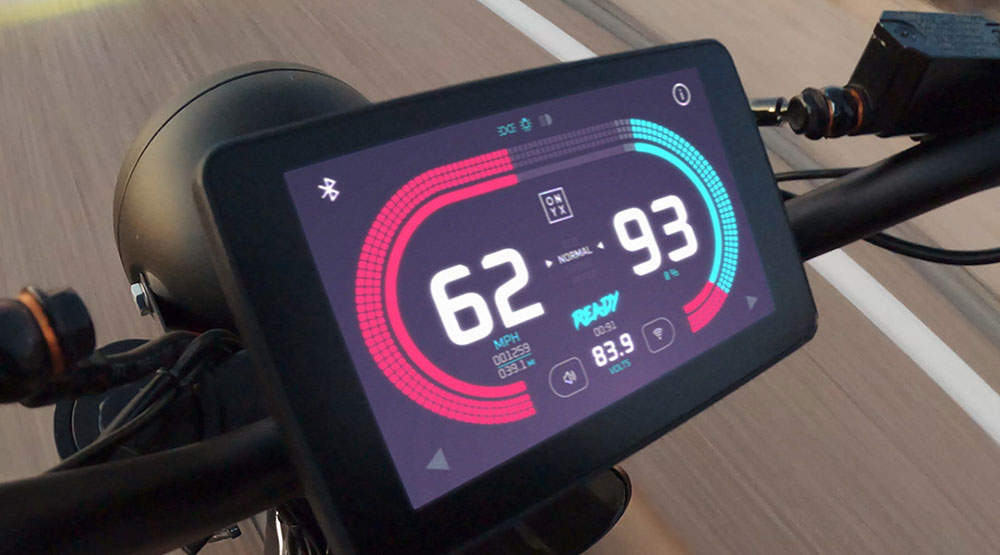
The Onyx RCR 80V’s digital display provides real-time speed, battery, and system data, reinforcing its role as a tech-enabled electric commuter.
The RCR 80V is the flagship of this strategy. It offers a massive 45Ah battery and a drivetrain capable of staggering torque and speed.
When you factor in the fuel cost — pennies per charge compared to the literal dollars per mile of a traditional car — the RCR looks like a cost-efficient alternative for daily transportation. It allows you to bypass the gas station, reducing reliance on gasoline while offering a more engaging ride that feels infinitely more alive than sitting in a traffic jam in a sedan.
Navigating the Regulatory Tightrope
However, because the RCR is more powerful than a typical e-bike, it enters a complex regulatory landscape. The world of e-bikes is currently divided into three distinct classes, but the Onyx RCR often blurs these lines due to its raw power. In many jurisdictions, once an e-bike exceeds certain speed and wattage thresholds — typically 20-28 mph depending on the class — it transitions from a bicycle to a motor-driven cycle, or moped.
Potential riders need to do their homework. In some states, the RCR’s top-tier performance means you may need a motorcycle license or specific moped registration to stay on the right side of the law.
This regulatory friction is essentially the compliance tax for owning a machine that can actually keep up with — and often outpace — urban traffic. It’s the price you pay for moving beyond the slow lane of traditional e-bikes and into the realm of true electric mobility. Speaking of price, this bike starts at around $5,199 — high for an e-bike, low for a moped.
Why Onyx RCR Fits the Moment
The Onyx RCR combines performance, design, and efficiency in a way that stands out in the e-bike category. It’s a testament to human ingenuity — the kind of hands-on tinkering that remains difficult to replicate with AI.
While a neural network might be able to calculate the most efficient route from point A to point B, it cannot experience the visceral thrill of 80 volts of pure “California swagger” or the “cyberpunk grit” of a machine designed for rebellion.
The Onyx RCR 80V is my Product of the Week because it embodies the theme of our current era: using smart, efficient technology to empower the human spirit rather than replace it. It is a high-performance reminder that, as long as humans are the more cost-effective “hardware,” we should ensure that the hardware has the absolute time of its life on two wheels.
Onyx RCR 80V images courtesy of Onyx Motors
Read the full article here